On August 24, Zhu Jian, Secretary of the Municipal Party Committee, chaired a special municipal party committee meeting to oversee the rectification and closure of specific issues identified in the education campaign on establishing and practicing a correct view of political achievements. He stressed that the campaign should be conducted openly, making the benefits tangible and visible to more people, and that the actual results of rectification should serve as a benchmark for the campaign’s effectiveness, injecting strong momentum into the city’s high‑quality development.
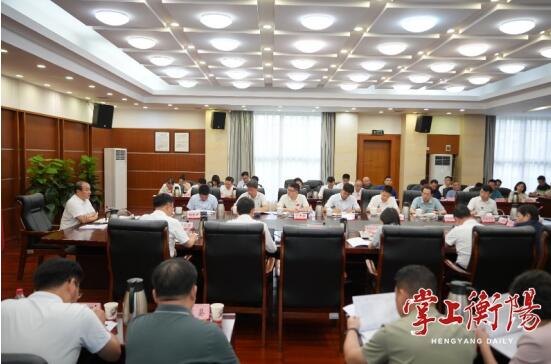
Photo: Meeting site
At the meeting, the Municipal Party Committee Office reported on the overall progress of rectification and closure of specific issues – identified at both the provincial and municipal levels – including delayed resettlement for expropriated and demolished households, resolution of long‑pending petitions, and urban waterlogging hazards. Each lead municipal department presented its work reports.
After listening carefully to the reports, Zhu Jian stated that all levels of the city’s party and government bodies must firmly establish and practice a correct view of political achievements, keep the education campaign open, and let the public see real changes and gain a greater sense of benefit. He called for continued dedication and the spirit of overcoming difficulties, and encouraged exploring innovative good practices to deepen rectification efforts.
Zhu Jian commented on each specific issue in turn. He stressed the need to push forward the resolution of delayed resettlement cases, promote good practices from earlier stages through on‑site meetings, focus on key links such as fundraising, and ensure that targets are met on schedule; continue to address stalled public service facilities and flood control infrastructure; consolidate achievements in resolving petition cases; deepen food safety rectification in schools and accelerate the promotion of “Mom’s Kitchen” canteens; dynamically improve mechanisms for urban waterlogging; clarify the relationship between property owners and property management companies and standardize property fee collection; strengthen the construction of care stations and friendly environments for new employment groups, and ensure protection of their rights and interests; vigorously tackle inadequate urban waste management and promote smart collection and disposal of construction and kitchen waste. At the same time, he urged consolidating rectification results, strictly reviewing each item against standards, and completing closure procedures in a timely manner, ensuring that no problem is left unresolved and no rectification is left unverified.
Zhu Jian outlined key tasks for the next phase: First, dynamically update ledgers to ensure a clear and accurate understanding of all issues. Second, strengthen regular scheduling mechanisms to push rectification forward in a step‑by‑step manner. Third, enhance categorized guidance and targeted measures, avoiding a one‑size‑fits‑all approach. Fourth, address both symptoms and root causes, resolving deep‑seated contradictions at the institutional and systemic levels to ensure long‑term effectiveness. Fifth, increase the use of exemplary cases and publicity, summarizing and promoting innovative practices in resettlement, revitalizing public facilities, and ““Mom’s Kitchen” canteens to create replicable and scalable good practices. All counties and districts should proactively undertake tasks and promote rectification through targeted initiatives. In the near term, they should coordinate flood prevention, disaster relief, and economic work, delivering satisfactory results through practical efforts.
Municipal leaders Liu Zhangyu, Zhang Runhuai, Xie Hong, Wang Jing, and Liu Zhigang attended the meeting.