-- Article list --

The Tujia ethnic minority, with a total population of 2,639,534, live mainly in the Xiangxi Tujia-Miao Autonomous Prefecture, and also in some counties in northwestern Hunan. This ethnic minority group is considered to have been assimilated by the Han ethnic majority. However, the Tujia people still maintain a specific cultural and social identity.
Folk Culture and Art
The Tujia people have their own language, which belongs to the Tibeto-Burman group of the Chinese-Tibetan language family. As they have no written script, they use Chinese characters, instead, and the large majority has come to speak the Han and Miao dialects.
The Tujia ethnic minority is influenced greatly by the Hans, and mainly engaged in agriculture. Diligent and courageous, the Tujias have created a colorful and unique culture and arts.
Tujia Brocade
The Tujia Brocade was also named Xilan Kapu. It's made by hand and has a history of about 2,000 years. In Tujia language "Xilan" means "bedcover" and "Kapu" means "flower". So originally, Xilan Kapu is a kind of bedcover which was decorated with raised designs of flowers. It has now developed into a work of art, which takes various forms, including clothes, bags, carpets, and sachets.
The Hand-Waving Dance of Tujia Ethnic Group
The Hand-waving Dance is the most popular, ancient dance of the Tujia people. In the past, it was a kind of martial dance, used when fighting with an enemy. It lasts from the beginning of January to the 17th of the lunar calendar. Hundreds or thousands people perform the dance, all dressed in splendid attire, singing, dancing, and beating drums and gongs, at night. At these times, all Tujias are immersed in a warm and lively atmosphere.
Maogusi Dance
Maogusi means "men with a lot of fur" in the Tujia dialect. The dance originated from the sacrificial ceremony of the ancient Tujia people. It's the most primitive and roughest type of Tujia Dance. Experts consider it to be a living fossil of Chinese operas. It reflects the ancient, primitive activities of the Tujias: hunting, fishing, farming, etc. All the dancers dress in clothing made from straw.
Food
Tujia people mainly eat rice as their staple food, other miscellaneous grains, such as corns, and sweet potatoes, potatoes, etc.Tujia cuisines are predominated by dishes like Tujia hot pot and tuanniancai. Tujia specialties such as ge fen (Kudzu root powder) , rice wine, cold noodles and Ciba ( a kind of pie made from Glutinous rice) are very tasty. In addition, "Tujia niancai" means that some dishes are only presented on the eve of the spring festival, including steamed meat , chicken soup with chestnuts, preserved fish, etc. Tujia hot pot is usually the favorite of all family members.
Clothing
Traditionally, Tujia women wear jackets trimmed with lace, and with short, broad sleeves. They wear long skirts, and wrap their coiled hair in cloth. They adorn themselves with necklaces, earrings, bracelets and ankle bracelets. Tujia men wear short jackets, with many buttons in front. The traditional hand-woven "xi" and "tong" cloth, with intricate designs, is the main material for clothing.
Living Quarters
The Tujia ethnic minority boasts a distinct architectural style; hanging cottages built on hillsides, and supported by pillars. The houses of the Tujia are also known as Diaojiaolou .On the lower floor, there is livestock; while the girls' bedrooms are kept upstairs. This design focuses on the use of small rooms but is also well ventilated, clean, and damp resistant.
Festivals
The grandest festival is the Tujia Year is called 'Gannian' or 'Diaonian Meeting', and is celebrated one day before the lunar New Year of the Han people. On that day, people prepare sumptuous dinners, and dance together. They also celebrate the Dragon Boat Festival, Sheri (on the second day of the second lunar month), and some others, as well. Among them, the "Diaonian Meeting", "Zhongwu Holiday", and "Guozu Festival" are the three most important holidays the Tujia people celebrate in a year.
Customs
The Tujia people are well known for their custom of a crying marriage, which they view as a necessary marriage procedure. The bride may cry in different ways with diversified words, which is also called "Crying Marriage Song"; the somewhat exaggerated singing helps to enhance the wedding atmosphere. Crying at wedding is a customary way to set off the happiness of the wedding, via falsely sorrowful words.
The Tujias also have some rather distinctive taboos. Young girls or pregnant women are not permitted to sit on thresholds, while men cannot enter a house wearing straw raincoats, carrying hoes, or carrying empty buckets. Nor are people allowed to approach the communal fire, or to say ostensibly unlucky things, on auspicious days.
Religious beliefs of the Tujia minority include Taoism, ancestor worship, and a shamanistic belief in gods, ghosts, and demons. Formerly, prayers were said before hunting, and when a person died, wizards were invited to expel evil spirits and ghosts from the house.

The Miao ethnic minority has a population of more than 1.9 million in Hunan, scattered throughout Huayuan, Fenghuang, Jishou, Baojing, Guzhang, Luxi of Tujia, Miao Autonomous State (in west Hunan), Chengbu Miao Autonomous County, Suining (in Shaoyang City), Miao Autonomous County of Maying, Miao and Dong Autonomous County of Jingzhou, Huitong, and Yuanling (in Huaihua).
The Miao dialect belongs to the Miao-Yao Austronesian of the Chinese-Tibetan Phylum. It has three main dialects in China - one based in west Hunan, one in east Guizhou, and the other in Sichuan, Yunnan, and part of Guizhou. The Miao people once had their own written characters, but these have been long lost. After 1956, the Miao people invented a kind of phonetic characters. Due to their centuries of contact with the Han Chinese, many Miaos can also speak Chinese.
The wide distribution of the Miaos, and the influence of the different environments in which they live, have resulted in marked differences in the dialects and names they use, and in the clothing they wear. Because of these different costums, the Miaos can be divided into the Long Skirt Miao, Short Skirt Miao, Red Miao, Black Miao, etc.
Living Quarters
The local Miao peoples build their villages beside rivers and on mountains. The world's largest Miao village comprises 1000 households. Most, however, are much smaller. Often, a village is a tight-knit community made up of twenty or thirty families, all belonging to the same clan, and most of whom are farmers or fishermen. They're quite self-sufficient, from growing their own food to building their own homes. Miao-style houses are wooden and high above ground, standing on stilts to accommodate the hilly terrain. Everything there is in balance with nature.
Clothing
Miao wear the most complicated and finely worked silver headdresses and ornaments. It's long been the custom for them to decorate themselves from head to toe, with silver. A full set can weigh up to ten kilograms. Since the silver ornaments are a symbol of wealth, a girl's family will start saving up for her right from the moment she's born. The most valuable item she'll ever own is the headdress, which by tradition, is decorated with phoenixes. In fact, the patterns on her headdress range from ancient totems to historical legends.
Food
The Miaos engaged in agriculture, and hunt and fish as a sideline. Major crops include paddy rice, maize, rape, ramie, oil-tea camellia, tung tree, etc. The weather in the areas they inhabit is mild, with a generous rainfall, and the areas are also rich in precious, medical herbs, such as Tianqi, Gastrodia elata, etc.
Customs
Wizards (witch doctors) are everywhere. There is one for almost every village. It is these who manage religious ceremonies for specific events (e.g., funeral and wedding). Miao people worship nature, totems and ancestors. Miao people believe every natural thing has its manito, but they worship the Dragon most. This is similar to most other Chinese, ethnic groups, including the Han and Tujia. Other nature gods include the Kitchen Range God, the Land God, etc. In western Hunan, Panhu is the Totem of the Miao, because Miao people believe they are the offspring of Panhu. There are Panhu temples (simple ones) in many villages, and people commemorate the Panhu with lavish, outdoor entertainment, at year end. Miao People also do the same with their common ancestors and family ancestors. During any of these events, Miao people will dance and sing.
Folk Culture and Art
The Miaos have created a variety of colorful arts and crafts, including cross-stitch work, embroidery, weaving, batik, and paper-cut. Their batik technique dates back to 1,000 years ago. A pattern is first drawn on white cloth, with a knife dipped in hot wax. Then the cloth is boiled in dye. The wax melts, leaving a white pattern on a blue background. In recent years, improved technology has made it possible to print more colorful designs, and many Miao handicrafts are now exported.
Specific cultural markers that set the Miao apart from other Chinese ethnic groups are their own unique dancing and singing. The Miaos are fond of singing and dancing, being especially famous for their love songs and wine songs. Lusheng is their favorite musical instrument. In addition, flutes, copper drum, mouth organs, Xiao (a vertical bamboo flute), and Suona horn are also very popular.
Festivals
The Miaos have the New Year Festival, the Flower Mountain Festival (May 5th), the Tasting New Rice Festival (between June and July), and the Tea Picking Festivals, etc. People of the Miao ethnic group perform a folk dance to celebrate their "Sisters Festival" on Sunday. Sisters Festival, which falls on March 15th every year in China's lunar calendar, is a traditional festival of the Miao ethnic group, and boys and girls choose their lovers on that day.
The Yao ethnic minority, with a population of 704,564, is mainly scattered throughout mountainous areas between the Hunan, Guangxi, and Guangdong boundaries. Historically, the Yaos have had at least 30 names including Panyao, Shanziyao, Guoshanyao, Pindiyao, Baikuyao, etc., each based on their ways of production, lifestyles, dresses, and adornments. The name "Yao" was officially adopted after the founding of the People's Republic in 1949.
Folk Culture and Art
Most Yaos live in beautiful, humid mountain valleys, which are densely covered with pines, Chinese firs, tea bushes, etc., and teeming with wild animals. Natural resources are rich there.
The ethnic minority has its own language, which belongs to the Yao Austronesia of Chinese-Tibetan Phylum. As a result of close contacts with the Han and Zhuang people, many Yaos are also familiar with the Han and Zhuang languages. The Yao people have no written language of their own, so they usually use written Chinese.
The Yaos cherish a magnificent oral literary tradition. Singing also forms an indispensable part of their lives. Their traditional instruments include drums, gongs, the suona horn (a woodwind instrument), and the long waist drum, which is unique to the Yaos. The revived waist drum dance has been frequently performed, both in China and abroad, since the 1950s. The Yaos are expert at weaving, dyeing, and embroidery, and the products made by them have become famous all over the country.
Food
Rice, corn, sweet potatoes, and taro are the staple foods of the Yao. Common vegetables include peppers, pumpkins, and soybeans. Alcoholic drinks and tobacco are also quite popular. A favorite dish of the Yao is "pickled fish". The cleaned fish is blended with salt and rice flour, then sealed in airtight pots. Beef, mutton, and other meat are also pickled this way, and are considered a banquet delicacy. The Yao people also love to drink tea. A daily necessity of the Yao is "oil tea". The tealeaves are fried in oil, then boiled into a thick, salty soup, and mixed with puffed rice or soybeans. The oil tea even serves to entertain visitors, on some occasions.
Clothing
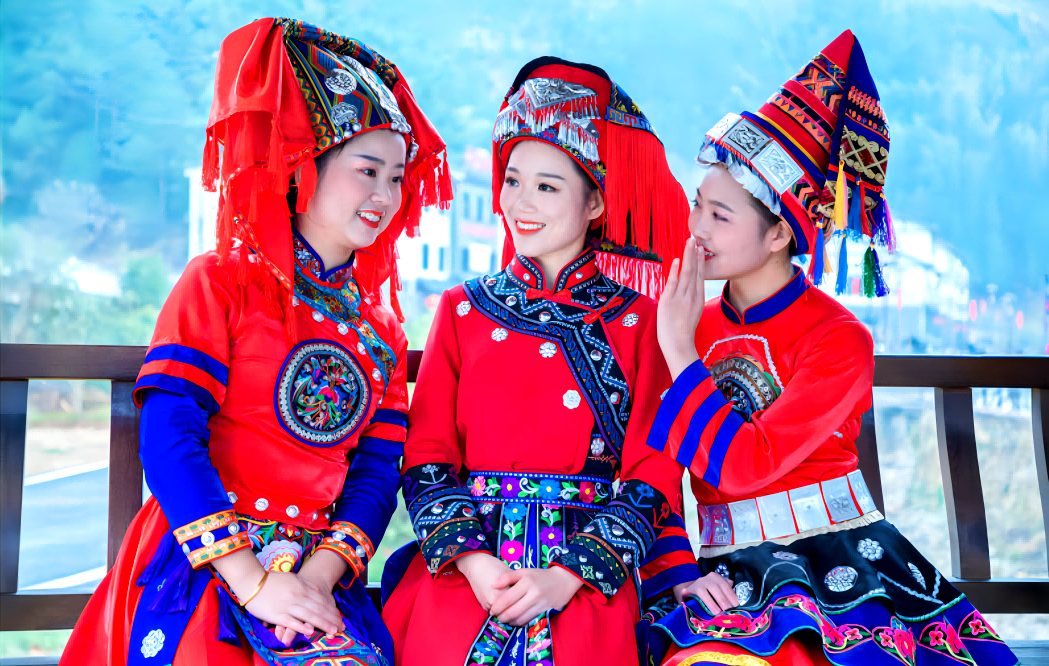
The Yao have such unique styles of dress, that various communities are often quite different from one another. The ancient Yao preferred "five-colored clothes". In modern times, Yao costumes still maintain their diversity. Men wear jackets buttoned in the middle or to the left, and usually belted. Some men like trousers long enough to touch their insteps, although others prefer shorts akin to knee breeches. Men's dress is mainly in blue or black. Women's dress varies more. Some Yao women fancy short collarless jackets, and cloth belts and skirts, either long or short. Some choose knee-length jackets buttoned in the middle, belts with both ends drooping, and either long or short slacks; some have their collars, sleeves, and trouser legs embroidered with beautiful patterns. In addition to the silver medals decorating their jackets, many Yao women wear silver bracelets, earrings, necklets, and hairpins.
Living Quarters
The typical house of the Yao is a rectangular wood-and-bamboo structure, usually with three rooms; the sitting room, in the middle; and bedrooms, on both sides. A cooking stove is set in a corner of each bedroom. Some hillside houses are two-storied, the upper story being the sitting room and bedrooms, the lower being stables.
Festivals
Festivals take place one after another, in Yao communities, at a frequency of about once a month. The Yao share some festivals, such as the Spring Festival, the Qingming Festival, the Dragon Boat Festival, and the Mid-Autumn Festival, with the Han Chinese. In addition, the Yaos have their own festivals, for instance, the Land God Festival, the Pure Brightness Festival, the Danu Festival, and the Shuagetang Festival. During festivals, Yao communities hold lavish rites, to offer sacrifices to their ancestors.
Customs
The Yao practice an interesting, primitive cooperation called "singing-while-digging". While the group is working, a young man stands out in the fields, beating a drum and leading the singing. Everyone sings after him.
The Yaos have intriguing marriage customs. With antiphonal singing as a major means of courting, youngsters choose lovers by themselves, and get married with the consent of the parents on both sides. However, the bridegroom's family must pay a sizeable amount of silver dollars and pork, as betrothal gifts to the bride's family.
The Yao people have a religion which is based on medieval Chinese Taoism, although many have converted to Buddhism, and some to Christianity. Though some have converted to other religions, many still practice their traditions, and worship gods, nature, and their ancestors. Their belief in "Panhu", the dog spirit, reveals a vestige of totemism.
On October 6, the Nanyueli Temple Fair was held in Nanyue District, Hengyang City. Local residents carried out a variety of intangible cultural heritage (ICH) activities, such as dragon and lion dances, molten iron fireworks, shadow puppetry, and fireworks display, to celebrate the Mid-Autumn Festival.


Liu Hai Cuts Wood, a flower drum opera known by every household in Hunan, is also familiar to audiences nationwide. Still, few people know about the authentic version of the legend and its origin, Changde. Early in the Northern Song Dynasty(960 A.D-1127A.D.), the legend of Liu Hai cutting Firewood had already taken shape. The version we know today is believed to have originated in the middle of Qing Dynasty (1636AD-1912AD).
Long time ago, near the Tower Gourd Well (named for the tower gourd images in the well) in Wuling District of Changde, there lived a young man Liu Hai and his mother. Liu Hai was very diligent and dutiful to his mother. In the hills where he often cut firewood, a fox fairy Hu Xiuying admired him for his kindness and insisted to marry him. Liu Hai hesitated first, because he was afraid that his poor living could not secure a happy marriage for Hu Xiuying. However, he was moved by her love after all. The marriage was also approved by Liu Hai's mother. Unfortunately, when they bought wedding supplies in Ji’er Alley of the downtown, the tenth Bodhisattvas in the adjacent temple (eighteen Bodhisattvas in total) wanted to rob Hu’s pearl, with which he could become immortal. Without her pearl, Hu would immediately show herself as a fox. She told Liu Hai the truth and he forgave her. Thanks to the help of the God Axe and Hu’s sisters, Liu Hai defeated the Bodhisattvas with his axe and got the pearl back. They lived together happily ever after.
The myth tells about a love story between Liu Hai and a fox fairy. According to the tale, Liu Hai is a diligent, upright and filial character who remains loyal to his lover and courageously pursues happiness. Even today, the legend holds profound realistic significance, vividly representing a common man's love for goodness and benevolence. The legend also made records of the local life conditions and folk customs of ancient Changde. The spirit of this story has been handed down for generation from father to son.
In Changde, there is a well named "Tower Gourd Well", which was documented in the legend, though dilapidated with wild grass due to air-slake and erosion. However, the "Liu Hai Temple" where Liu Hai is said to have fought the tenth Bodhisattvas for the love, was completely destroyed.

With a population of 23.56 thousand, the Zhuangs are distributed sparsely but widely throughout Hunan. Most of the Zhuangs live in Zhuang village of Gingtang in Yao autonomous county of Jianghua.
The Zhuang ethnic minority has its own language which belongs to the Zhuang-Dai branch of Zhuang-Dong Austronesian, part of the Chinese-Tibetan Phylum. Ancient Zhuang characters appeared in the Southern Song Dynasty (1127-1279), but never became popularized. In 1955 the central government helped them create a writing system based on the Latin alphabet. Still the Chinese language is commonly used among the Zhuangs.
Living Quarters
Most Zhuangs now live in one-story houses the same as the Hans. But some have kept their traditional two-story structures with the upper story serving as the living quarters and the lower as stables and storerooms. The old housing style, they think, suits the mountainous terrain and the humid climate.
Clothing
Contemporary Zhuang clothing is similar to that of the Han people. But traditional dresses remain in many places or are worn for special occasions. For instance, some elderly women like collarless, embroidered and trimmed jackets buttoned to the left together with baggy trousers, embroidered belts and shoes and pleated skirts. Some women prefer collarless, left-buttoned jackets, square kerchiefs and loose trousers -- all in black. They fancy silver ornaments.
Food
The Zhuangs are mainly engaged in agriculture, with paddy and corn as their main crops. Rice and corn make up the Zhuangs' staple food.
Customs
Tattooing used to be an ancient Zhuang custom. A great writer of the Tang Dynasty (618-907), Liu Zongyuan, mentioned it in his writings. Chewing betel nuts is a habit still popular among some Zhuang women.
The Zhuangs are polytheists, worshipping, among other things, giant rocks, old trees, high mountains, land, dragons, snakes, birds and ancestors. Taoism and Buddhism have also had a deep influence on the Zhuangs since the Tang Dynasty (618-907). Foreign Christian and Catholic missionaries came to the area in the 19th and early 20th centuries, but their influence was limited to the cities and towns.
Folk Culture and Art
Zhuang brocade, famous both at home and abroad, is a splendid handicraft which originated in the Tang Dynasty (618-907). Woven in beautiful designs with natural cotton warp and dyed velour weft, the brocade is excellent for making quilt covers, table-cloths, braces, aprons and handbags.
Legends, fairy tales, stories and ballads frame the folk literature of the Zhuangs who are also famous for their singing. Sweet songs can be heard wherever you go in the Zhuang area. Extemporaneous melodies and lyrics and clever use of metaphors, riddles and banter add charm to their songs.
Common Zhuang musical instruments include the Suona (Chinese cornet), bronze drum, cymbal, gong, Sheng (Chinese wind pipe), Xiao (vertical bamboo flute), Dizi (Chinese flute) and Huqin (a stringed instrument) made of horse bones.
Zhuang dances are characterized by distinct themes, forceful and nimble steps, jocular and humorous gestures and true-to-life emotions. The Rice-Husking Dance, Silk-Ball Dance, Shrimp-Catching Dance, Tea-Picking Dance, Shoulder-Pole Dance and Bronze-Drum Dance not only vividly depict the Zhuangs' life and work, but also display their straightforward, unbending nature.
Yet what combines the Zhuangs' folk literature, music, dance and other forms of art is Zhuang Opera which first originated from religious rites in the Tang Dynasty.
Festivals
While sharing many festivals with the Hans, such as the Spring Festival, the Mid-Autumn Festival, the Dragon Boat Festival, etc. the Zhuangs have three red-letter days of their own: the Devil Festival, the Cattle Soul Festival and the Feasting Festival. The Devil Festival, which falls on July 14 on the lunar calendar (usually in August on the Gregorian calendar), is an important occasion next only to the Spring Festival. On that day, every family prepares chicken, duck and five-colored glutinous rice to be offered as sacrifices to ancestors and ghosts.

With a sizable population of 97.37 thousand, the Hui ethnic minority is Hunan's most widely distributed ethnic minority. People of Hui origin can be found in most of the cities throughout the province, especially in Taoyuan, Hansou, Dingcheng, Lixian of Changde City, Longhui, Shaodong, Shaoyang county of Shaoyang city, Longshan, Fengfang, Yongshun of west Hunan.
The Hui people took Chinese as their common language. During their long history, the Hui people, aided by the Han people, accumulated great wealth. Their development and progress was, however, facilitated by adopting the Han language and living with the Hans. Some of the Hui people are good at Arabic and Farsi.
Clothing
The clothes of the Hui are influenced by their religion: men wear white caps and women veils. Women's veils differ from place to place. Besides covering the hair, some veils cover the mouth and nose, only exposing a pair of eyes; some expose the eyes and noses; but most only cover the hair and neck. The colour of the veil reflects the owner's status: unmarried young women wear pink or other veils; middle-aged women wear black ones, and those over 60 wear white veils. Men, except for clerks and elders who wear yellow or white silk caps, mostly wear white brimless cloth caps.
Food
The Hui people are mainly involved in agriculture; they also keep livestock, produce and trade handicrafts and food as well. Traditional items of trade are jewelry, jade and bullion.
Customs
The Islamic religion had a deep influence on the lifestyle of the Hui people. The mosque is also a symbol of Hui architecture. According to the Hui's dietary rules, the meat of pig, dog, horse, donkey, mule as well as all birds and beasts of prey is not allowed. They are also prohibited from eating the blood of any animal, and from eating any living animal that dies naturally. Alcoholic drink is strictly forbidden. These taboos originated in the Koran, the holy book of the Moslems.
The Hui pay great attention to personal Hygiene. They pray five times a day and each time they wash themselves before praying. Ablution can be "major" or "minor". The former means washing the whole body, and the latter means washing the face, feet and hands, to get rid of sins and repent before Allah. They use a specially made aluminum kettle for washing.
Folk Culture and Art
The Hui people had some well-known thinkers, politicians, poets, scholars, artists and dramatists. They have made tremendous contributions to the cultural development of the Chinese nation. Muslim arts and crafts include carving, weaving, embroidery etc., of which stone carving of the Shaoyang Hui has a long history.
Festivals
The main festivals of the Hui ethnic minority are the Kaizhai Festival, Corban Festival and Almsgiving Festival.
In the areas where the Hui live a typical site is the mosque. Every mosque has a minaret. After Islam was introduced into China, mosques partly absorbed traditional Chinese architectural style, forming a three-in-one palace consisting of lobby, prayer hall and bathhouse. Some have retained Arabic domes, with a crescent moon on the top of the roof.

Nestled among the tree-clad hills dotting an extensive stretch of territory in Huaihua, Xinhuang, Zhijiang, Jingzhou, Huici, and Suining are innumerable villages, in which dwell the Dong people.
With no written script of their own, before 1949, many Dongs learned to read and write in Chinese. Philologists sent by the central government helped work out a Dong written language on the basis of the Latin alphabet, in 1958.
Living Quarters
The Dongs live in villages of 20-30 households, which are located near streams. There are also large villages of 700 households. Their houses, built of fir wood, are usually two or three stories high, stand on stilts, and are usually located on steep slopes or riverbanks. People live on the upper floors, and the ground floor is reserved for domestic animals and firewood. In the old days, landlords and rich peasants lived in big houses with engraved beams and painted columns. Paths inside a village are paved with gravel, and there are fishponds in most villages. One lavish feature of Dong villages is the drum towers. Meetings and celebrations are held in front of these towers, and the Dong people gather there to dance and make merry on New Year's Day. Standing 13 stories high, each is decorated with carved dragons, phoenixes, flowers, and birds.
Clothing
Men usually wear short jackets with front buttons. In the mountainous localities in the south, collarless skirts and turbans are worn. Females are dressed in skirts or trousers with beautifully embroidered hems. Women wrap their legs and heads in scarves, and wear their hair in a coil. Home-woven cloth is used to make traditional Dong clothing; finer cloth and silks are used for decoration, or for making festival costumes. Machine-woven cloth that is printed black, and purple or blue, is becoming more popular.
Food
Farming is the major occupation of the Dongs, who grow rice, wheat, millet, maize and sweet potatoes. A typical Dong diet consists mainly of rice. In the mountainous areas, glutinous rice is eaten with peppers and pickled vegetables.
Customs
One of the Dongs favorite trees is oil-tea camellia trees. Serving guests with oil-tea is the traditional way the Dong people show hospitality. Another favorite tree of this ethnic group is fir, which is grown very extensively. Whenever a child is born, the parents begin planting fir saplings for their baby. When the child reaches the age of 18, and marries, the fir trees, which have also matured, are felled, and used to build a home for the couple. For this reason, such fir trees are called "18-year-trees". With the introduction of scientific cultivation methods, a fir sapling can now mature in only eight or 10 years, but the term "18-year-trees" is still current among the Dong people.
Many popular legends and poems, covering a wide spectrum of themes, have been handed down, from generation to generation, by the Dongs. Their lyrics tend to be very enthusiastic, while narrative poems are subtle and indirect, allusive and profound. Songs and dances are important aspects of Dong community life. Since ancient times, the Dongs have worshipped both Gods and Ghosts. Under the influence of the Han culture, though, some Dongs have converted to Buddhism.
Folk Culture and Art
Most spectacular is the folk architecture that goes into the construction of bridges. Wood, stone arches, stone slabs, and bamboo are all used in erecting bridges. The roofed bridges, which the Dongs have dubbed "wind and rain" bridges, are best-known for their unique architectural style.
Festivals
The Dongs have many festivals: Spring Festival, Ox Worshipping Festival, New Harvest Festival, Qingming Festival, Dragon Boat Festival, etc.

1. Nanyue-the Praying City
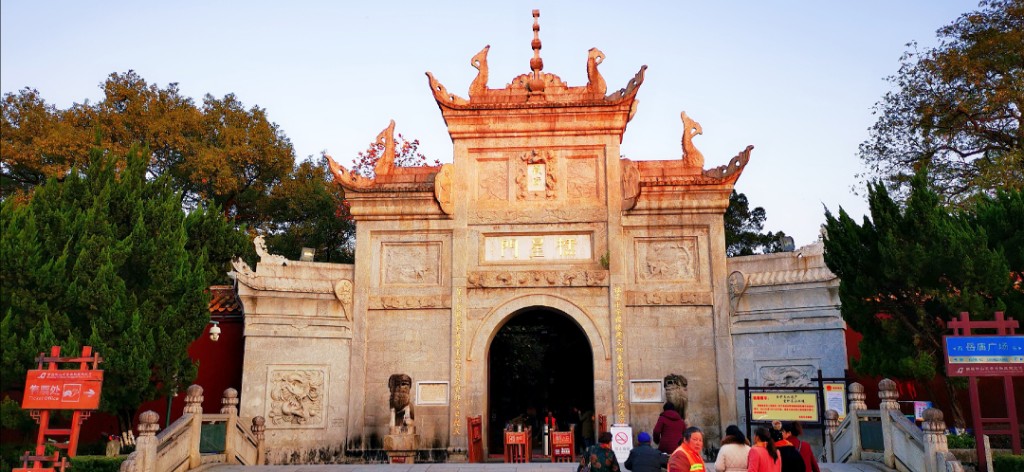
Nanyue is a renowned place of interest and a well known religious site. Each year, hundreds of visitors fromHunan,Jiangxi,Guangdongand Guangxi provinces come here to pray for good luck. The peak time is the eighth lunar month, with tens of thousands of visitors arriving daily. The visitors are clothed in black, bound with black scarves around their heads and with a red or a yellow pocket patch that reads “Praying in Nanyue” on their chest. Some of them hold giant candles in their hands, while others wave red flags or carry tablets to pray for their prayers to be answered.
2. Dishes are Tasteless without Spicy Food
This saying describesHengyangresidents’ appetite for hot peppers. People inHengyangare fond of salty and spicy food, especially hot peppers, which are an indispensable ingredient of every household’s dishes. Nearly all the people in the countryside plant numerous varieties of peppers. Among them are the lantern-shaped pepper in Qidong and the yellow sunburn pepper in Hengshan. The former one is spicy, sweet, big and suitable for eating as a vegetable. However, the latter one is small but spicy enough to be used as condiment only. Every autumn, people dry the ripe peppers in the sunshine and smash them into pieces for food.
There is a wide variety of food in theHengyangregion. Food in Hengdong tends to be salty. The food habits of people in Hengnan or other rural areas are quite different from those in urban areas. Breakfast and lunch are large meals with wine and dishes, while supper is very simple. It’s common for people to have just some noodles and porridges. People in Changning are interested in rice cakes made of polished glutinous rice dipped with sugar, sesame or soybean powder. People in Hengdong like to eat fish gel, which is made by adding oil, salt, garlic, ginger, soy sauce and flavoring to fish.
3. Customs of the Tianzhu Festival
The Tianzhu Festival is celebrated on the 6th day of the 6th month of the Chinese lunar calendar. There is an old saying, “On the double-six festival, it’s time to hang clothes to dry.” Therefore, the Tianzhu Festival is also called “clothes drying festival”. People inHengyangusually bring their clothes, books and paintings outside, exposing them to the sunlight in order to keep them away from being damaged by bacteria and mold.
4. Waterless Dragon Boat Race
During the Dragon Boat Festival, Sanxiang holds dragon boat races in memory of Qu Yuan, a famous historic government official. Since Nanyue is a mountainous area without rivers, people make dragon boats on land that can be “sailed” without water. These dragon boats are made with ordinary bamboo and richly colored with a hole in the middle for people to fit in, enabling people to walk with it. The key to winning this kind of “dragon boat race” does not lie in speed but performance. Competitors wear heavy make-up while dancing and singing.
5. Nanyue Day Trip
Generations of Nanyue natives show their devotion to Zhu Rong (the god of fire) by presenting the very first incense stick to him every year. As soon as the clock strikes twelve, showing the arrival of a new year, people from all sides swarm into theNanyueTemple. This is called the "Day Trip". After the people leave their homes, even friends do not greet each other until dawn in order not to lose their good luck. After the sun rises, people welcome the New Year with hands folded, a traditional gesture to show respect to others. When leaving the temple for home, they break part of a branch from a tree around the temple and pick up several leaves. This is called "catching the firewood" (which sounds the same as "make fortune" in Chinese). The housewives busy themselves preparing an elaborate meal so that the whole family can join together for a New Year’s meal before dawn. There is a folk saying "Before the cocks start crowing and the dogs biting, the people who are having dinner are local Hengshan people".
Folk Arts
1. Dragon Dance and Lion Dance
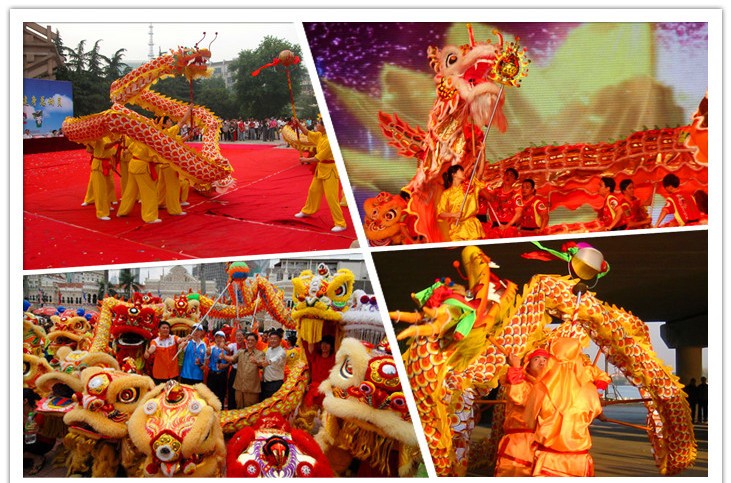
The dragon is an auspicious symbol for the Chinese. It is said that dragons have been protecting the security and prosperity ofNanyueMountainfor thousands of years. Since the Qing dynasty, the Dragon Dance or so called “rolling-dragon lights” has been popular inHengyangCounty.
The straw dragon of Jiushi village is an exquisite piece of artwork. The entire body is made of straw. These dragons perform just like traditional rolling ones, which should give way to the straw ones.
During the War of Resistance against
2. Puppet Show
Puppets are used as a performing style of drama and are controlled by a performer behind the stage. The actors, who have painted faces and delicate costumes, sing Chinese operas. There are various kinds of puppet shows in

3. Shadowgraph
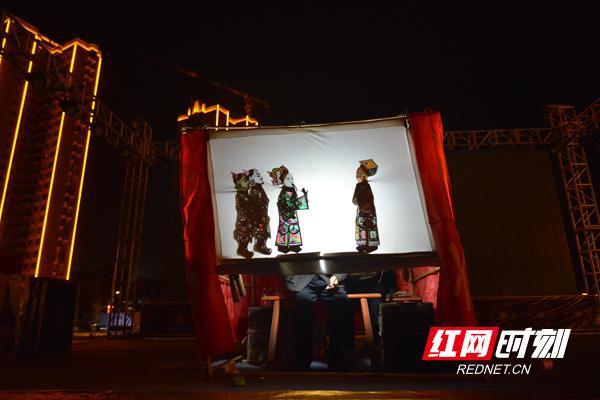
Shadowgraph is also called “shadow play”. First, the transparent shapes of various characters are made from donkey or cow skin, then shadow of those shapes is be displayed on the screen by the light coming from behind. While controlling the shadows during a performance, the controller also sings along with the music of yugu, a Chinese instrument made of bamboo. There are as many as 2,000 historical stories and scripts.
The shadowgraph is very popular among the folk inHengyangregion, especilaly inHengyangcity, Hengshan county and Changning county. With 300 years history of shadowgraph,HengshanCountywas approved as a “Village for Shadowgraph Art" by theHunanprovince in 1995.