-- Article list --
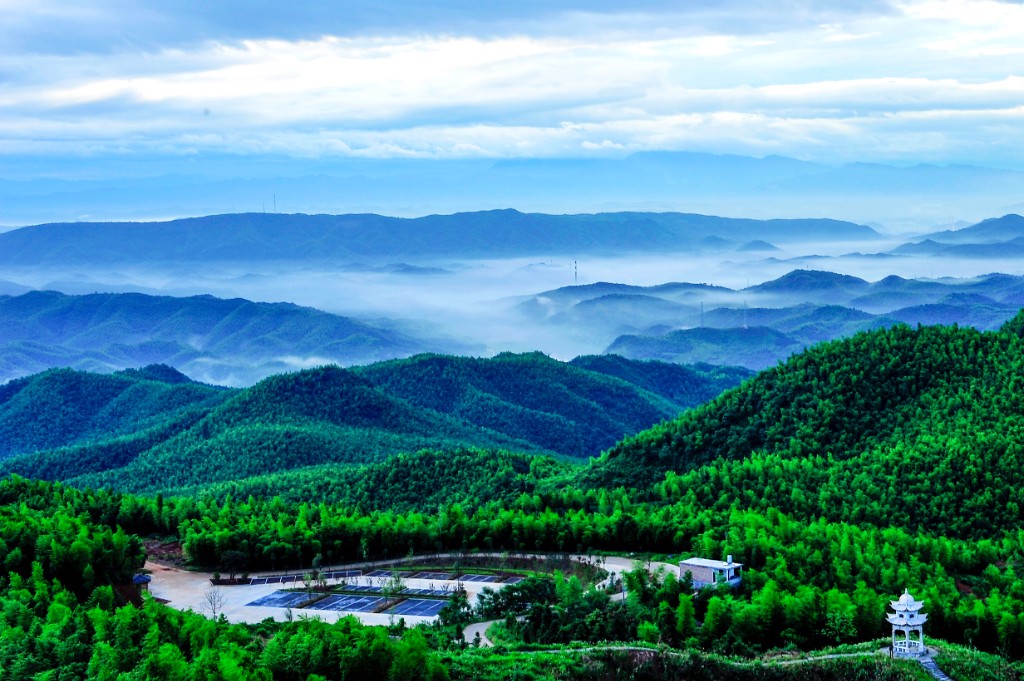
Hengyang City has 99 families, 342 genera, and 1,047 species of woody plants.
National First-Class Protected Rare Tree Species: Ginkgo (Ginkgo biloba), money tree (Pachira aquatica), golden money tree (Podocarpus macrophyllus), water pine (Glyptostrobus pensilis), Bretschneidera (Bretschneidera sinensis), velvet-pod honey locust (Gleditsia vestita), and fragrant fruit tree (Emmenopterys henryi), among others.
National Second-Class Protected Rare Tree Species: Cephalotaxus (Cephalotaxus spp.), eucommia (Eucommia ulmoides), zelkova (Zelkova spp.), Machilus (Machilus spp.), Chinese yew (Taxus chinensis), and magnolia (Magnolia officinalis).
National Third-Class Protected Tree Species: Yellow-branch oil fir (Cunninghamia konishii), soft-hair oil fir (Cunninghamia lanceolata var. pubescens), concave-leaf magnolia (Magnolia obovata), Phoebe (Phoebe spp.), Chinese ash (Fraxinus chinensis), silver dove tree (Davidia involucrata), Chinese torreya (Torreya grandis), golden-leaf tree (Chrysolepis chrysophylla), Michelia (Michelia spp.), Hunan stone oak (Lithocarpus hancei), and Yao mountain sorbus (Sorbus randaiensis).
Fast-Growing and High-Quality Native Tree Species: Chinese fir (Cunninghamia lanceolata), Masson pine (Pinus massoniana), oak (Quercus spp.), Castanopsis (Castanopsis spp.), Lithocarpus (Lithocarpus spp.), Cyclobalanopsis (Cyclobalanopsis spp.), Liquidambar (Liquidambar formosana), oak (Quercus spp.), Schima (Schima superba), and Kalopanax (Kalopanax septemlobus), totaling 20 families and 120 species.
Introduced Tree Species: Slash pine (Pinus elliottii), loblolly pine (Pinus taeda), Scots pine (Pinus sylvestris), Huangshan pine (Pinus hwangshanensis), Chinese white pine (Pinus armandii), dawn redwood (Metasequoia glyptostroboides), bald cypress (Taxodium distichum), pond cypress (Taxodium ascendens), smooth-bark birch (Betula luminifera), alder (Alnus spp.), and Italian poplar (Populus).
Economic and Specialty Trees for Selective Breeding and Cultivation: Nan bamboo (Phyllostachys pubescens), oil-tea camellia (Camellia oleifera), sandalwood (Santalum spp.), chestnut (Castanea mollissima), Qidong seedless fragrant pomelo (Citrus maxima), Hengshan Kowloon plum (Prunus salicina), apple plum (Prunus salicina), smooth-skinned jujube (Ziziphus mauritiana), ginkgo nut (Ginkgo biloba), among others.

It is known that Hengyang City is home to more than 200 species of mammals and birds, including 30 species of mammals and over 170 species of birds from 17 orders and 40 families.
National First-Class Protected Animals: Clouded leopard (Neofelis nebulosa), white stork (Ciconia ciconia), river deer (Hydropotes inermis, also known as water chevrotain), and Chinese merganser (Mergus squamatus).
National Second-Class Protected Animals: Pangolin (Manis pentadactyla), tiger-striped frog (Hoplobatrachus rugulosus), otter (Lutra lutra), large Indian civet (Viverra zibetha), small Indian civet (Viverricula indica), masked palm civet (Paguma larvata), sambar deer (Rusa unicolor), gorals (Naemorhedus), Alpine musk deer (Moschus chrysogaster), and mandarin duck (Aix galericulata).
Birds of Prey and Other Notable Species: Barn owl (Tyto alba), various species of owls including the Eurasian eagle-owl (Bubo bubo), brown wood owl (Strix leptogrammica), short-eared owl (Asio flammeus), kestrel (Falco tinnunculus), red-footed falcon (Falco vespertinus), silver pheasant (Lophura nycthemera), northern goshawk (Accipiter gentilis), white-crowned long-tailed pheasant (Syrmaticus reevesii), and the temminck’s tragopan (Tragopan temminckii). Additionally, Chinese giant salamander (Andrias davidianus) is also among the notable species.
Provincial Key Protected Animals: Egret (Egretta), ring-necked pheasant (Phasianus colchicus), bamboo partridge (Bambusicola thoracicus), white-breasted waterhen (Amaurornis phoenicurus), spotted dove (Spilopelia chinensis), South China tiger (Panthera tigris amoyensis), oriental turtle dove (Streptopelia orientalis), grey heron (Ardea cinerea), cattle egret (Bubulcus ibis), and more. Additionally, species like the Chinese bamboo rat (Rhizomys sinensis), silver star bamboo rat (Rhizomys pruinosus), fox (Vulpes spp.), yellow-throated marten (Martes flavigula), raccoon dog (Nyctereutes procyonoides), leopard cat (Prionailurus bengalensis), various snakes, toads, and frogs—over 30 species in total—are included.

The land area of Hengyang City is 15,303 square kilometers, equivalent to 1.5303 million hectares. By landform classification:
The cultivated land covers 375864.31 hectares, accounting for 24.561% of the total area, including 229133.06 hectares of paddy fields and 62191.63 hectares of dry land. The orchard covers 29624.85 hectares (1.936%), including 47.22 hectares of mulberry fields, 4916.34 hectares of tea plantations, 18599.13 hectares of orchards, and 6062.16 hectares of other orchards.
The forest land is 674502.31 hectares (44.078%), including 564139.97 hectares of forest land, 25134.23 hectares of shrubland, 27915.73 hectares of sparse wood land, 54374.43 hectares of unestablished forests, 2748.39 hectares of cut-over land, and 189.56 hectares of nurseries.
There are 26.09 hectares of pasture land, 0.08 hectares of improved grassland, and 4.94 hectares of artificial grassland.
The urban, rural, and industrial-mining land covers 104772.11 hectares (6.846%), including 4056.10 hectares of urban areas, 4040.24 hectares of designated town, 84332.43 hectares of villages, 7499.06 hectares of independent industrial and mining land, and 4844.28 hectares of special-use land.
The transportation land covers 14706.17 hectares (0.961%), including 1194.02 hectares for railways, 4483.97 hectares for highways, 9018.54 hectares for rural roads, 8.59 hectares for civil airports, and 1.05 hectares for ports and docks.
The water area is 130336.07 hectare (8.517%), including 28768.46 hectares of rivers, 11391.37 hectares of reservoirs, 62399.15 hectares of ponds, 12.90 hectares of reed land, 9159.89 hectares of tidal flats, 16781.34 hectares of ditches, and 1822.96 hectares of floating structures.
There are 200,446.08 hectares of unused land (13.09%), including 79,566.89 hectares of unused grassland, 84.22 hectares of swamps, 22,538.73 hectares of bare exposed rock or gravel, 86.79 hectares of sandy land, 16,496.55 hectares of bare land, 79,758.31 hectares of field ridges, and 1,914.59 hectares of other unused land.

As to the water amount, the natural water flow on land of the entire city is about 14.55 billion cubic meter in 2006, with an increase of 11.8 billion cubic meter about 23.3 percent, and an increase of 24.4 percent compared with the 11.7 billion cubic meter in 2005. The distribution of the water in the four districts of the downtown, and Hengyang County, Hengnan County, Changning County, Leiyang City, Hengdong County, Hengshan County, Nanyue County and Qidong County are as following: 369.1 million, 2.012 billion, 2.102 billion, 2.223 billion,3.2 billion,1.849 billion, 733 million, 218.2 million, and 1.797 billion. The total amount of the underground water flow in about 2.598 billion cubic meter. And the water use is distributed as following: 1.792 billion cubic meter for the irrigation of the agriculture, 106.5 million cubic meter for forest, stock breeding and fish breeding, 1.22 billion cubic meter for the industry, 48.36 million cubic meter for public water use in the city and the surrounding towns, 121.3 million cubic meter for the living of the people living in the city and towns, 167.5 million cubic meter for the living of the people living in the countryside, 4.03 million cubic meter for the ecology and environment, and the total amount is 3.460 billion cubic meter in which the amount of underground water used is 307.8 million cubic meter.
The total amount of the water flow of the mainstream and the four sub streams of Xiangjiang River in the city in a year is as follows: the amount given by Guiyang Hydrological Station, Hengyang Hydrological Station and Hengshan Hydrological Station on the mainstream of Xiangjiang River are 27.63 billion, 53.38 billion and 63.15 billion cubic meter respectively; Ouyang Hai Hydrological Station on the Chonglin River 5.818 billion cubic meter; Shenshan Tou Hydrological Station on Zhengshui River 1.986 billion cubic meter; Leiyang Hydrological Station on Leishui River 11 billion cubic meter; and Ganxi Hydrological Station on Maoshui River 11.37 billion cubic meter. As to the water quality, according to the statistics given by The Sub-center of Water Environment Monitoring in Hengyang which evaluates the water quality with Environmental Quality Standards for Surface Water (GB 3838-2002) as its standards, the water environment of the mainstream of Xiangjiang River, Guiyin River belongs to the II category; Wenchang the IV category; Songbai, Nan Daqiao, Hengyang and Dafu the hyper-V category; Leishui River in Leiyang the IV category; Ganxi on Maoshui River the III category; and the water environmental quality on the river month of Maozhui belongs to the IV category. The main super-scaling item in the super-scaling rivers is mainly fecal coliform bacteria. The total amount of the wastewater discharge in the city is 361 million cubic water, in which 106 million cubic meter reaches the rank and 361 million cubic meter has been discharged into river.
Renowned as China's "Land of Nonferrous Metals," "Land of Nonmetallic Minerals," "Granary of Fish and Rice," and "Hometown of Oil Tea Camellia," Hengyang features the globally recognized Shuikoushan Lead-Zinc Mine ("World Lead Capital"), leads Asia in albite reserves, and holds South China's largest rock salt deposits. The city boasts 69 mineral types, 1,047 woody plant species (99 families, 342 genera), and over 200 mammal and bird species. Four primary tributaries of the Xiangjiang River – Chongling, Zhengshui, Leishui, and Mishui – each drain basins exceeding 3,000 km² within its territory.
Steeped in over 2,300 years of history, Hengyang stands as a cultural cradle of Huxiang Culture, renowned for its enduring religious traditions and scholarly heritage. Legendary tales resonate through its lands – Shennong's agricultural innovations, Cai Lun's papermaking revolution, Zhou Dunyi's philosophical explorations, and Wang Chuanshan's intellectual legacy. The city has nurtured luminaries including inventor Cai Lun, philosopher Wang Chuanshan, and military strategist Luo Ronghuan, whose collective contributions have elevated the city's cultural stature. Natural wonders crown its landscape: Mount Heng (Nanyue), one of China's Five Sacred Peaks, has served as imperial worship grounds since ancient times. Scenic highlights encompass Tiantang Mountain, Cai Lun Bamboo Sea, Goulou Peak, and the "China Seal Mountain". Cultural landmarks feature Shigu Academy (one of China's Four Great Ancient Academies) and 14 state-level cultural heritage sites under State Council protection, including Nanyue Martyrs' Shrine, Xiangnan Uprising Headquarters (Peilan House), Nanyue Temple, Cai Hou Memorial Temple, Water-Mouth Mountain Lead-Zinc Smelting Site, Hengzhou Kiln Complex,Wang Chuanshan's Residence & Tomb, Luo Ronghuan's Former Home, Dayu Village Wang Clan Ancestral Hall, and Xiangnan Student Union Site. The "Eight Scenic Wonders of Hengzhou" – Yanfeng Misty Rain, Shigu River Views, Zhuling Mystic Caves, Qingcao Fishing Villages, Huayao Spring Streams, Yueping Snowscapes, Dongzhou Peach Waves, and West Lake White Lotuses – epitomize its poetic landscapes.
A total of 69 mineral types have been discovered in Hengyang City, with proven reserves for 57 of them. These include six energy minerals, 29 metal minerals, 33 non-metal minerals, and one type of water and gas mineral. The city has implemented 20 geological exploration projects (including ongoing projects).
Hengyang is known as a major hub for non-ferrous metals in Hunan Province and serves as an important base for non-metallic mineral resources. Over 60 types of proven mineral deposits have been identified, including iron, manganese, lead, zinc, tungsten, copper, tin, gold, uranium, kaolin, barite, potassium feldspar, sodium feldspar, and coal, with more than 440 mining sites of varying sizes. The city’s lead-zinc reserves total 2.1447 million tons, ranking first in the province.
Tin reserves amount to 12.67 million tons, accounting for 66% of the provincial total, while gold reserves make up nearly 50% of the province’s total. Feldspar reserves account for 99% of the province’s supply. Changning’s Shuikoushan is renowned as the “Kingdom of Lead and Zinc” and has been mined for over a century. As of the end of 1992, it still held the largest lead-zinc reserves in China. The kaolin deposits in Jiepai and Hengshan-Maji areas cover more than 40 square kilometers, making it one of the four major porcelain clay bases in China. The potassium feldspar deposits in Maji and Donghu areas have reserves of 13.2 million tons, ranking first in Asia.
Gold Deposits:Both rock gold, placer gold, and associated gold deposits are present within the region. Major deposits are found in Changning’s Shuikoushan, as well as Jinan Temple, Jinximiao, Huangtutang, Liusiqiao, and Da’an in Hengyang County. Other deposits exist in Ganxi of Hengdong County, Dianmenqian and Lingpo of Hengshan County. Among them, Shuikoushan in Changning has associated gold reserves of 82.88 tons, accounting for over 50% of Hunan’s total.
Rock Salt Deposits:The city’s rock salt resources are mainly located in Hengyang’s urban area, extending from Jinjialing in the north to Jiangjiashan in the south, covering an interconnected mining area of 800 square kilometers. The total rock salt reserves reach 140 billion tons, with large-scale deposits, simple geological structures, and stable mineral layers. The halite mineral layers range from 51 to 335 meters in thickness, with an average sodium chloride content of 46.62% and a mineralization rate of 86%. The establishment of Xiangheng Salt Mine in 1969 marked the end of Hengyang’s salt shortage.
Barite Deposits:Major barite mines are located in Tanzishan of Hengnan County, Xinqiao of Hengshan County, Quanxin of Hengdong County, Zhaobingling of Hengyang County, and Dingling of Qidong County. The barite from Tanzishan in Hengnan County is of the highest quality, with barium sulfate content reaching 94.5%, making it a key barite production area in Hunan.
Kaolin Deposits:Also known as porcelain clay, kaolin is mainly found in Jiepai, Guoqing, and Jiangbaiyan of Hengyang County; Maji, Donghu, and Wangfeng of Hengshan County; Xiling and Shuang’an of Changning City; and Shangbao and Jixian of Leiyang City. The Jiepai-Maji region is one of China’s four major porcelain clay bases, with industrial reserves of 9.314 million tons.
Iron Ore Deposits:Hengyang has the largest iron ore reserves among all cities in Hunan Province. The main deposits are concentrated in Maduqiao, Qingshan, Yuanliping, Lingguan, Hejiachong, and Liyushan in Qidong County, which hold around 200 million tons. Other deposits are found in Zhangcunjiao, Jinzhu, Huaqiao, and Lijiang in Hengnan County, as well as Yangjia, Tonghuang in Changning City, and Shangbao, Daozi in Leiyang City.
Lead-Zinc Deposits:With over 30 lead-zinc ore deposits, Hengyang’s total reserves stand at 2.62 million tons, ranking first in China. Major deposits are found in Shuikoushan, Yangjia, Miaoqian, Baisha, Daohu of Changning; Lingpo, Maji, Donghu, Futian of Hengshan; Tubao, Luodu of Leiyang; Sankouwan, Qingshuitang of Qidong; Shuangxi of Hengyang; Yuxing, Donggangshan, Diaomalong, Yinkengchong of Hengdong; and Huaqiao, Dongyang of Hengnan. Shuikoushan in Changning has the largest lead-zinc reserves in China, earning it the title “Kingdom of Lead and Zinc.” Despite a century of mining, it still had 765,300 tons of reserves as of 1992, maintaining its top position nationwide.
Coal Deposits:Hengyang’s coal resources are primarily found in Baisha, Mashui, Dahetan, and Nanjingqiao of Leiyang; Yanhu, Dapu, Baifang of Changning; Zhoushi of Hengshan; Shanchao of Hengyang; Gaohu of Hengdong; Baiji, Jingzichong, and Moshitang of Qidong. The most concentrated deposits are in Leiyang, covering 427.6 square kilometers with estimated reserves of 460 million tons. In 1993, raw coal production reached 4.238 million tons, making Leiyang one of Hunan’s leading coal-producing counties.
Gypsum Deposits:Hengshan County has abundant gypsum resources, with preliminary proven reserves exceeding 10 million tons. Its blue gypsum contains more than 75% calcium sulfate and is mainly used as a setting agent in silicate cement. White gypsum (also known as fiber gypsum) contains 95.5% calcium sulfate and is widely used in ceramics, chemicals, education, and agriculture. Raw gypsum powder contains 99.1% calcium sulfate, while calcined gypsum has 99.5% purity. These products are used for casting molds in ceramics, special metal castings, and other applications. Hengshan’s gypsum board products are highly durable, easy to install, and widely distributed across Guangdong, Guangxi, Jiangsu, Zhejiang, Jiangxi, and Hainan, with annual sales exceeding 150,000 tons.
Marble (Han White Jade) Deposits:Leiyang has identified over 40 million cubic meters of Han white jade, available in two types: egg-green and snow-white, with the former being particularly valuable. This marble is known for its purity, fine texture, and strong luster, resembling jade in smoothness. With excellent hardness and stable properties, it has been used in iconic buildings such as the Great Hall of the People, the Monument to the People’s Heroes in Beijing, the Yellow Crane Tower in Wuhan, Orange Isle in Changsha, and the Nanyue Temple. Its products are sold in over 10 provinces and cities, including Guangdong and Hainan.
Sodium Feldspar Deposits:Hengshan’s sodium feldspar reserves are the largest in Asia, with an annual production capacity of 120,000 tons and mineral powder processing capacity of 50,000 tons. Proven reserves stand at 40 million tons, with a projected reserve of over 100 million tons, making it the largest sodium feldspar deposit in Southeast Asia. The feldspar has high quality and stable chemical composition. It is widely used in medium-alkali glass, flat glass, ceramics, chemicals, and rubber industries, with customers in Guangdong, Guangxi, Hunan, Hubei, Jiangxi, Sichuan, Yunnan, Guizhou, and Anhui, as well as exports to Japan, South Korea, Thailand, Malaysia, Indonesia, and Taiwan.
The soils in Hengyang City are divided into zonal and azonal soils.There are a total of 9 soil types,20 subtypes,85 soil series,261 soil varieties,and 111 variants.The zonal soils mainly include alpine meadow soils,yellow-brown earths,and red soils,while the azonal soils mainly include black calcareous soils,red calcareous soils,purple soils,paddy soils,and alluvial soils.The red soils,purple soils,and paddy soils cover the largest areas,are widely distributed,and have the highest utilization rates.
The geographical distribution of the soils is generally as follows:Red soils are distributed in belts or patches;purple soils are mostly concentrated in the middle of basins in a network pattern;paddy soils are distributed in a dendritic pattern in the hilly and plain river valley areas below an altitude of 200 meters;alluvial soils are distributed in a dendritic pattern along the banks of rivers in open terrain;Quaternary red soils are mostly scattered in a bun-shaped pattern on purple shale.
How are these soils formed? Due to the tilting of the basin from the periphery to the center,a ring-shaped soil combination is formed.Between altitudes of 200 and 300 meters,the soils are composed of several kinds of soils like calcareous soils,sandstone red soils,shale red soils,and granite red soils.In the transitional hilly ridges and low-lying areas between the uplands and low mountains,hydromorphic paddy soils are often formed;in the middle section,gleyed paddy soils are formed;and on the hill slopes with paddy fields,submerged paddy soils are common.Between altitudes of 300 and 500 meters,with a general slope of 25–30 degrees,the soils are mostly sandstone and shale red soils or granite red soils.In the relatively flat hilly areas with water sources for irrigation,such as ridges and banks,water is often diverted to create paddy fields.These paddy fields are mostly hydromorphic,while the mountainous areas are natural red soils.In geological structures or fault zones,cold-soaked or mineral-toxic fields are often formed.On the slopes of hills and mountains,under the long-term influence of lateral seepage from surface water,seepage paddy soils are formed.Above an altitude of 500 meters,the mountainous areas have a vertical distribution of red soils,yellow soils,yellow-brown earths,and alpine meadow soils.
The red soils have 3 subtypes,24 soil series,and 61 soil varieties.In the second soil census,the area was 1.1586 million hectares.They are widely distributed in the hills and plains below an altitude of 760 meters.The purple soils cover an area of 162,500 hectares in the city.They are divided into three subtypes—acidic,neutral,and calcareous—based on the calcium carbonate content and pH value of the surface layer.They are distributed in the middle of the basin,between altitudes of 60 and 200 meters,extending from Xialiu and Dapu in Hengdong County in the east,to Guoshuiping in Qidong County in the west,to Yanpo and Zha Jiang in Hengyang County in the north,and to Guanling and Dongshan in Changning City and Yaotian in Leiyang City in the south,including the Shilu area.The largest areas are in Hengnan and Hengyang counties,with distributions also in Baiguo and Guantang in Hengshan County.
The paddy soils cover an area of 278,100 hectares.Between altitudes of 50 and 500 meters,they are distributed in six subtypes:swampy,gleyed,seepage,submerged,and those near industrial and mining areas as well as mineral-toxic paddy soils.