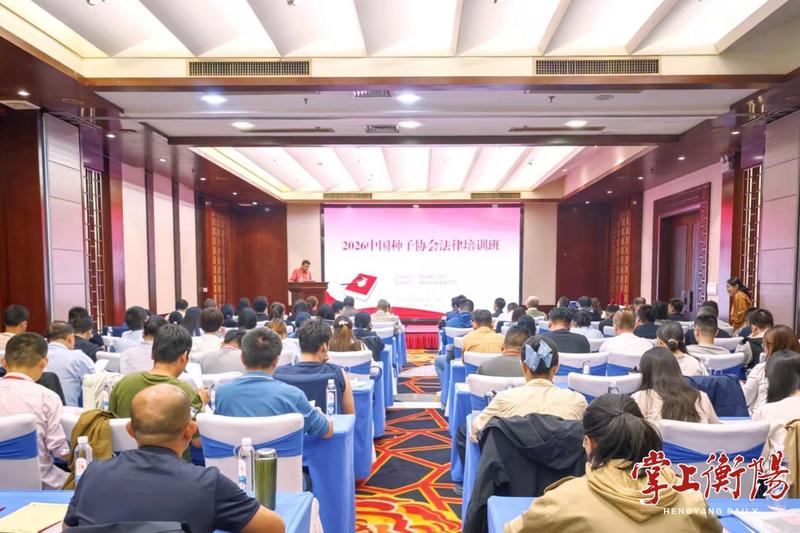
The 2026 China Seed Association Legal Training Program was held in Hengyang from October 29 to 30. Organized by the China Seed Association and co-hosted by the Hengyang Academy of Agricultural Sciences, the program brought together more than 120 representatives from seed industry regulators, companies, law firms and industry associations across China.
At the opening ceremony, a senior official from the Hengyang Academy of Agricultural Sciences said that the 13th CPC Hengyang Municipal Congress, held recently, had set the direction for agricultural sci-tech innovation and the development of the rule of law in the seed industry. Co-hosting this national training program was a concrete step toward implementing the congress’s guiding principles and supporting the revitalization of the seed industry through the rule of law.
A representative of the China Seed Association noted that China had accelerated efforts to strengthen the legal framework for the seed industry in recent years, with progress in legislation, judicial practice and law enforcement, alongside improvements to the system for protecting intellectual property rights in the sector. Participants were encouraged to apply what they learned, assess business risks against the latest regulations, strengthen internal compliance mechanisms, and reject variety infringement, unauthorized use of registered varieties and counterfeit or substandard products, thereby helping maintain a fair market environment.
The training came ahead of the implementation of the newly revised Implementing Rules of the Regulations of the People’s Republic of China on the Protection of New Varieties of Plants (Agriculture and Rural Affairs). Experts in legislation, frontline regulatory officials and lawyers specializing in the seed industry delivered sessions on eight topics: revisions to the implementing rules; guidelines for identifying essentially derived varieties; key points in variety-right application and examination; infringement risk prevention for seed producers; corporate systems for protecting rights and preventing infringement; management of regional variety trials; resolution of seed-quality disputes; and key areas of seed law enforcement inspections. Interactive question-and-answer sessions also addressed practical challenges raised by participants.
Participants said the program was timely and practical, combining authoritative policy interpretation with guidance relevant to business operations. They noted that it would help them better understand the latest regulations, clarify compliance requirements, and strengthen their ability to prevent risks and protect their legal rights. They pledged to apply what they had learned to daily operations, ensure compliant business practices and contribute to the high-quality development of China’s seed industry.
Translator: Jing