-- Article list --
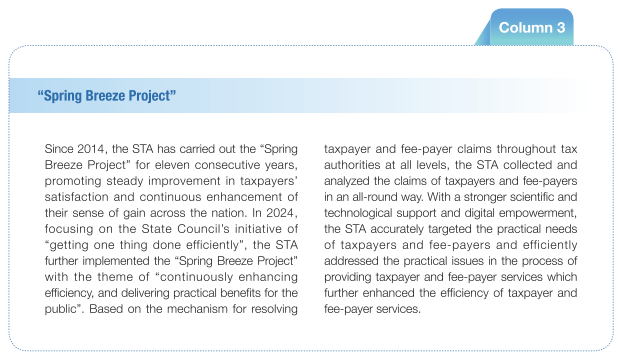
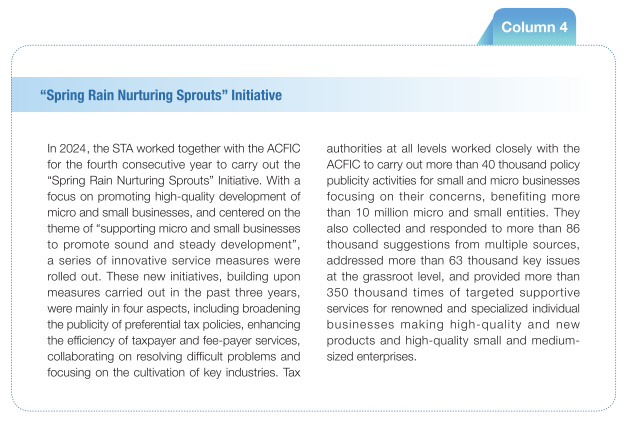
Focusing on the philosophy of "getting one thing done efficiently", the "Spring Breeze Project" was launched under the theme of "continuously enhancing efficiency, and delivering practical benefits for the public". A series of service measures benefiting both individuals and enterprises were integrated across four major categories, effectively enhancing taxpayer and fee-payer experience. In collaboration with the All-China Federation of Industry and Commerce (ACFIC), the STA conducted the 2024 "Spring Rain Nurturing Sprouts" initiative to support the development of micro and small enterprises, introducing 12 innovative service measures. The "Bank-Tax Interaction" program was further deepened, helping creditworthy micro and small enterprises secure credit loans totaling 3.06 trillion yuan in 2024. The STA continued to promote cross-regional processing of tax matters. Based on taxpayer-tax authority interactive services, are mote virtual window was established to provide cross-regional processing services for taxpayers and fee-payers. The implementation of cross-border electronic tax payment has facilitated taxpayers and fee-payers abroad to complete tax payments. With an upgraded mechanism for resolving taxpayer and fee-payer claims, the STA and provincial tax authorities leveraged coordinated efforts to resolve 1043 hot claims for taxpayers and fee-payers. Furthermore, the STA has strengthened management and services for the professional tax-related service industry, and effectively protected the legitimate rights and interests of taxpayers and fee-payers. According to a third-party survey, the taxpayer satisfaction score in 2024 reached 89.4 points which was anew high.
The STA intensified the implementation of structural tax and fee cuts. Focusing on key sectors and critical areas, the STA ensured precise and efficient execution, and further improved tax and fee supporting policies. Policy review, promotion and explanation were refined. The STA continued to optimize the "Policies Looking for People" service, facilitating direct and swift access to policies. Violations such as fraudulent tax relief claims or malicious exploitation of tax preferences were strictly tackled through resolute and swift enforcement to safeguard the accurate and stable implementation of preferential policies. In 2024, tax and fee cuts and tax refunds under the existing policies supporting technological innovation and manufacturing development exceeded 2.6 trillion yuan. Driven by these targeted tax and fee supporting policies, sales revenue from high-tech industries nationwide increased by 11.3% year-on-year, while that of manufacturing enterprises increased by 3.9% year-on-year.
What is the "Policies Looking for People" service?
Leveraging the strengths of tax big data, tax authorities have optimized the "Policies Looking for People" service which intelligently matches tax policies with eligible entities based on industry, enterprise type, personnel identity and other criteria, ensuring that qualified businesses receive timely and tailored policy support. In 2024, tax authorities continued to optimize the "Policies Looking for People" service. Through integrating taxpayer information, operational data, and behavioral patterns during tax filing and fee-paying processes, the STA developed a strategy to deliver a package of customized tax preferential policies and operational guidelines to taxpayers, focusing on supporting technological innovation, manufacturing development, capital market stability, and real estate market regulation. Throughout the year, 629 million policy recommendations were precisely delivered to taxpayers (individuals/entities) for a total of 405 million times and 16.25 million targeted promotional materials were distributed to 11.48 million newly registered businesses. These efforts have empowered market entities to fully utilize preferential policies and further enhanced their tax compliance.



The State Council, China's Cabinet, unveiled a new regulation mandating internet platform companies to regularly report tax-related information of businesses and workers operating on their platforms, in a move to ensure a level playing field for the development of the digital economy.
According to the State Council, the new rules, comprising 14 articles, require platform operators to submit identity and income information of both businesses and workers using their platforms to local tax authorities on a quarterly basis.
The regulation seeks to improve the efficiency of tax services and administration, safeguard the legitimate rights of taxpayers and ensure a level playing field in the digital economy.
Notably, the rules also clarify exemptions. Platform workers engaged in public convenience services such as delivery, transport and housekeeping — who either qualify for tax exemptions or fall outside the scope of tax obligations — are not required to have their income reported.
The Ministry of Justice and the State Taxation Administration emphasized that the "new tax reporting rules for internet platform companies will not increase the tax burden for the vast majority of businesses and workers operating on these platforms."
For most operators and workers on such platforms, particularly those who are compliant with existing tax laws, their tax payments will remain the same, they said.
They added that small and micro-sized businesses will continue to benefit from preferential tax policies. Merchants with monthly sales under 100,000 yuan ($13,933) are eligible for a value-added tax exemption and platform workers earning less than 120,000 yuan a year — after applying deductions — are generally exempt from personal income tax, they added.
To reduce the compliance burden, the rules said that internet platforms are not obligated to resubmit tax information that has already been provided through withholding declarations or can be obtained via government data-sharing mechanisms. Tax authorities are required to offer secure and efficient reporting channels, easy-to-use data interfaces and timely policy consultations.
Privacy protection has also been underscored. Internet platform firms must securely store tax-related information of platform users, while tax agencies are obligated to maintain confidentiality and establish safeguards to manage the data in accordance with law.
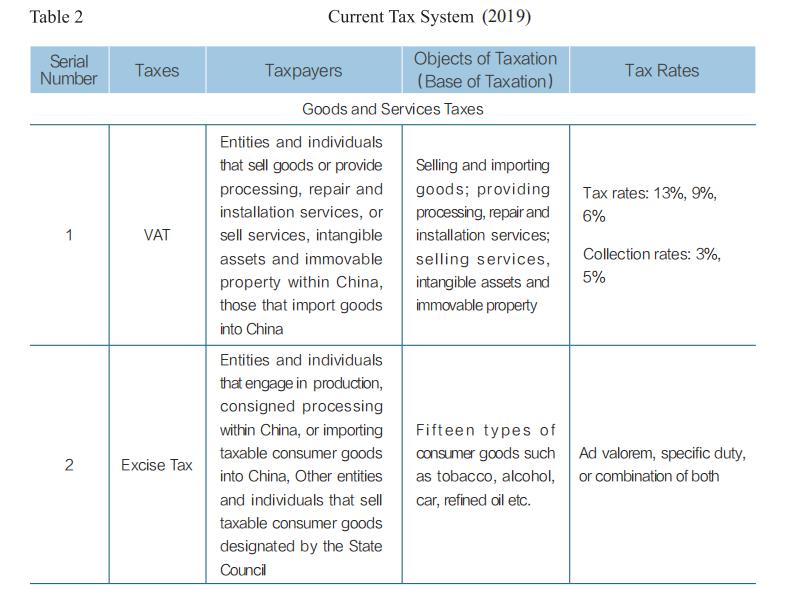
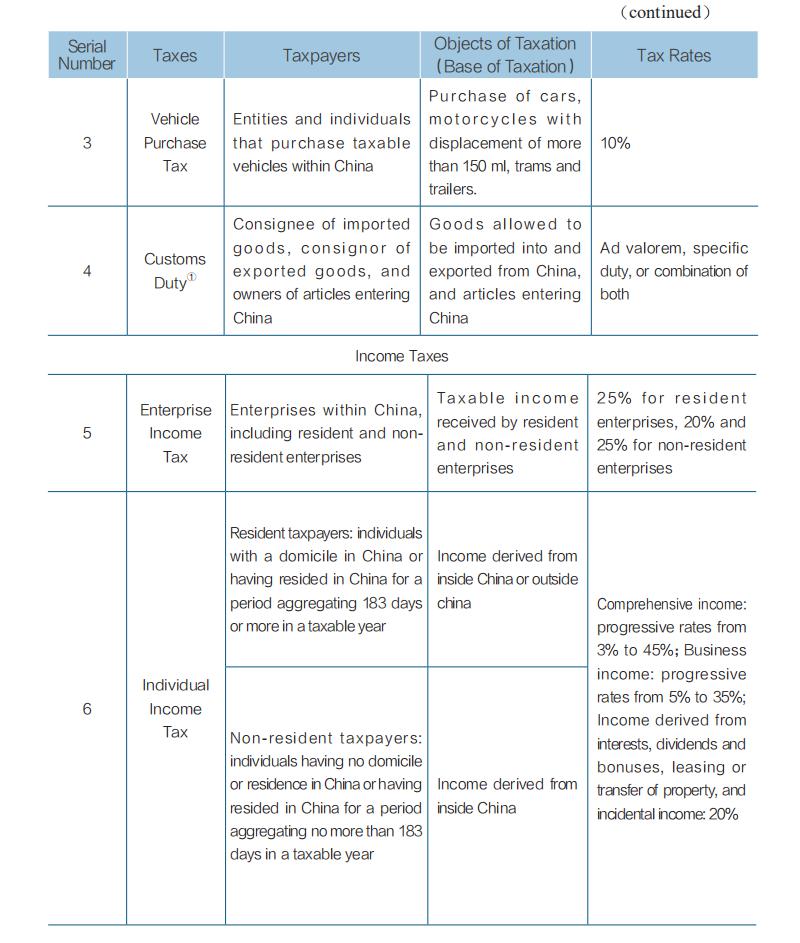
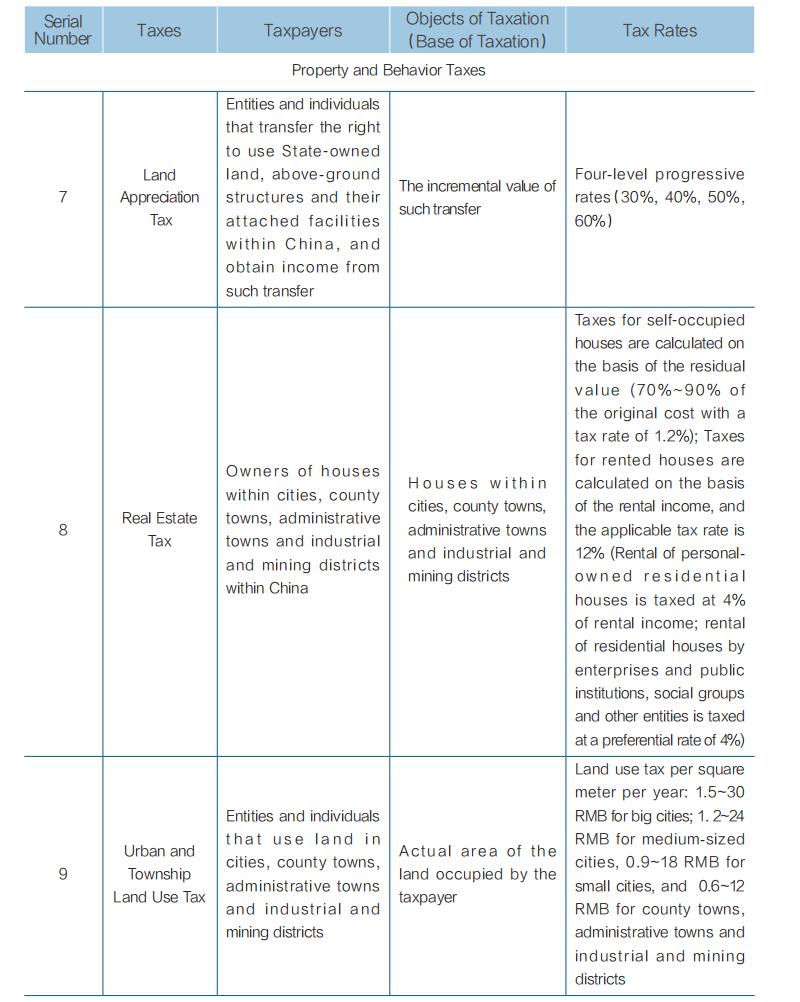
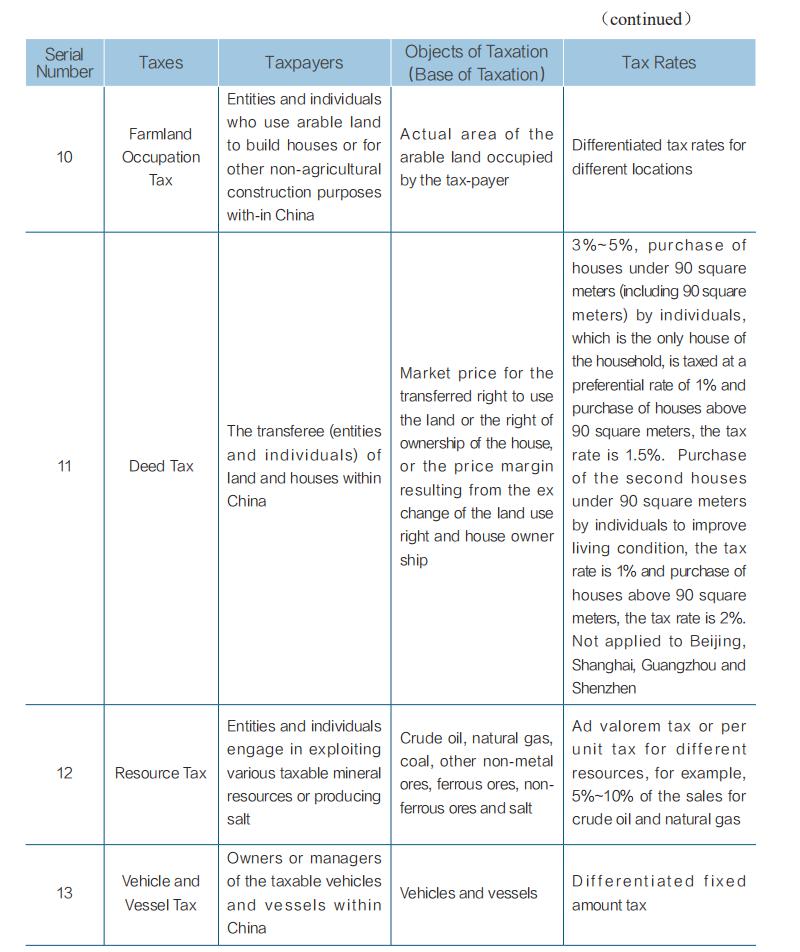
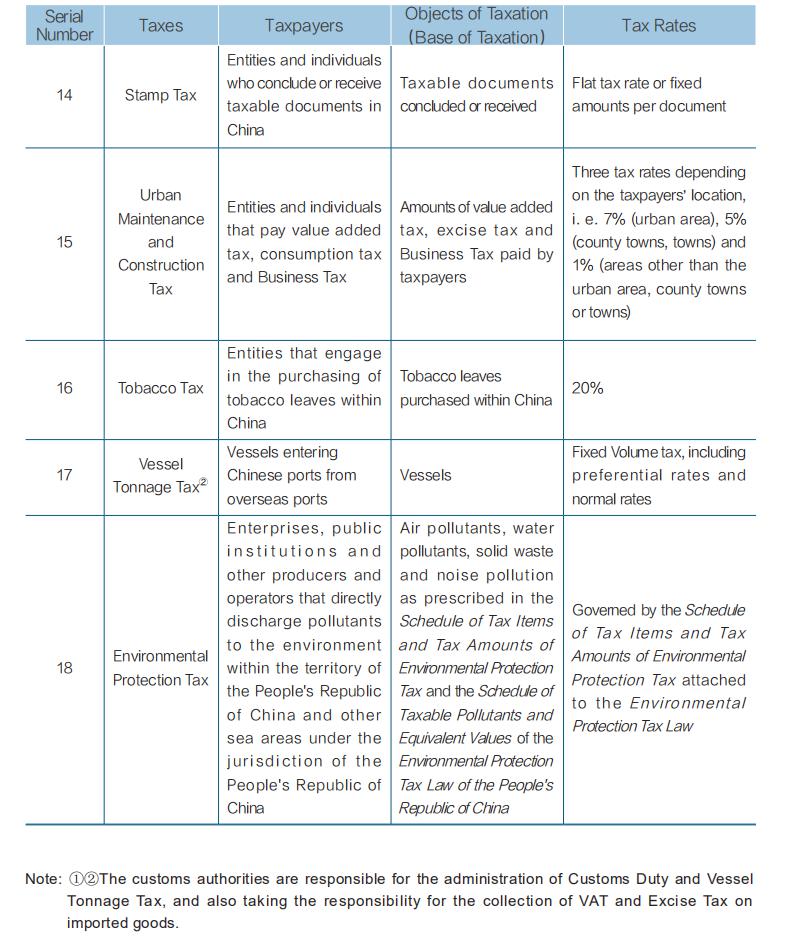
There are eighteen different kinds of taxes in China, which can be divided into three categories according to their nature. (See Table 2)
◆ Goods and services taxes, including VAT, Excise Tax, Vehicle Purchase Tax and Customs Duty.
◆ Income taxes, including Enterprise Income Tax and Individual Income Tax.
◆ Property and behavior taxes, including Land Appreciation Tax, Real Estate Tax, Urban and Township Land Use Tax, Farmland Occupation Tax, Deed Tax, Resource Tax, Vehicle and Vessel Tax, Stamp Tax, Urban Maintenance and Construction Tax, Tobacco Tax, Vessel Tonnage Tax and Environmental Protection Tax.
Adopted at the Nineteenth Meeting of the Standing Committee of the Eleventh National People’s Congress of the People’s Republic of China on February 25, 2011; and amended in accordance with Decision on Amending Eight Laws including Construction Law of the People’s Republic of China adopted at the Tenth Meeting of the Standing Committee of the Thirteenth National People’s Congress of the People’s Republic of China on April 23, 2019.
Article 1 Owners or custodians of vehicles and vessels within the territory of the People’s Republic of China, as prescribed in the Tax Items and Amounts Table of Vehicle and Vessel Tax attached to this Law, shall be the taxpayers of vehicle and vessel tax and shall pay vehicle and vessel tax in accordance with this Law.
Article 2 The applicable tax amount for vehicles and vessels shall be implemented in accordance with the Tax Item and Amount Table of Vehicle and Vessel Tax attached to this Law.
The specific applicable tax amount for vehicles shall be determined by local people’s governments of provinces, autonomous regions and municipalities directly under the central government in accordance with the tax amount range as prescribed in the Tax Items and Amounts Table of Vehicle and Vessel Tax attached to this Law and the regulations of the State Council.
The specific applicable tax amount for vessels shall be determined by the State Council within the tax amount range as prescribed in the Tax Items and Amounts Table of Vehicle and Vessel Tax attached to this Law.
Article 3 The following vehicles and vessels shall be exempted from vehicle and vessel tax:
(1) Vessels for fishing and aquaculture;
(2) Vehicles and vessels used exclusively by the army and armed police forces;
(3) Vehicles and vessels used by the police;
(4) National comprehensive firefighting and rescue vehicles and special vessels hung with emergency rescue special license plates;
(5) Vehicles and vessels of the foreign embassies and consulates in China, representative offices of international organizations in China and their relevant personnel, which shall be exempted from tax in accordance with the law.
Article 4 Vehicle and vessel tax may be reduced or exempted for energy-saving or new energy-powered vehicles and vessels. Where tax reduction or exemption is needed due to serious natural disasters or other special reasons, vehicle and vessel tax may be reduced or exempted. The specific measures shall be prescribed by the State Council and submitted to the Standing Committee of the National People’s Congress for the record.
Article 5 Local people’s governments of provinces, autonomous regions and municipalities directly under the central government may, according to the actual situation, reduce or exempt vehicle and vessel tax for public transportation vehicles and vessels, and motorcycles, three-wheeled vehicles and low-speed trucks owned by rural residents and mainly used in rural areas.
Article 6 Insurance institutions engaged in compulsory third-party liability insurance for motor vehicles shall be the withholding agents of vehicle and vessel tax on motor vehicles, and shall withhold vehicle and vessel tax in accordance with the law and issue vouchers for the taxes withheld when charging insurance premiums.
Article 7 The place for vehicle and vessel tax payment shall be the place of registration of the vehicles or vessels, or the place where the withholding agent is based. For vehicles and vessels that do not need registration in accordance with the law, the tax payment place shall be the place where the owner or custodian of the vehicles or vessels is based.
Article 8 The obligation for paying vehicle and vessel tax occurs in the month when the ownership or management right of the vehicle or vessel is obtained.
Article 9 Vehicle and vessel tax shall be filed and paid annually. The specific tax filing and payment period shall be determined by local people’s governments of provinces, autonomous regions and municipalities directly under the central government.
Article 10 Vehicle and vessel registration and administration departments, such as public security, transportation, agriculture and fisheries authorities, vessel inspection institutions and industry regulatory authorities of withholding agents of vehicle and vessel tax, shall provide relevant information on vehicles and vessels to tax authorities in order to strengthen the collection and administration of vehicle and vessel tax.
When vehicle owners or custodians apply for vehicle registration and periodic inspection, they shall submit the certificate of tax payment or tax exemption in accordance with the law to the traffic management department of the public security authority. The traffic management department shall verify the documents before processing the application.
Article 11 Vehicle and vessel tax shall be administered in accordance with the provisions of this Law and Tax Collection and Administration Law of the People’s Republic of China.
Article 12 Implementation regulations for this Law shall be formulated by the State Council.
Article 13 This Law shall enter into force from January 1, 2012. Provisional Regulations on Vehicle and Vessel Tax of the People’s Republic of China, which was promulgated by the State Council on December 29, 2006, shall be repealed simultaneously.
All information in this document is authentic in Chinese. English is provided for reference only. In case of any discrepancy, the Chinese version shall prevail.
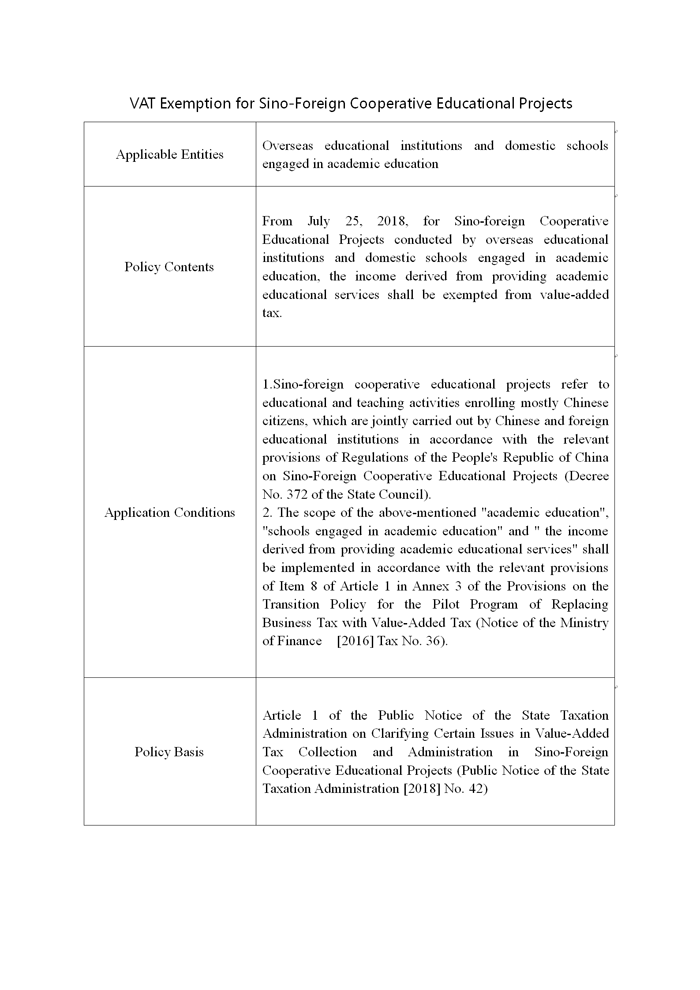
Favorable taxation policies accessible to SMEs
Small and low-profit enterprises can pay their income taxes at the rate of 20%. Small enterprises earning low profits are taxed at 20% provided that they are engaged in the industries not restricted or prohibited by the state, and meet the following conditions:
(1) any industrial enterprise with an annual taxable amount not exceeding RMB 300,000, less than 100 employees and a total asset of no more than RMB 30 million;
(2) any other enterprise with an annual taxable amount of no more than RMB 300,000, no more than 80 employees and total asset not exceeding RMB 10 million.
Small scale taxpayers are eligible for lower value added tax (VAT). The Interim Regulation of the People's Republic of China on Value Added Tax and the Detailed Rules for Implementing the Interim Regulations of the People's Republic of China on Value Added Tax lower the annual sales requirements for small scale taxpayers applying for the general taxpayer status. Required annual sales volume of industrial enterprises is reduced from RMB one million to RMB 500,000 and commercial enterprises, RMB1.8 million to RMB 800,000. In addition, the VAT bearing rate for small scale taxpayers, both industrial and commercial, is lowered from 6% and 4% to 3%.
Verified taxable income rate is further decreased. According to the Measures for Verification Collection of Enterprise Income Tax, taxable income rate applicable to the following industries is further reduced: manufacturing industry, from 7-20% to 5-15%; entertainment industry, from 20-40% to 15-30%; transportation industry, from 7-20% to 7-15%; and food and beverage, from 10-25% to 8-25%. It is also stipulated that a 3-10% rate is applicable to agriculture, forestry, animal husbandry and fishery.
Favorable policies indirectly accessible to SMEs
Support financing of SMEs. Non-profit credit guarantee and re-guarantee institutions who are listed among national pilots aiming at facilitate financing for SMEs shall, upon completion of tax exemption procedures from tax administrative shall enjoy a three-year exemption of business tax (i.e. revenue from credit guarantee and re-guarantee operations in accordance with relevant regulations of the prefecture-level people's government and revenue from credit rating, consulting and training excluded).
Where a startup investment enterprise invests in an unlisted small or medium new- and high-tech enterprise for two years (24 months) or more in the form of equity investment, a tax credit of 70% of the amount of investment in the small or medium new- and high-tech enterprise can be claimed against the taxable income of the year. When two full years end since it holds shares in the small or medium new- and high-tech enterprise, and, if the tax credit is less than the taxable income, the tax credit can be carried forward to the next tax year.
As for donations by enterprises, public institutions, social groups or individuals via NGOs or government bodies to the Administration Center of Innovation Fund for Small Technology-based Firms, a tax credit of 12% the annual profit will be allowed for enterprises and 30% the amount of taxable income for individuals.
Other incentives for SMEs
Support technological innovation. Science and technology incubators such as national high & new technology innovation service centers, university science parks, software parks, and overseas students' innovation park recognized by the state or province shall be exempt from business tax, house property tax, and land use tax in cities and towns upon recognition. Revenue from technology transfer, technology development and related consulting and service is free from business tax. Where the enterprise derives income the technology transfer, the first RMB 5 million of the taxable income is exempted from income tax. The amount over the RMB 5 million is subject to income tax at 50% of the full rate.
Encourage reorganization of property rights. No business tax will be applied to transfer of land use right or ownership of fixed assets. SMEs holding shares in the form of fixed assets or intangible assets will be free from business tax.
Promote circular economy. Enterprises shall enjoy a 10% reduction of taxable income, given that the main materials for the products should come from the prescribed resources under the Catalog for the Preferential Tax Treatment on the Integrated Utilization of Resources and that the products should meet the industry standards and not fall under the restricted and prohibited categories. Enterprises engaged in environmental protection, energy and water conservation shall receive tax concession of the first 3 years income tax exemption and the next 3 years taxation at 50% of the normal rate, starting from the tax year in which the first transaction of sales is reported. SMEs developing and producing animations independently where taxable services are incurred will be levied at 3% in terms of business tax (income from advertisements and entertainment deducted). SMEs engaged in agriculture, forestry, animal husbandry, and fishery can enjoy income tax exemptions and reductions according to relevant regulations.
Encourage employment of disabled people. SMEs absorbing the disabled workforce, including welfare enterprises, blind massage institutions, work injury or physical disability rehabilitation stations, where income from services (excluding advertisement service) account for 50% of the combined value of VAT taxable items and business tax taxable items, have access to business tax reduction based on the number of disabled employees. The tax reduction is six times as much as the minimum annual income approved by the provincial people's government with a maximum of RMB 35,000 per person per year.