-- Article list --
(1) All items listed as prohibited for entry;
(2) Manuscripts, printed materials, films, photographs, records, movies, audio tapes, video tapes, laser discs, computer storage media and other items containing state secrets;
(3) Precious cultural relics and other cultural relics prohibited from export;
(4) Endangered and precious animals and plants (including specimens), as well as their seeds and propagation materials.
Restricted Items from Exit
(1) Precious metals such as gold and silver and their products;
(2) National currency;
(3) Foreign currencies and foreign securities;
(4) Radio transceivers and communication security equipment;
(5) Precious Chinese medicinal herbs;
(6) General cultural relics;
(7) Other articles restricted from export by customs.
[For details, please refer to Decree No. 43 of the General Administration of Customs of the People's Republic of China]
(1) Cultural relics (including works of deceased modern famous calligraphers and painters) carried, checked or mailed by individuals for export shall be declared to the Customs. The customs will inspect and release them based on the identification mark stamped by the cultural administrative department and the cultural relics export invoice, or the export permit issued by the cultural administrative department designated by the Ministry of Culture. Printed materials and audio-visual products carried, checked or mailed by individuals entering or leaving the country shall be declared to the Customs. If the amount exceeds the reasonable amount for personal use, it shall be returned;
(2) The entry of cultural relics. Individuals who carry or mail cultural relics into the country shall declare them to the Customs voluntarily and truthfully upon entry. The Customs shall allow entry of them within a reasonable amount for personal use. Special note: The entry procedures for donated cultural relics shall be handled in accordance with the relevant regulations on the import of goods;
(3) Re-entry of Temporarily Imported Cultural Relics.
·Individuals who carry, check or mail cultural relics into China for temporary entry shall submit a written declaration to the Customs upon entry, specifying the necessity for re-exit of such relics. The Customs at the port of entry shall seal the cultural relics and entrust the declarer to deliver them to the National Cultural Relics Entry and Exit Examination and Management Office designated by the National Cultural Heritage Administration (NCHA).
·Cultural relics that are not declared upon entry, whose customs seals are damaged, or whose re-exit appraisal procedures have not been completed after entry shall go through the exit procedures in accordance with the regulations on the exit of cultural relics.
Tips | Cigarettes, Alcohol, and Currency
You can bring in 400 cigarettes (2 cartons), 100 cigars, or 500 grams of pipe tobacco duty-free; and 2 bottles (1.5 liters) of liquor duty-free.
You can bring in no more than RMB 20,000 and cash no more than the equivalent of USD 5,000. If the amount exceeds the prescribed amount, you shall declare it to the customs.
You may carry foreign currency up to the equivalent of USD 5,000 when leaving China. If you carry more than USD 5,000, you need to apply for a permit and declare it to customs.
Tips | Items Requiring Quarantine Examination and Approval
According to the List of Animals and Plants, Their Products and Other Quarantine Items Prohibited from Being Carried or Sent into the People's Republic of China, animals and animal products such as dried meat, fresh milk, butter, etc. (excluding milk powder), bird's nests (excluding canned bird's nests that have been commercially sterilized), plants, seeds and seedlings, fruits and vegetables, fungi, soil, etc. are all prohibited items from being carried or sent into China. They shall go quarantine examination and approval procedures before entry, and they can only enter the country after passing quarantine inspection.
Tips | Endangered Species and Their Products
China implements protection for endangered species and their products. Travelers should be careful to distinguish when buying handicrafts or souvenirs abroad. For protected species listed in the Appendix of the Convention on International Trade in Endangered Species of Wild Fauna and Flora (CITES), such as ivory, giant clams, and agarwood, any trade method or carrying or mailing of endangered species and their products into or out of the country is illegal, except for those who legally hold import and export permits and go through customs formalities in accordance with regulations.
[For other items restricted from entry, please refer to Decree No. 43 of the General Administration of Customs of the People's Republic of China]
(1) Various weapons, simulated weapons, ammunition and explosives;
(2) Counterfeit currency and counterfeit securities;
(3) Printed materials, films, photographs, records, films, audio tapes, video tapes, laser discs, computer storage media and other items that are harmful to China's politics, economy, culture or morality;
(4) Various strong poisons;
(5) Opium, morphine, heroin, marijuana and other addictive narcotics and psychotropic substances;
(6) Animals, plants and their products that carry dangerous germs, pests and other harmful organisms;
(7) Food, medicine or other items that are harmful to human and animal health, come from epidemic areas or can spread other diseases.
Restricted Items from Entry
(1) Radio transceivers and communication security equipment;
(2) Cigarettes and alcohol;
(3) Endangered and precious animals and plants (including specimens) and their seeds and propagation materials;
(4) National currency
(5) Other articles restricted from entry into the country by customs.
For the purposes of further adapting to the new situation of port law enforcement, the quarantine supervision for pet dogs and cats brought into China shall be conducted in a safe, scientific and standardized way. Relevant issues are hereby announced as follows:
I. Live animals brought into China shall only be limited to dogs or cats (hereinafter referred to as pets), and one person is allowed to bring one pet on each entry. Persons bringing pets into China shall provide the customs with a valid quarantine certificate and a vaccination certificate issued by the official animal quarantine authorities in the exiting countries or regions. Pets shall have electronic chips in them.
II. Pets brought into China shall be quarantined for 30 days (including the withholding period) in an isolated area designated by the Customs. Pets that need to be quarantined shall enter China from a port with quarantine facilities. The Customs shall supervise and inspect the pets in quarantine. The Customs shall carry out classified management of the pets brought into China by designated countries or regions and non-designated countries or regions, and the pets in the following circumstances shall be exempt from quarantine:
(I) Pets coming from designated countries or regions have valid electronic chips, and have passed on-site quarantine;
(II) Pets coming from non-designated countries or regions have valid electronic chips and rabies antibody test reports issued by the recognized laboratories (the rabies antibody titer must be greater than 0.5 IU/ml), and have passed the on-site quarantine;
(III) The pets that are brought in are guide dogs, hearing dogs, or search and rescue dogs, have valid electronic chips and have passed the on-site quarantine, and their carriers have provided corresponding user certificates and professional training certificates.
The list of designated countries or regions, the list of accepted laboratories publishing rabies antibody test results and the list of ports with quarantine facilities shall be those as published by the General Administration of Customs.
III. Under any of the following circumstances, the Customs shall, in accordance with relevant provisions, return or destroy the pets within a specified period:
(I) The number of pets brought into China exceeds the quota;
(II) Any person bringing in the pets fails to provide the Customs with a valid quarantine certificate or a rabies vaccination certificate issued by the official animal quarantine institution in the exiting country or region;
(III) Pets required to be quarantined are planned to enter China from a port without quarantine facilities; and
(IV) Pets fail to pass the quarantine inspection.
Guide dogs, hearing dogs and search and rescue dogs without vaccination certificates may, upon application by their carriers, be vaccinated against rabies in qualified institutions.
For pets to be returned within a specified period, their carriers shall, within the prescribed limit period, claim and bring them out of China by the withholding certificate issued by the Customs; Their failure to make such claim within such period shall be regarded as automatic waiver.
IV. For the specific quarantine requirements for the pets brought into China, please refer to the Annex, the Quarantine Requirements for Pets Brought into the Peoples Republic of China.
This Announcement shall come into force on May 1, 2019.
The Announcement is hereby given.
GG (2019) No. 5
For the purposes of further adapting to the new situation of port law enforcement, the quarantine supervision for pet dogs and cats brought into China shall be conducted in a safe, scientific and standardized way. Relevant issues are hereby announced as follows:
I. Live animals brought into China shall only be limited to dogs or cats (hereinafter referred to as pets), and one person is allowed to bring one pet on each entry. Persons bringing pets into China shall provide the customs with a valid quarantine certificate and a vaccination certificate issued by the official animal quarantine authorities in the exiting countries or regions. Pets shall have electronic chips in them.
II. Pets brought into China shall be quarantined for 30 days (including the withholding period) in an isolated area designated by the Customs. Pets that need to be quarantined shall enter China from a port with quarantine facilities. The Customs shall supervise and inspect the pets in quarantine. The Customs shall carry out classified management of the pets brought into China by designated countries or regions and non-designated countries or regions, and the pets in the following circumstances shall be exempt from quarantine:
(I) Pets coming from designated countries or regions have valid electronic chips, and have passed on-site quarantine;
(II) Pets coming from non-designated countries or regions have valid electronic chips and rabies antibody test reports issued by the recognized laboratories (the rabies antibody titer must be greater than 0.5 IU/ml), and have passed the on-site quarantine;
(III) The pets that are brought in are guide dogs, hearing dogs, or search and rescue dogs, have valid electronic chips and have passed the on-site quarantine, and their carriers have provided corresponding user certificates and professional training certificates.
The list of designated countries or regions, the list of accepted laboratories publishing rabies antibody test results and the list of ports with quarantine facilities shall be those as published by the General Administration of Customs.
III. Under any of the following circumstances, the Customs shall, in accordance with relevant provisions, return or destroy the pets within a specified period:
(I) The number of pets brought into China exceeds the quota;
(II) Any person bringing in the pets fails to provide the Customs with a valid quarantine certificate or a rabies vaccination certificate issued by the official animal quarantine institution in the exiting country or region;
(III) Pets required to be quarantined are planned to enter China from a port without quarantine facilities; and
(IV) Pets fail to pass the quarantine inspection.
Guide dogs, hearing dogs and search and rescue dogs without vaccination certificates may, upon application by their carriers, be vaccinated against rabies in qualified institutions.
For pets to be returned within a specified period, their carriers shall, within the prescribed limit period, claim and bring them out of China by the withholding certificate issued by the Customs; Their failure to make such claim within such period shall be regarded as automatic waiver.
IV. For the specific quarantine requirements for the pets brought into China, please refer to the Annex, the Quarantine Requirements for Pets Brought into the Peoples Republic of China.
This Announcement shall come into force on May 1, 2019.
The Announcement is hereby given.
Annexes: 1. Quarantine Requirements for Pets Entering the People's Republic of China.doc
2. List of Laboratories Publishing Rabies Antibody Test Results Accepted by the General Administration of Customs.doc
3. Registration Form for the Information on Pet Dogs and Cats Brought to China.doc
4. List of Ports with Quarantine Conditions for Pets that Arrive in China.doc
General Administration of Customs
January 2, 2019
In accordance with relevant laws and regulations such as the Exit and Entry Administration Law of the People's Republic of China and the Regulations of the People's Republic of China on Frontier Inspection of Exit from or Entry Into the Country, foreigners holding an interline ticket of an aircraft, ship, or train of international voyage and transiting through China to a third country or region within 24 hours are exempted from visa application, provided that they do not leave the port; any of them intending to leave the port shall apply for a temporary entry permit from the entry-exit frontier inspection station.
Foreigners applying for a temporary entry permit shall submit their valid passports or other international travel documents, interline tickets and other materials, fill in the landing card for foreigners in transit, and accept inquiries from the entry-exit frontier inspection station. The entry-exit frontier inspection station will not issue temporary entry permits to foreigners in the following cases:
(1) the applicant is not allowed to enter China by laws or administrative regulations;
(2) passports or other international travel documents of the applicant are valid for less than 3 months, or with stamp of rejection by China’s visa-issuing agencies;
(3) the applicant has records of illegal entry or exit, illegal residence, or illegal employment within 5 years; or
(4) the applicant has violations of accommodation registration regulations within 2 years and the circumstances are severe.
Foreigners temporarily entering China shall apply to the exit and entry departments of China's public security organs for corresponding stay permits in accordance with regulations in case that they have to stay beyond the permitted time limit due to sudden illness or force majeure. Foreigners staying beyond the permitted time limit and failing to apply for stay permits will be punished in accordance with law by entry-exit frontier inspection authorities or the public security organs of local people’s governments at or above the county level.
Notice: The English version is only for reference. To learn more, please refer to the authoritative Chinese version.
Ⅰ. Legal Basis
(1) Article 6 of the Exit and Entry Administration Law of the People's Republic of China
Exit-entry border inspection authorities may carry out border inspections on articles carried by passengers upon exit-entry in accordance with the needs to maintain national security and the order of exit-entry. Where necessary, the exit-entry border inspection authorities may carry out border inspections on goods carried by transportation vehicles upon exit-entry, but the customs shall be notified.
(2) Article 66 of the Exit and Entry Administration Law of the People's Republic of China
Exit-entry border inspection authorities may carry out inspections on passengers upon exit-entry in accordance with the needs to maintain national security and the order of exit-entry.
Ⅱ. Things to be Noted
1. Exit-entry passengers and transportation vehicles shall not carry prohibited items stipulated by laws and administrative regulations that endanger national security and social order;
2. Do not leave the country when carrying illegally documents, materials and other items that are classified as state secrets;
3. If exit-entry passengers transport guns and ammunition as carry-on or checked luggage, they shall apply for permission at the frontier inspection stations in accordance with relevant laws and administrative regulations. Without permission, no transportation is allowed of guns and ammunition as carry-on or checked luggage upon exit-entry.
Notice: The English version is only for reference. To learn more, please refer to the authoritative Chinese version.
I. Scope of Application
This service guide is applicable to foreigners applying for exit-entry permits.
II. Legal Basis
Exit and Entry Administration Law of the People's Republic of China, Regulations of the People's Republic of China on Administration of the Exit and Entry of Foreigners.
III. Competent Authorities
The National Immigration Administration (NIA) has entrusted the exit-entry administration authorities of public security organs at the prefecture-level (including districts and counties under the administration of municipalities directly under the central government) and above to accept applications for exit-entry permits of foreigners.
With the approval of NIA at the request of exit-entry administration authorities under provincial public security organs, exit-entry administration authorities of county-level public security organs may be authorized by NIA to accept applications for exit-entry permits of foreigners.
IV. Application Conditions
1. Where a foreigner in China has no valid passport or other international travel document due to loss, damage, theft and robbery and is not able to obtain reissued documents from the embassy or consulate of his/her country in China, he/she shall submit a certification of passport loss report or a note from the embassy or consulate of his/her country in China or present invalidated or expired documents and any temporary identity document in use instead of a passport.
2. For other circumstances where NIA considers it necessary to issue exit-entry permits for foreigners., relevant provisions shall prevail.
V. Prohibitive Requirements
Where an applicant does not comply with the aforementioned conditions for application or falls within the circumstances stipulated in Article 28 of the Exit and Entry Administration Law of the People's Republic of China, the exit-entry permits for foreigners shall not be issued.
VI. Application Materials
1. Applicants shall fill in the Visa/Stay Permit/Residence Permit Application Form and submit a photo that complies with the Guidelines for Exit and Entry Documents Photographs.
2. Applicants shall submit a certification for passport loss report or a note from the embassy or consulate of his/her country of residence in China, or present invalidated or expired document and any temporary identity document in use instead of a passport.
3. Other supporting materials deemed necessary by NIA.
VII. Basic Process and Way of Application
1. Application. To apply for foreigners' exit-entry permit, foreigners shall complete relevant procedures and accept interview in person at the exit-entry administration authority of public security organs.
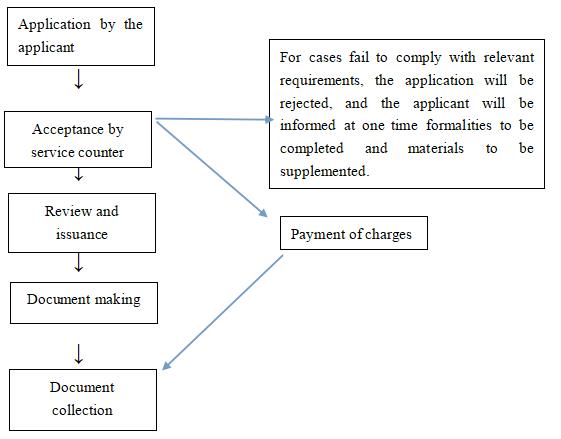
2. Acceptance. The competent authority shall review and decide whether or not to accept an application. Where the application falls within the scope of the administrative authority, and the application materials are complete and comply with the requirements, the application shall be accepted on the spot and an acceptance receipt shall be issued. Where the formalities and materials required for the application for exit-entry permit are incomplete, the competent authority shall inform the applicant of the formalities to be completed and the materials to be supplemented at one time.
3. Review and Verification. The public security organs shall strengthen the verification process to ensure authenticity of the application reasons through interviews, telephone inquiries, field investigations and other means, and confirm whether the applicant is of foreign nationality. Where an applicant or relevant entity/individual is notified to take an interview but fails to do that at the agreed time without justifiable reasons, the application may be denied by law.
4. Decision. For applications eligible for the conditions and criteria, the decision-making authority shall decide to issue exit-entry permits for foreigners.
VIII. Time Limit for Issuance
A decision shall be made within 30 working days from the date of accepting the application for exit-entry permit for foreigners.
IX. Charging Basis and Standards
1. Basis for Charges
Notice of the Ministry of Public Security of People's Republic of China on Adjusting the Fees for Visas and Documents of Foreigners (Gong Tong Zi [1996] No. 89).
2. Charging Standards
Exit-entry permit for foreigners: CNY 100
X. Results Delivery
Approved and issued exit-entry permit for foreigners shall be collected by the applicant in person at the relevant exit-entry administration authority of public security organs with the acceptance receipt.
XI. Rights and obligations of administrative counterpart
1. Applicants are entitled to the following rights according to relevant laws and regulations:
a. Those who meet the legal conditions and criteria are entitled to equal rights to obtain an administrative license in accordance with law;
b. They shall have the right to make statements and defend against implementation of the administrative license by an administrative authority;
c. Other rights stipulated by laws and regulations.
2. Applicants shall perform the following obligations in accordance with relevant laws and regulations:
a. Applicants shall submit relevant materials and reflect the reality truthfully to the administrative authority, and shall be held responsible for authenticity of substantive content of the application materials;
b. Applicants shall cooperate with administrative authorities to verify authenticity of the application materials through interviews, telephone inquiries, field investigations and so on;
c. Other obligations stipulated by laws and regulations.
XII. Flowchart for issuance of exit-entry permits for foreigners
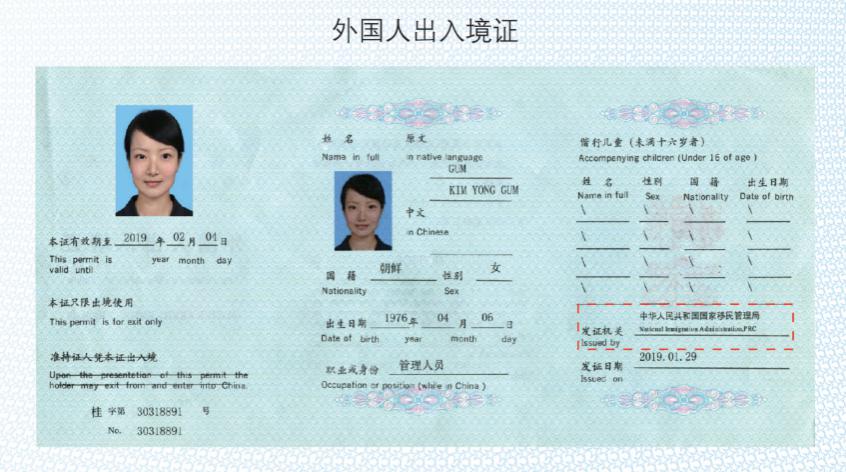
XIII. Sample of the exit-entry permit
Notice: The English version is only for reference. To learn more, please refer to the authoritative Chinese version.
China's General Administration of Customs announced on Oct 26 the ending of mandatory health declarations for individuals entering or exiting the Chinese mainland from Nov 1, 2023.
Both inbound and outbound passengers will no longer need to fill in the entry or exit health declaration form, according to the Frontier Health and Quarantine Law and the rules for its implementation.
However, individuals showing symptoms of infectious diseases such as fever, cough, difficulty breathing, vomiting, diarrhea, skin rash, unexplained subcutaneous bleeding, or those already diagnosed with infectious diseases must voluntarily report their health status to customs officers.
People with infectious disease symptoms must cooperate with customs in carrying out health quarantine procedures, including temperature checks, epidemiological investigations, medical examinations and sample testing, it said.
Those who conceal or evade quarantine measures will bear corresponding legal responsibilities. If their actions result in the spread of infectious diseases or pose a serious transmission risk, they will face corresponding criminal liabilities, the administration said.
China adopted the quarantine declaration system in January 2020 as a measure to combat COVID-19, requiring travelers to fill in exit/entry health declaration forms and declare their health to customs.
This guide is provided on an informational basis to assist you in going through the Customs formalities when you enter or leave China through international airports, seaports, train or bus stations.
GENERAL PROVISIONS
In accordance with “Customs Law of the People’s Republic of China”, inward and outward passengers shall enter or leave the territory at the place where the Customs is established. Passengers shall be subject to Customs control, and shall declare honestly to the Customs.
All inward and outward passengers entering or leaving China, except those who are exempted from examination or control in accordance with relevant regulations and those under the age of 16 traveling with adults, shall complete <CHINA Customs BAGGAGE DECLARATION FOR OUTWARD PASSENGERS> or <CHINA Customs BAGGAGE DECLARATION FOR INWARD PASSENGERS> (hereinafter referred to as <DECLARATION FORM>) and declare truthfully to the Customs.
The inward and outward passengers who have nothing to declare shall choose the “Nothing to Declare Channel” (GREEN CHANNEL). Personal articles, carried by inward passengers, within the limitation set by the Customs, are exempted from duty, and personal articles carried by outward passengers shall be released.
The inward and outward passengers carrying articles to declare shall choose the “Goods to Declare Channel” (RED CHANNEL).
The <DECLARATION FORM> verified and endorsed by the Customs shall be kept properly, and shall be re-submitted to the Customs at the time of return if necessary.
Seals affixed by the Customs on the baggage shall not be opened or broken without Customs prior authorization.
Passengers who are not certain about the above instructions shall ask the Customs officers for details or choose the “Goods to Declare Channel” (RED CHANNEL).
CUSTOMS RELEASE CRITERIA AND PROCEDURES
CAUTION: Inward or outward baggage effects, personal articles carried by international passengers shall be limited to the PERSONAL USE only and subject to REASONABLE QUANTITY control.
CAUTION: Inward passengers with the articles listed below SHALL choose “GOODS TO DECLARE” (RED CHANNEL).
Items | Customs Control | |
1 | Personal articles from overseas, valued at RMB5,000 or above, carried by Chinese residents. | The exceeding part or amount (subject to reasonable personal use) above the limitation set by the Customs shall be levied duty upon. |
2 | Personal articles intended to remain in the territory, valued at RMB2,000 or above, carried by non-Chinese residents. | |
3 | 1,500ml or above of alcoholic drinks (containing 12% or above alcoholic content); 400 sticks or above of cigarettes; 100 sticks or above of cigars; 500g or above of tobacco. | |
4 | RMB20,000 cash or above, or any other foreign currencies in cash equivalent to US$5,000 or above. | Items will be dealt with according to the current regulations. Passengers carrying foreign currencies in cash worth more than US$5,000 and intending to take the currencies out of China in the future shall fill out two declaration forms. After being endorsed by the Customs, one copy of the declaration forms will be returned to the passengers for future use at the time when leaving China. |
5 | Animals and plants, animal and plant products, microbes, biological products, human tissues, blood and blood products. | Items will be dealt with according to the current regulations. |
6 | Radio transmitters, radio receivers, communication security equipments. | |
7 | Other articles which are prohibited or restricted from being brought into the territory in accordance with the law of the People’s Republic of China. | |
8 | Goods of commercial value, samples, advertisements. | |
9 | Unaccompanied baggage. |
CAUTION: Outward passengers with the articles listed below SHALL choose “GOODS TO DECLARE” (RED CHANNEL).
Items | Customs Control | |
1 | Camera, video camera, laptop computer or other trip necessities valued each at over RMB5,000, and intended to be brought back at the end of the trip. | Passengers shall fill out two declaration forms. After being endorsed by the Customs, one copy of the declaration forms will be returned to the passengers for use at the time when re-entering China. |
2 | RMB20,000 cash or above, or any other foreign currencies in cash equivalent to US$5,000 or above. | Items will be dealt with according to the current regulations. |
3 | Gold, silver and other precious metals. | |
4 | Cultural relics, endangered animals or plants and products thereof, biology species resources. | |
5 | Radio transmitters, radio receivers, communication security equipments. | |
6 | Other articles which are prohibited or restricted from being brought out of the territory in accordance with the law of the People’s Republic of China. | |
7 | Goods of commercial value, samples, advertisements. |
TIPS! The onsite clearance flow for the inward and outward passengers:
Obtain the declaration form
Read the instruction on the reverse side carefully.
Fill out the declaration form
Choose the Customs declaration channel
Submit the declaration form
Conduct the Customs formalities.
OTHER USEFUL INFORMATION
- PROHIBITED AND RESTRICTED ARTICLES
CAUTION: Please don’t bring such articles into or out of China, or you are liable for the violation of the law and the following consequences.
Your are subject to punishment if you fail to declare to the Customs when carrying the articles listed above.
Articles Prohibited from Importation:
Arms, imitation arms, ammunition and explosives of all kinds.
Counterfeit currencies and counterfeit negotiable securities.
Printed matter, films, photographs, gramophone records, cinematographic films, loaded recording tapes and video tapes, compact discs ( video and audio ), storage media for computers and other articles which are detrimental to the political, economic, cultural and moral interests of China.
Deadly poison of all kinds.
Opium, morphine, heroin, marihuana and other addictive drugs and psychotropic substances.
Fruits, solanaceae vegetables, live animals (except dogs and cats as pet), animal products, pathogenic micro-organisms of animals and plants, pests and other harmful organisms, animal carcasses, soil, genetically modified organisms, relevant animals and plants, their products and other objects subject to quarantine from countries or regions with prevalent epidemic animal or plant diseases.
Foodstuff, medicine and other articles coming from epidemic stricken area or harmful to man and livestock or those which might spread disease.
Articles Prohibited from Exportation:
All articles enumerated as articles prohibited from Importation.
Manuscripts, printed matter, films, photographs, gramophone records, cinematographic films, loaded recording tapes and video-tapes, compact discs ( video and audio ), storage media for computers and other articles which involve state secrets.
Valuable cultural relics and other relics prohibited from Exportation.
Endangered and precious rare animals and plants (including their specimens), their seeds and reproducing materials.
- EXCHANGE CONTROL
CAUTION: Passengers fail to observe the exchange regulation are subject to the administrative penalty fine or even get their currencies confiscated.
Foreign exchange:
There are no quantitative restrictions imposed on the foreign currencies, traveler’s checks, or letters of credit brought in.
However, inward passengers shall accurately declare to the Customs if carrying foreign currencies in cash worth more than 5,000 U.S. dollars. The Customs shall release it on passengers' departure upon the declaration made at the last entry.
Without last time declaration record of foreign currencies in cash, or if the recorded amount is less than what the passengers carry this time, the Customs shall release the discrepancies upon certificate issued by the Foreign Exchange Bureau or its authorized banks.
RMB
The limit of RMB allowed to bring in or take out is 20,000 yuan. The exceeding part is prohibited.
Starting from March 18, 2024, the Hunan International Travel Health Care Center has resumed online reservation service for entry-exit physical examinations and vaccinations. Individuals applying for entry-exit related matters can make an appointment in advance via the center's official WeChat account. Please note that those unable to provide reservation information will not be accepted.
Starting from March 18, 2024, the Hunan International Travel Health Care Center has resumed online reservation service for entry-exit physical examinations and vaccinations. Individuals applying for entry-exit related matters can make an appointment in advance via the center's official WeChat account. Please note that those unable to provide reservation information will not be accepted.
Reservation time:
You can make an appointment for the following two weeks starting around 12:00 on the last working day of a week.
Consulting telephone: 86-731-86869403; 86-731-86869431 (Please call during working hours)
Physical examination time: 8:30-11:30 on working days
Address: No. 188, Xiangfu Middle Road, Yuhua District, Changsha
Updated on Feb. 28, 2025
I. Scope of Application
This service guide is applicable to foreigners applying for travel permits.
II. Legal Basis
Exit and Entry Administration Law of the People's Republic of China
III. Accepting Authority
The National Immigration Administration (NIA) has entrusted exit-entry administrations authorities of public security organs at and above the prefecture-level (including districts and counties under the administration of municipalities directly under the central government) to accept and handle foreigners' applications for travel permits.
With the approval of NIA at the request of exit-entry administration authorities of provincial public security organs, exit-entry administration authorities of public security organs at the county-level are authorized by NIA to accept and handle applications for travel permits.
IV. Application Conditions
Foreigner's travel permits with prescribed period may be issued to foreigners who apply to travel to places not open to foreigners and provide relevant identification documents as required in due course.
V. Application Materials
1. Individuals applying for a foreigner's travel permit shall submit evidentiary materials related to the reasons for staying in the destination area;
2. For tourist groups of foreigners who apply for travelling to places not open to foreigners, travel agencies shall submit reception plans to the exit-entry administration authority of the provincial-level public security organs in their location. Reception plans shall be submitted 60 days prior to arrival of the tourist groups, and the exit-entry administration authority shall verify whether tourist routes pass through regions where foreigners are prohibited from entry. No approval procedures are required for tourist routes clear of the prohibited regions, while approval procedures shall be observed for tourist routes passing through regions where foreigners are prohibited from entry and travel agencies shall submit reception plans, lists of relevant personnel, copies of valid passports and visas (or permanent resident ID cards) of the foreigners to apply for approval.
VI. Basic Process and Way of Application
1. Application
To apply for foreigners' travel permit, foreigners shall complete relevant procedures in person at the exit-entry administration authority of public security organs. Where the application meets relevant regulations, travel agencies may apply to the exit-entry administration authority of provincial public security organ under the local government on the behalf of the applicants.
2. Acceptance
Upon examination of applications for foreigners' travel permit, eligible applications shall be accepted, and a receipt of acceptance shall be issued, followed by a decision on issuance or not being made within the validity period of the receipt of acceptance. For applications with incomplete procedures and materials, the exit-entry administration authority of public security organs shall inform the applicant of the formalities to be completed and the materials to be supplemented at one time.
3. Review and Verification
The exit-entry administration authority of public security organs shall verify the authenticity of the application reasons through interviews, telephone inquiries, field investigation and other means, and confirm the applicant is of foreign nationality. Where an applicant or relevant entity/individual is notified to take an interview but fails to do that at the agreed time without justifiable reasons, the application may be denied by law.
4. Decision
For applications eligible for the conditions and criteria, the decision-making authority shall decide to issue travel permits for foreigners.
VII. Time Limit for Issuance
A decision shall be made within 30 working days from the date of acceptance.
VIII. Charging Basis and Standards
1. Basis for Charges
Notice on Adjusting the Fees for Visas and Documents of Foreigners (Gong Tong Zi [1996] No. 89) of the Ministry of Public Security
2. Charging Standards
Travel permit for foreigners: CNY 50
IX. Results Delivery
Approved and issued travel permits for foreigners shall be collected by the applicants in person at the relevant exit-entry administration authority of public security organs with the acceptance receipt.
X. Rights and obligations of administrative counterpart
1. Applicants are entitled to the following rights according to relevant laws and regulations:
a. Those who meet the legal conditions and criteria are entitled to equal rights to obtain an administrative license;
b. They shall have the right to make statements and defend against implementation of the administrative license by an administrative authority;
c. Other rights stipulated by laws and regulations.
2. Applicants shall perform the following obligations in accordance with relevant laws and regulations:
a. Applicants shall submit relevant materials and reflect the reality truthfully to the administrative authority, and shall be held responsible for authenticity of substantive content of the application materials;
b. Applicants shall cooperate with administrative authorities to verify authenticity of the application materials through interviews, telephone inquiries, field investigations and so on;
c. Other obligations stipulated by laws and regulations.
XI. Flowchart for issuance of travel permits for foreigners
XII. Sample of foreigners' travel permit
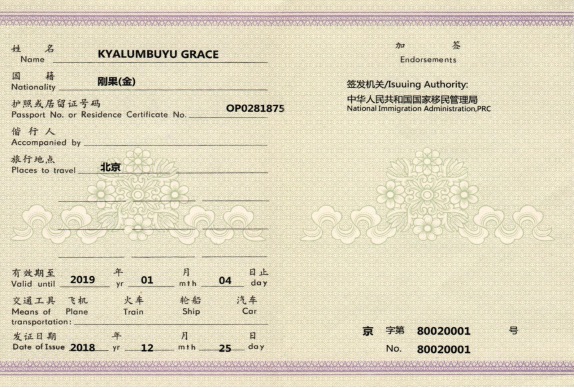
Notice: The English version is only for reference. To learn more, please refer to the authoritative Chinese version.
Office Equipment and Vehicles of Resident Offices
A motor vehicle which has been imported duty free as described above may be transferred to another resident officer/official or to another staff member of the resident office or sold to an authorized operating entity if more than four years have elapsed since the vehicle was released by the Customs Office and the term of office of the original staff member who imported the vehicle has expired. At the end of the six-year period of customs supervision, the vehicle may also be transferred, sold or dedicated for another purpose. Resident offices may apply for import and export of office equipment and motor vehicles for resident offices and permanent personnel. They may apply for the import of duty-free motor vehicles in accordance with relevant Customs regulations.
Motor Vehicles for Personal Use
To apply for import of such a vehicle, the following documents should be submitted to the responsible customs office:
1. Identity papers;
2. Long-term residence permits;
3. Completed Application Form of the Customs of the People's Republic of China for Importation and Exportation of Articles for Personal Use;
4. Bill of lading (waybill), packing list and other required documents.
5. Applicants who are permanent China-based personnel, other than experts, should provide a photocopy of their identity papers and long-term residence permits and submit, through their resident offices, the Filing Certificate of the Customs Bureau of the People's Republic of China for Resident Offices, or their foreign-invested enterprise's Registration Certificate of the People's Republic of China for Consignor and Consignee Customs Declaration of Cargo Imports and Exports.
Permanent personnel importing motor vehicles should, within 10 days of the release of such vehicles by the Customs, obtain a Notice of the Customs Bureau of the People's Republic of China on the Issuance/Cancellation of Licenses for Imported/Exported Vehicles from the responsible customs office, and complete the formalities for obtaining a license for stated motor vehicle.
Motor vehicles imported by permanent personnel may not transfer the titles to their vehicles until they have completed vehicle registration formalities with the competent public security and traffic administration authorities for one year.
To transfer such titles, permanent personnel should file a written application with the responsible customs office and provide the following documents:
1. Identity papers;
2. Long-term residence permits;
3. The Motor Vehicle Operation Permit for the imported motor vehicle;
4. Their resident office's Filing Certificate of the Customs Bureau of the People's Republic of China for Resident Offices or their foreign-invested enterprise's Registration Certificate of the People's Republic of China for Consignor and Consignee Customs Declaration of Cargo Imports and Exports, and/or other certification documents as required by Customs officials.
After being approved by Customs and obtaining a Notice of the Customs Bureau of the People's Republic of China on the Issuance/Revocation of Licenses for Supervised Inbound/Outbound Vehicles, permanent personnel may complete the formalities for the transfer of the titles to their vehicles with any competent public security and traffic administration authority.
Cultural Relics
The Chinese law expressly prohibits valuable cultural relics and other protected cultural relics from exiting the territorial boundaries of China.
To take a cultural relic out of China, an application form should be filled out and submitted to the cultural relics entry and exit supervision authority for review and approval before the cultural relic exits China. The supervision authority should respond to the application within 15 workdays.
If a cultural relic is approved to be taken out of China, the cultural relics entry and exit supervision authority will affix an exit mark to permitted cultural relic and issue a cultural relic exit permit. The cultural relic will be allowed to leave China upon the presentation of its exit permit after the Customs authorities ensure its exit label. If the cultural relic is prohibited from leaving China, the cultural relic entry and exit supervision authority will record the event and return prohibited relic to its original site.
Upon request by the customs office at the port of exit or by the carrier, the cultural relic entry and exit supervision authority may issue certificates for declared objects which have been identified as replicas of cultural relics.
Cultural relics of private owners carried by outbound passengers will be released by Customs upon the presentation of the Cultural Relic Exit Permit and the verification of 1994 version wax mark beginning with the letter "B" stamped by the cultural relics appraisal institution.
Permanent personnel may, after obtaining residence permits, apply for importation of one motor vehicle. Applications for this purpose should be in writing and submitted by the permanent personnel or their appointed customs declaration agency to the responsible customs office. The motor vehicle will be released after the application is reviewed and approved by the responsible customs office and upon presentation of approval and/or other required documents. The vehicle will be subject to duties according to relevant regulations.
● All the articles that are prohibited from being carried into China;
● Manuscripts, publications, films, photographs, gramophone records, movies, audio and video tapes, laser discs and computer storage media connected with State secrets;
● Valuable cultural relics and other cultural relics that are prohibited from being carried out of China;
● Animals in danger of becoming extinct, rare animals and plants (including respective specimens), their seeds and reproduction materials.

