-- Article list --
Visa Replacement
A foreign visitor whose passport is lost or stolen should provide a certificate issued by the entry and exit department of the local public security bureau or a statement from the embassy or consulate of his or her home country in China proving that his or her passport has been lost or stolen.
A foreign visitor whose passport is about to expire or passport visa pages are close to full and therefore must request a new passport, should present his or her passport with which he or she has entered China, to the proper authorities for replacement or renewal.
In the case of an infant born in China and thus bearing an independent passport, his or her birth certificate and a photocopy of his or her parents' foreign passports should be presented.
Visa Extension
According to the Article 29 of the Exit and Entry Administration Law of the People's Republic of China adopted on June 30, 2012, where the duration of stay needs to be extended, the visa holder shall file an application with the exit-entry administration of public security organ under the local people’s government at or above the county level in the place of his stay seven days prior to the expiry of the duration specified in the visa, and shall submit information of specific application matters in accordance with relevant requirements. If upon examination, the reasons for extension are appropriate and sufficient, such extension shall be granted; if an extension is denied, the foreigner shall leave China on the expiry of the duration.
Who may apply for the visa extension?
In normal cases, the applicant should come in person to the exit-entry administration authorities to submit the application. However, in any of the following cases, the applicant can have others (the inviting unit or individual, the applicant’s relatives) or an agency submit the application on his/her behalf:
1) The applicant is under 16 or more than 60 years old, or with mobility difficulties due to diseases or other reasons.
2) The applicant is not a first-time visitor to China and has a good stay or residence record for the past visits.
3) There is an inviting unit or individual funding the applicant’s visit.
When to apply for visa extension?
The applicant shall submit an application for visa extension at least 7 days before the visa expires. If it’s too late, the applicant may overstay and is subject to a fine and possible deportation.
Where to apply for visa extension?
The applicant shall file an application for visa extension with the exit-entry administration of public security organ under the local people’s government at or above the county level in the place of his stay.
What materials are required for visa extension?
1. To apply for the visa extension, the applicant shall go through the following procedures and submit relevant materials.
(1) Present his or her valid passport, or other international travel certificates;
(2) Fill in a visa application form for foreigners, and submit a recently-taken color photo which is 33 mm (width) by 48 mm (height) in size with white background;
(3) Provide supporting materials justifying the reason for the visa extension; and,
(4) Perform other procedures and submit other materials required.
2. Documents required for visa extension
The foreigner who wishes to extend his/her visa shall apply for such extension to the exit/entry administration department of the local public security bureau 7 days before the expiration date and provide required supporting documents when submitting such application:
1) The C visa holder, for the purpose of visa extension, shall submit supporting documents provided by the exit/entry authority under the local government at or above the county level, or provided by the local transportation company such as civilian aviation, railway, highway, or port companies. The extension will not exceed 30 days.
2) The F visa holder shall submit supporting documents provided by the inviting and hosting organization, which, if not in the registry, shall also provide supporting registration documents. The extension will not exceed 180 days.
3) The G visa holder shall submit supporting documents provided by the hosting organization as well as the onward air (train or ship) ticket with confirmed date and seat to the destination country or region. The extension will not exceed 30 days.
4) The J2 visa holder shall submit supporting documents provided by the foreign affairs department of the provincial government. The extension will not exceed 30 days.
5) The L visa holder shall submit his/her tour itinerary. Package tourists are also required to provide supporting documents provided by the travel agency. The extension will not exceed 30 days.
6) The M visa holder shall submit supporting documents provided by the inviting or hosting organization or individual. The inviting or hosting organization, if not in the registry, shall also provide proof of registration. If the partner is an individual, the supporting documents shall be signed by this individual and the supporting documents of this partner's household registration or domicile shall also be provided. The extension will not exceed 180 days.
7) The Q2 visa holder shall submit supporting documents provided by the visited individual, including proofs of ID and familial relations. The extension will not exceed 180 days.
8) The R visa holder shall submit supporting documents provided by the inviting or hosting organization, which, if not in the registry, shall also be supported by proofs of registration. The extension will not exceed 180 days.
9) The S2 visa holder, for the purpose of visiting a family member, shall submit the supporting documents provided by the visited individual, including proofs of stay or residence permits and familial relations. Other applicants shall submit proofs of personal affairs or humanitarian reasons. The duration of stay for the family-visiting applicant will be extended by no more than 180 days; for other applicant, no more than 90 days.
10) The X2 visa holder shall submit supporting admission documents provided by the education and training institution in China. The extension will not exceed 180 days.
The extended duration of stay will not exceed the original duration of stay specified on the visa.
For the application documents required for visa extension, processing procedures and methods, fee basis and standards, etc, you can visit the official website of China's National Immigration Administration and refer to the Guide on Visa Extension, Change and Reissuance for Foreigners under "Services". The requirements for the photos for travel documents can be found in the Guidelines for Travel Documents Photographs in the "Services" section. Additionally, you can find the office address and contact information of local exit-entry reception halls in "Office Enquiries" under "Services". You can also dial 12367 for further information.(Source: National Immigration Administration)
3. Handling Authority: Public Security Organs at or above the Municipal Level
The Changsha Municipal Public Security Bureau
Address: Southwest of the intersection of Xiangzhang Road and Guitang Road, Yuhua District, Changsha (长沙市雨花区香樟路与奎塘路交汇处西南侧)
Tel: 0731-12367;
Office hours: Monday-Friday (except statutory holidays)
9:00-12:00; 13:30-17:30 (Autumn: July 1-September 30)
9:00-12:00; 13:00-17:00 (Winter: October 1-June 30 next year)
Buses: No. 63, No. 68, No. 159, No. 167, No. 802, No. 805.
Bus Stop: Outangpo Station in Xiangzhang Road
1. Qualified applicants:
Foreigners who need to enter China because of emergency;
Foreigners who are invited to enter China because of urgent commercial affairs, emergency repair works, or other urgent issues;
Foreigners who participate in tours organized by tourist agencies in accordance with laws and regulations;
Note: Application shall be verified by related departments;
Application shall be processed by port-visa-granting offices authorized by the Ministry of Public Security.
2. Approach:
(1) Individuals shall apply for personal port visa after arriving at the port. Tourist agencies shall apply to the port-visa-granting office for tourists after arrival;
(2) Organizing institutions (individuals) shall apply to the local port-visa-granting office for invitees before arrival; applications on behalf of foreigners shall be transferred by administrative departments of prefecture-level city governments and governmental agencies with higher level of authority.
3. Required materials:
(1) Personal passport or other international travel documents (original and hard copies);
(2) Filled application for port visa;
(3) Personal photographs;
(4) Invitation letters or other supporting documents issued by organizing institutions (individuals) or tourist agencies (original and hard copies);
Notes: Inquiries shall be conducted by port-visa-granting offices before application for port visa. Background information shall be verified by port-visa-granting offices and organizing institutions (individuals). Related institutions and individuals shall cooperate with legal investigation.
(1) To apply for C visa, the applicant shall provide an invitation letter issued by the administrative departments of county governments and governmental agencies with higher level of authority or department of civil aviation, railway, highway, port and other transport institutions, to clarify entry because of emergency.
(2) To apply for F visa, the applicant shall provide a letter of permitting port visa issued by the administrative departments.
(3) To apply for L visa, the applicant shall provide an invitation letter from qualified travel agencies, a list of members and a travel plan.
(4) To apply for M visa, the applicant shall provide an invitation letter from authorized institutions or organizing institutions which have been put on records to port-visa-granting offices; for other organizing institutions, the applicant shall provide a schedule after entry, an invitation letter for clarifying entry because of emergency and registration materials.
(5) To apply for Q2 visa, the applicant shall provide an identification of the inviter, an invitation letter including reasons for entry because of emergency and relationships between family members from a foreigner with permanent residence.
(6) To apply for R visa, the applicant shall provide supporting materials from the administrative department of talents and an invitation letter from organizing institutions for clarifying entry because of emergency.
(7) To apply for S2 visa, the applicant who comes to China for visiting relatives shall provide inviter’s passport and residence credential, an invitation letter from a foreigner living in China including reasons for entry because of emergency and relationships between family members; the applicant who comes to China for other private affairs shall provide supporting materials of entry because of other urgent issues.
Note: Family members refer to spouses, parents, parents-in-law, children, siblings, grandparents, grandchildren and spouses of children.
Identification of Mainland China resident refers to a household registration record or a resident identity card. Identification of Chinese citizens residing abroad refers to a Chinese passport and evidence of permanent residence abroad. Identification of Hong Kong or Macau resident refers to a Mainland Travel Permit for Hong Kong and Macau Residents. Identification of Taiwan resident refers to a Mainland Travel Permit for Taiwan Residents. Identification of foreigner refers to a foreigner’s permanent residence card. Chinese citizens residing abroad and Hong Kong and Macau residents shall also submit a certificate of residence proving residence longer than 6 months.
4. Other notices
(1) Port-visa-granting offices shall verify the application submitted by organizing institutions or individuals. If the application meets the requirements, organizing institutions or individuals will receive a foreigner’s port visa acceptance form provided by the port-visa-granting office. The applicant shall present the form to the port-visa-granting office upon arriving at the port in order to apply for a visa.
(2) After verification and approval, port-visa-granting offices shall issue a one-time visa, valid for 5 days with maximum stay duration of 30 days, to qualified foreign applicants travelling individually, or a one-time group tourist visa, valid for 15 days with maximum stay duration of 30 days, to foreign tourist groups. The port-visa-granting office will not issue a visa to foreigners who bear features stated in article 21, Exit and Entry Administration Law of the People’s Republic of China.
(3) Foreigners with a port visa travelling individually shall enter China from the port where the port-visa-granting office is located. Foreigners travelling with a tourist group can enter China from all ports. Under exceptional circumstances foreigners shall stay at the restricted area and leave the country from a specific port according to the requirements by port-visa-granting office.
(4) Port-visa-granting offices of Shenzhen, Zhuhai, and Xiamen can issue a special administrative region tourist visa allowing a maximum stay duration of 3 or 5 days. Foreigners holding a special administrative region tourist visa cannot enter areas outside the administrative region of the city where the port of entry is located.
(5) Foreigners shall pay the visa application fee to the port-visa-granting office according to the regulations when applying for a port visa.
I. Scope of Applicants for Port Visas
Foreigners who need to enter China urgently for humanitarian reasons, or are invited to enter China for urgent business activities or engineering repair, or have other urgent needs, and hold supporting materials approved by relevant competent departments to apply for visas at entry ports;
Foreign tour groups that are organized and invited by approved travel agencies with corresponding qualifications.
II. Legal Basis
Exit and Entry Administration Law of the People's Republic of China, Regulations of the People's Republic of China on Administration of the Entry and Exit of Foreigners.
III. Application
1. For an individual applying for a port visa, the applicant may submit the application to the port visa authority on their arrival at the entry port.
2. For a tour group applying for port visas, the travel agency that invites the tour group and organizes the tour shall submit the application to the port visa authority.
3. The inviting entity (or individual) may file an application to the local port visa authority on behalf of a foreigner before the latter's arrival at the port of entry. If the inviting entity (or individual) files an application to a non-local port visa authority on behalf of a foreigner, the application may be forwarded through the exit-entry authorities of public security organs at or above prefecture level in the submitter's location.
IV. Supporting Materials Required for Port Visa Application
Foreigners who apply for port visas shall accept the inquiries from port visa authorities. If the port visa authorities need to verify relevant information with the inviting entity (or individual), the entity (or individual) shall provide necessary assistance.
To apply for a port visa, the applicant shall submit a valid passport or other international travel documents, fill in the Port Visa Application Form, submit personal photos that meet specified requirements. The applicant is also required to present an invitation letter as well as supporting materials provided by relevant competent departments or the inviting entity (or individual) that state the matters for urgent entry or present the invitation letter provided by a travel agency.
When filing a port visa application on behalf of a foreigner, the inviting entity (or individual) shall submit a duplicate of the applicant's passport or other international travel documents as well as the invitation letter or supporting materials relevant to the matters for urgent entry.
1. To apply for C (Crew) visa, invitation letters that state the reasons for urgent entry shall be submitted. The invitation letters shall be provided by competent departments of the people's government at or above the county level and by transportation companies in the fields of civil aviation, railway, road, and port, etc.
2. To apply for F (Visitor) visa, supporting materials issued by competent departments shall be submitted to show the official approval of applying for a visa at the port of entry.
3. To apply for group L (Tourist) visa, the number of tourists in the tour group shall be two or more, while an invitation letter, name list of the tourists as well as the itinerary and reception plan provided by a travel agency which is approved and has corresponding qualifications shall be submitted.
4. To apply for M (Business) visa, an invitation letter provided by an authorized entity or a registered entity to state the reasons for urgent entry shall be submitted. If being invited by other entities, relevant materials are required, including schedule and reception plan of related activities for entry, an invitation letter stating the reasons for urgent entry, and relevant certificates of legal registration.
5. To apply for Q2 (Short-Term Family Reunion) visa, the applicant shall submit the invitation letter provided by a Chinese citizen or a foreigner with permanent residency status in China to state the family relationship and the reasons for urgent entry, and identity certificates of the inviting party.
6. To apply for R (Talent) visa, the applicant shall submit supporting materials provided by competent departments of talents as well as an invitation letter provided by the inviting unit to state the reasons for urgent entry.
7. To apply for the S2 (Short-Term Private Business) visa, the applicant who plans to visit relatives shall submit the invitation letter provided by a foreigner staying or residing in China to state family relationship and the reasons for urgent entry as well as the passport and residence certificate of the inviting party. The applicant entering China for other personal matters, shall submit relevant supporting materials for urgent entry due to private emergencies or other humanitarian reasons.
V. Facilitation Measures
Foreigners who are invited to China to participate in major events, important meetings, and construction of key projects under the Belt and Road Initiative may apply for port visas with the supporting materials issued by relevant Chinese competent departments in case of insufficient time to apply for visas due to unexpected and urgent matters.
Foreign experts and scholars invited by key domestic institutions of higher learning, scientific research institutes and renowned enterprises, as well as the high-level foreign management talents and technical specialists identified by the competent departments of talents as well as the competent departments of science and technology innovation of the people's governments of cities divided into districts or above, may apply for port visas for entry. The aforementioned applicants after entry may apply for multiple-entry visas or residence permits valid for 5 years to the exit-entry departments of public security organs with relevant supporting materials provided by the inviting units.
VI. Port Visa Issuance
Port visas shall be issued by port visa authorities to individual applicants when they arrive at ports of entry and to foreign tour groups before their entry.
Port visa authorities shall issue corresponding types of visas based on the applicants' reasons for entry, and the visas issued are valid for a single entry.
For individual visas, the validity period for entry shall not exceed 5 days and the duration of stay shall not exceed 30 days. For group tourist visas, the validity period for entry shall not exceed 15 days and the duration of stay shall not exceed 30 days. Under special circumstances, port visa authorities may impose restrictions and specify them in visas on matters such as the stay areas for foreigners after their entry and the ports of exit.
VII. Charging Standards
Port visa service shall be charged in accordance with the charging standards set by the State.
VIII. Other Matters for Attention
1. Port visa authority shall issue a receipt of acceptance after receiving an application filed by an inviting entity (or individual) on behalf of a foreign applicant provided the application complies with relevant requirements. The applicant may apply for a port visa with the receipt of acceptance upon arrival at the port of entry.
2. A foreigner who holds a port visa shall enter China through the port where the issuing authority is located, while a tour group can enter China through any of the open ports. Under special circumstances, foreigners shall stay in specified areas and leave the country through specified ports in accordance with the requirements of port visa authorities.
3. Port visa authorities in Shenzhen, Zhuhai, and Xiamen may issue special economic zone tourist visas with a duration of stay for three or five days. Foreigners holding a special economic zone tourist visa shall not stay beyond the city's administrative area where the entry port is located.
4. Definition of family members: spouse, parents, spouse's parents, children, siblings, paternal grandparents, maternal grandparents, paternal grandchildren, maternal grandchildren, and children's spouse.
5. Identity certificates. Identity certificates of Chinese mainland resident refer to household register certificates or certificates of residence that prove the actual places of residence for over 6 months as well as resident ID cards. Overseas Chinese identity certificates refer to Chinese passports and certificates of overseas residence. Identity certificates of Hong Kong and Macao residents refer to the Mainland Travel Permit for Hong Kong and Macao Residents. Taiwan resident identity certificates refer to the Mainland Travel Permit for Taiwan Residents. Foreigner's identity certificates refer to Foreigner's Permanent Residence Card. Overseas Chinese as well as Hong Kong, Macao and Taiwan residents shall also submit the certificate of residence that prove the actual places of residence for over 6 months.
6. Relevant supporting materials in foreign languages shall be translated into Chinese.
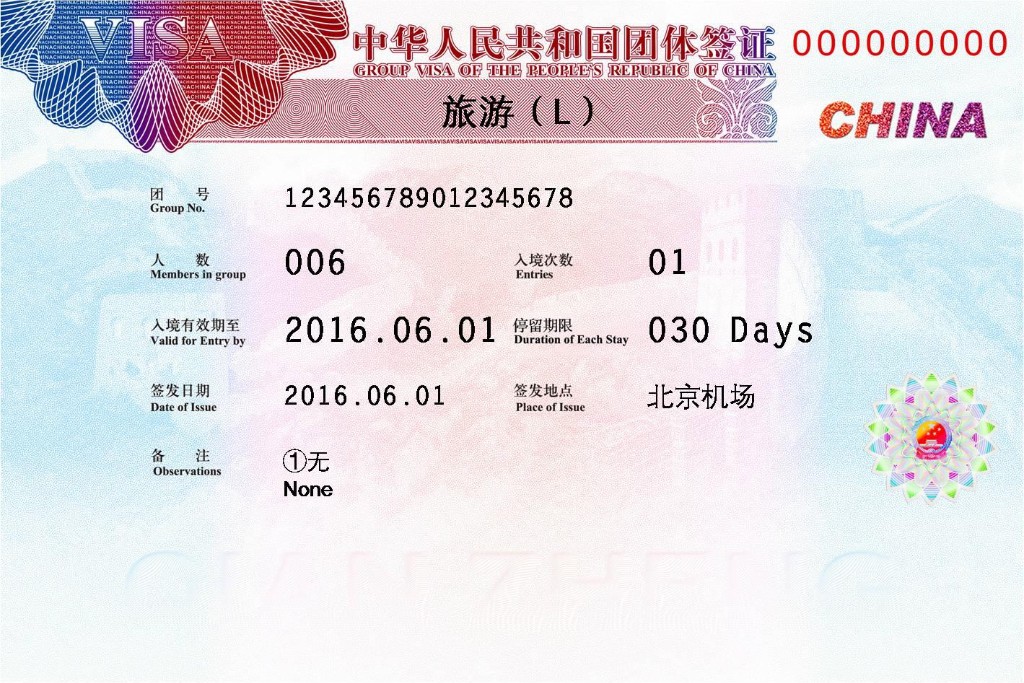
Ⅸ. Sample of Group Visa
I. 24-Hour Visa-Free Transit Policy
All open exit-entry ports in China implement this policy for nationals of all other countries around the world. Foreigners transiting through China to third countries or regions may stay in China for no more than 24 hours without a visa, provided that they hold valid international travel documents and onward international flight/ship/train tickets with confirmed seats, and will not leave the restricted areas of ports. For any foreigner who does need to leave the designated restricted area, a temporary entry permit must be obtained first at the immigration inspection authority of the port concerned.
II. 240-Hour Visa-Free Transit Policy
Currently, China is implementing this policy for nationals of 55 countries including Russia, the United Kingdom and the United States. Nationals of these countries, who need to transit through China to third countries or regions, may enter visa-free through any of the designated 60 open exit-entry ports in 24 provinces, autonomous regions and municipalities directly under the Central Government and stay in the permitted areas for no more than 10 days, provided that they hold valid international travel documents and onward tickets with confirmed seats and departure dates. Foreign nationals covered by this policy may, within the designated areas, engage in activities like travel activities, business activities, visits, family reunions, etc., during their stay periods. Activities such as work, study, or news reporting still require prior approvals and appropriate visas.
(I) List of 55 Countries
Europe (40 countries): Albania, Austria, Belarus, Belgium, Bosnia and Herzegovina, Bulgaria, Croatia, Cyprus, Czech Republic, Denmark, Estonia, Finland, France, Germany, Greece, Hungary, Iceland, Ireland, Italy, Latvia, Lithuania, Luxembourg, Malta, Monaco, Montenegro, the Netherlands, North Macedonia, Norway, Poland, Portugal, Romania, Russia, Serbia, Slovakia, Slovenia, Spain, Sweden, Switzerland, Ukraine, United Kingdom
North America (2 countries): Canada, United States
South America (4 countries): Argentina, Brazil, Chile, Mexico
Oceania (2 countries): Australia, New Zealand
Asia (7 countries): Brunei, Indonesia, Japan, Qatar, Singapore, South Korea, United Arab Emirates
(II) Eligible Ports and Permitted Stay Areas

I. Scope of Application
Applicable to foreigners applying for visa extension, change and reissuance after entry with a regular visa.
II. Legal Basis
Exit and Entry Administration Law of the People's Republic of China, Regulations of the People's Republic of China on Administration of the Entry and Exit of Foreigners.
III. Accepting Authorities
The National Immigration Administration (NIA) entrusts the exit-entry departments of public security organs at or above the prefecture-level cities (including counties and districts under the jurisdiction of municipalities directly under the central government) to accept the foreigners' visa affairs.
The exit-entry departments of public security organs at the county level, upon the request of the exit-entry departments of the provincial level public security organs and the approval of NIA, are authorized and may accept the visa application of foreigners.
IV. Conditions of Application
Foreigners who, after entering China with ordinary visas, need to stay in China for non-diplomatic or unofficial purposes may, in accordance with relevant regulations, apply to exit-entry departments of public security organs for visa extension, change and reissuance. The applicant shall go through the relevant formalities at exit-entry departments of public security organs. In any of the following cases, the inviting entity or relatives of the applicant may apply on behalf of the applicant:
1.The applicant is under the age of 16 or over the age of 60 or it would unduly inconvenience the applicant due to illness or other reasons;
2.The applicant's current entry is not his or her first entry into China and the applicant has good records of stay or residence in China;
3.The inviting entity or individual has guaranteed to cover the necessary expenses of the applicant incurred in China.
V. Application Materials
1. Applications for visa of foreigners may be accepted upon completion of relevant formalities and submission of relevant materials
a. Valid passport or other international travel documents
b. Fill out the Visa/ Stay Permit/ Residence Permit Application Form and submit a photo that complies with the Guide for Entry and Exit Document Photographs
c. Supporting materials related to reasons of application
d. Other formalities to be completed and supporting materials to be submitted
2. Documents required for visa extension
To apply for extension of a stay, a foreigner shall apply to the exit and entry departments of public security organs 7 days prior to the expiration date of the stay specified in the visa, and submit relevant supporting materials as required:
a. Holder of C visa shall submit a letter of certificate issued by the competent departments of the people's government at or above the county level or the local civil aviation, railway, road and port transportation companies. The stay may be extended for no more than 30 days.
b. Holder of F visa shall submit a letter of certificate issued by the inviting and receiving entities. The entities that have not filed for records shall also submit the registration certificate. The stay may be extended for no more than 180 days.
c. Holder of G visa shall submit a letter of certificate issued by the receiving entity and a connecting ticket (flight, bus or ship) to the destination country (region) with confirmed seat and date. The stay may be extended for no more than 30 days.
d. The holder of J2 visa shall submit a letter of certificate issued by the foreign affairs departments of the people's government at the provincial level. The stay may be extended for no more than 30 days.
e. Holder of L visa shall submit a travel plan and itinerary, and for a group tour, also a letter of certificate issued by the travel agency. The stay may be extended for no more 30 days.
f. Holder of M visa shall submit a letter of certificate issued by the local inviting and receiving entities or individuals, and the entities that have not filed the record shall also submit the registration certificate. The inviting individual shall put signature in the letter and submit local household registration or a certificate of the actual residence. The stay may be extended for no more than 180 days.
g. Holder of Q2 visa shall submit an invitation letter provided by the individuals to be visited, the identity certificate, and proof of family relationship. The stay may be extended for no more than 180 days.
h. Holder of R visa shall submit a certificate letter issued by the inviting and receiving entities, and the entities that have not filed for records shall also submit the registration certificate. The stay may be extended for no more than 180 days.
i. For the S2 visa holders, the visiting personnel shall submit an invitation letter provided by the individuals to be visited, a foreigner residence permit and proof of family relationship. Foreigners visiting for other purposes shall submit certificates stating the nature of the private affairs or humanitarian causes. The duration of stay may be extended to no more than 180 days for those visiting relatives, and no more than 90 days for those visiting for other purposes.
j. Holder of X2 visa shall submit a current study certificate issued by an education or training institution within the territory of China. The stay may be extended for no more than 180 days.
Note: The accumulated extension of stay shall not exceed the original duration of stay specified in the visa.
3. Documents required for visa change
Where a foreigner changes purpose of stay, is granted entry conveniences in accordance with relevant provisions of the State, starts using a new passport, or needs to stay separately from his or her tour group after entering China with a group visa due to objective reasons, the applicant may apply for a change of visa by submitting the following documents:
a. To apply for the change to F visa, the applicant shall submit a letter of certificate issued by the inviting entities, and may be issued the zero-entry, single-entry, double-entry or multiple-entry visa with a valid period upon entry no more than one year and a stay no more than 180 days.
b. To apply for the change to J2 visa, a letter of certificate issued by the foreign affairs department of the people's government at the provincial level shall be submitted. A zero-entry visa with a stay of no more than 30 days can be issued.
c. To apply for the change to M visa, the applicant shall submit a letter of certificate issued by the inviting entities, and may be issued the zero-entry, single-entry, double-entry or multiple-entry visa with a validity period of entry no more than one year and a stay not exceeding 180 days.
d. To apply for the change to Q2 visa, the applicant shall submit an inviting letter provided by the individual to be visited, identity certificates and proof of family relationship. And the zero-entry, single-entry, double-entry or multiple-entry visas with a validity period of entry no more than one year and a stay no more than 180 days may be issued.
e. To apply for the change to R visa, the applicant shall meet the qualifications and requirements set by the competent authorities of the Chinese government for inviting high-level foreign talents or urgently needed specialists, and submit relevant certificates and supporting materials in accordance with the provisions, as well as certification letter issued by the inviting and receiving entities. And the zero-entry, single-entry, double-entry or multiple-entry visas with a validity period of entry no more than five years and a stay no more than 180 days may be issued.
f. To apply for the change to S2 visa, the visiting individual shall submit an inviting letter provided by the person to be visited, foreigner's residence permit and proof of family relationship. Foreigners visiting for other purposes shall submit relevant supporting materials stating the nature of the humanitarian causes. And the zero-entry or single-entry visas with a validity period of entry no more than three months and a stay no more than 180 days may be issued.
g. To apply for the change to X2 visa, the applicant shall submit an official letter and a certificate of admission and enrollment issued by an education or training institution within Chinese territory, and may be issued a zero-entry, single-entry or double-entry visa with a validity period of no more than one year and a stay of no more than 180 days.
h. A foreigner who starts using a new passport because the original one is about to expire or is running out of visa pages may apply for a change of visa by submitting the original passport for the latest entry or relevant certificates issued by the embassy or consulate of the applicant's country in China specifying that the original passport has been withdrawn. A visa that is consistent with the original visas in type, validity period of entry, duration of stay and the remaining valid entry times may be issued. The entry times of the new visa will be decided in accordance with the remaining valid entry times of the original visa.
i. Foreigners who need to stay separately from the tour group after entering China with a group visa shall submit a letter of certificate issued by the hosting travel agency. The visa may be changed in accordance with the provisions in the preceding paragraph.
The accumulated stay period of the changed visas shall not exceed one year since the date of current entry.
4. Documents required for visa reissuance
Where a foreigner needs to apply for reissuance of visa because the original visa is lost, damaged, destroyed, stolen or robbed after entering China, the applicant shall submit the following supporting materials:
a. If the visa is lost, stolen or robbed, the applicant shall submit the certificate of reporting the loss of passport or the official note issued by the embassy or consulates of the applicant's country in China, and the new valid passport or other international travel documents.
b. If the visa is damaged, the applicant shall submit the damaged passport or the official note issued by the embassy or consulates of the applicant's country in China, and the new valid passport or other international travel documents.
c. If the group visa is lost, stolen, robbed or damaged, the applicant shall submit a certification letter issued by the hosting travel agency and a copy of the original group visa.
The applicant may be reissued a visa that is consistent in type, validity entry period, duration of stay and the remaining valid entry times with the original one.
VI. Facilitation Measures
1. Visa facilitation measures regarding the Belt and Road Initiative (BRI)
If foreign seafarers carrying out BRI maritime transport tasks need to leave the port city and change means of transport for exit, the time limit of issuance shall be shortened from 7 working days to 3 working days, and for emergency exits of the seafarers, visa may also be issued on the same day of acceptance.
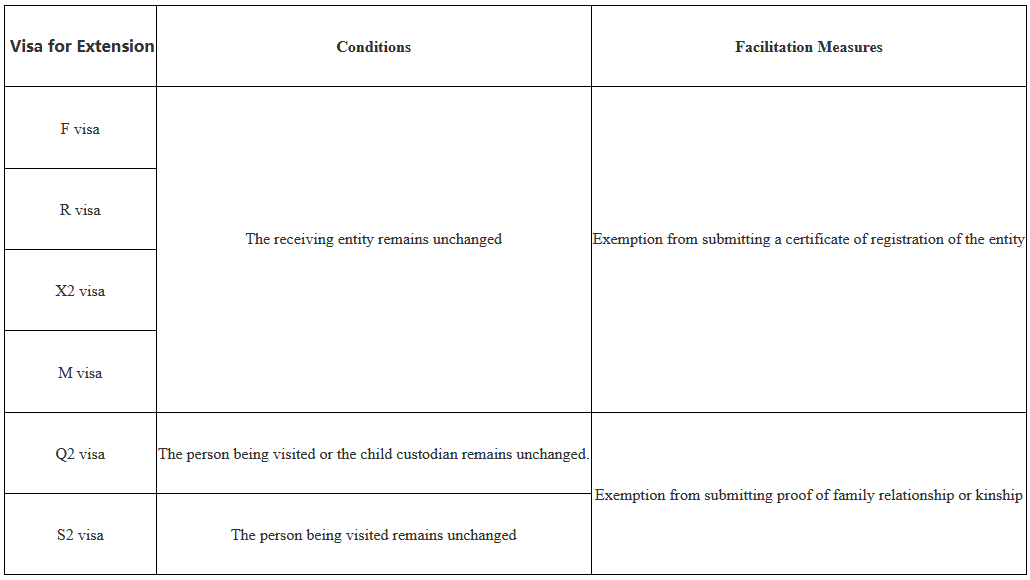
2. Simplified formalities for visa extension
3. Expedited conveniences for foreigners in urgent needs
The exit and entry departments of public security organs shall provide convenience to the immediate acceptance and approval of visas for foreign nationals in the following three cases:
- For foreign nationals who have lost their passports and are in urgent need of reapplying for visas for departure, their application shall be accepted and examined in a timely manner by submitting the tickets (air, bus or ship) with confirmed seats and date as well as an explanation letter provided by the inviting entities;
- Foreign seamen and their accompanying family members who urgently need to apply for stay permits to leave the port cities for outbound flights shall be accepted for examination and approval in a timely manner by submitting the guarantee letter issued by the shipping agency and the tickets (air, ship or bus) with confirmed seats and date;
- Foreign tour group members who urgently need to apply for group visa separation to leave the country shall be accepted for examination in a timely manner by submitting the letter of explanation provided by the receiving travel agency and the tickets (air, bus or ship) with confirmed seats the date.
4. Visa and residence facilitation for Chinese of foreign nationality
For Chinese of foreign nationality who come to China to visit their relatives, for business talks, carry out exchanges in science, education, culture and health, or handle personal affairs, the exit and entry departments of public security organs may issue multiple-entry visas valid for five years. Residence permits valid for 5 years may be issued to Chinese of foreign nationality who need to stay for a long term to work, study, visit relatives or engage in private affairs in a local area.
5. High-level foreign talents
a. The foreign experts and scholars invited by key domestic institutions of higher learning, scientific research institutes and well-known enterprises, as well as the high-level foreign management talents and technical specialists identified by the competent talents authorities as well as the competent authorities for technology and innovation of the people's governments of the cities with subordinate districts or above, may apply for port visas for entry. After entering China, they may apply for multiple-entry visas or residence permits for private affairs with a validity period of no more than five years by presenting certificates and letters from the inviting entities. Those who are employed by enterprises or entities may apply for work-type residence permits with a validity period of no more than five years according to the regulations.
b. Foreign talents and members of innovation groups introduced to key sectors and industries in China may apply for work-type residence permits valid for no more than five years by presenting their work permits and certificate letters from their employers. A team member of innovation or entrepreneurship groups may apply for a residence permit for private matters valid for no more than five years (marked with "entrepreneurship") with a letter of guarantee from the leader of the team.
c. Foreigners with outstanding contributions and fit the special needs of China's development can recommend foreign members of their working team and research supporting personnel to apply for long-term visas or residence permits valid for no more than five years.
d. High-level foreign talents working in key domestic institutions of higher learning, scientific research institutes, and renowned enterprises are allowed to engage in part-time innovation and entrepreneurship after being approved by both the entities where they work full time and part time and filing for records to exit-entry departments.
6. International students
a. Outstanding foreign students who have obtained a bachelor's degree or above from a key Chinese institution of higher learning and engage in innovation and entrepreneurship in China after graduation can apply for a residence permit for private affairs valid for two to five years (marked with "entrepreneurship") by presenting their university graduation certificate and certificates for innovation and entrepreneurship. Those who are employed by enterprises and other entities may apply for a work-type residence permit in accordance with relevant regulations.
b. Foreign students who have graduated from internationally renowned universities and come to China for innovation and entrepreneurship within two years after graduation can apply for residence permit for private affairs valid for no more than two years (marked with "entrepreneurship") with the academic (degree) certificates. Those who are employed by enterprises and other entities may apply for a work-type residence permit in accordance with relevant regulations.
c. Foreign students from overseas institutions of higher learning who are invited to take internship in China by well-known Chinese enterprises and public institutions can apply for a visa for private affairs valid for one year (noting "internship") with a letter issued by the inviting entity and a study certificate issued by their institutions of higher learning. Foreign students from overseas institutions of higher learning who come to China for internship in accordance with intergovernmental agreements may apply for work-type residence permits in accordance with relevant regulations.
7. Employment of foreigners
If a foreigner has obtained a work permit but does not have enough time to go abroad to apply for a work-type visa, the applicant may directly apply for a work-type residence permit in China with relevant work permits. If the foreigner has applied for a work-type residence permit valid for more than one year twice consecutively, the applicant may apply for a work-type residence permit valid for five years at his or her third application in accordance with relevant regulations.
VII. Basic Process and Method of Handling
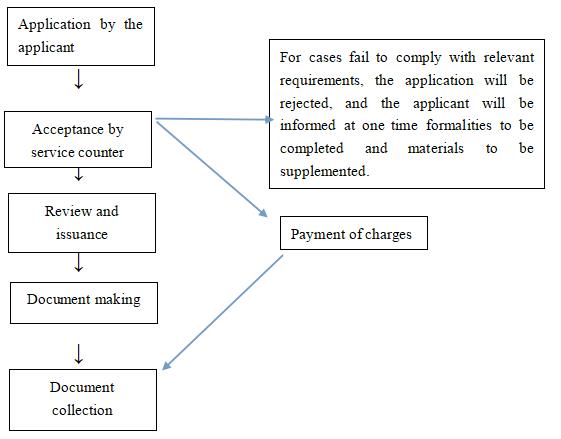
1. Application. Foreigners who apply for extension, change or reissuance of visa, shall go to exit-entry departments of public security organs in person to go through relevant formalities. For cases complying with relevant provisions, the inviting entities or individual, families or relatives of the applicant or specialized service agencies may file the application on behalf of the applicant.
2. Acceptance. The accepting authority decides whether to accept or not after examining the application. The applying matters shall fall within the functions and powers of the administrative authority. If the application materials are complete and meet the requirements, the application shall be accepted on the spot and a receipt of acceptance shall be issued. If the formalities or materials required for the application for a visa are incomplete, the applicant shall be notified regarding the formalities to be completed and the materials to be supplemented at one time.
3. Review and verification. The exit- and entry departments of public security organs shall strengthen verification. The authenticity of the application shall be confirmed through means of interviews, telephone inquiries, field investigations and others. Verification shall also be taken to confirm whether the applicant is of foreign nationality. If an applicant or relevant entity, individual is notified to take an interview but fails to do that at the agreed time without justifiable reasons, the application may be denied by law.
4. Decision-making. If the conditions and standards are met, the authority in charge shall make the decision on granting administrative permits and issue visas of corresponding categories.
VIII. Time Limit for Issuance
Upon examination and verification, if the foreigner's application complies with the conditions of acceptance, the application shall be accepted, and an acceptance receipt shall be provided. The decision on whether or not to issue a visa shall be made within the validity period of the acceptance receipt. The validity period of the acceptance receipt for visa application shall be no more than seven working days from the date of acceptance.
IX. Charging Basis and Standards
1. Charging Basis
Reply of the State Development Planning Commission and the Ministry of Finance on Approving the Adjustment to the Visa Charging Standards of Public Security Organs of the Mainland (Ji Jia Ge [2003] No. 392).
2. Charging Standards
Based on the Notice of Public Security Organs to Adjust Charging Standards to Foreigners' Visas (Gong Ming Fa [2011] No. 470)
Zero-entry Visa (of non-reciprocal countries): CNY 160 per person
Single-entry Visa (of non-reciprocal countries): CNY168 per person
Double-entry Visa (of non-reciprocal countries): CNY 252 per person
Multiple-entry Visa valid for no more than half a year (of non-reciprocal countries): CNY 420 per person
Multiple-entry Visa valid for no more than one year (of non-reciprocal countries): CNY 672 per person
Adding or reducing accompanying persons (non-reciprocal countries): CNY 160 per person
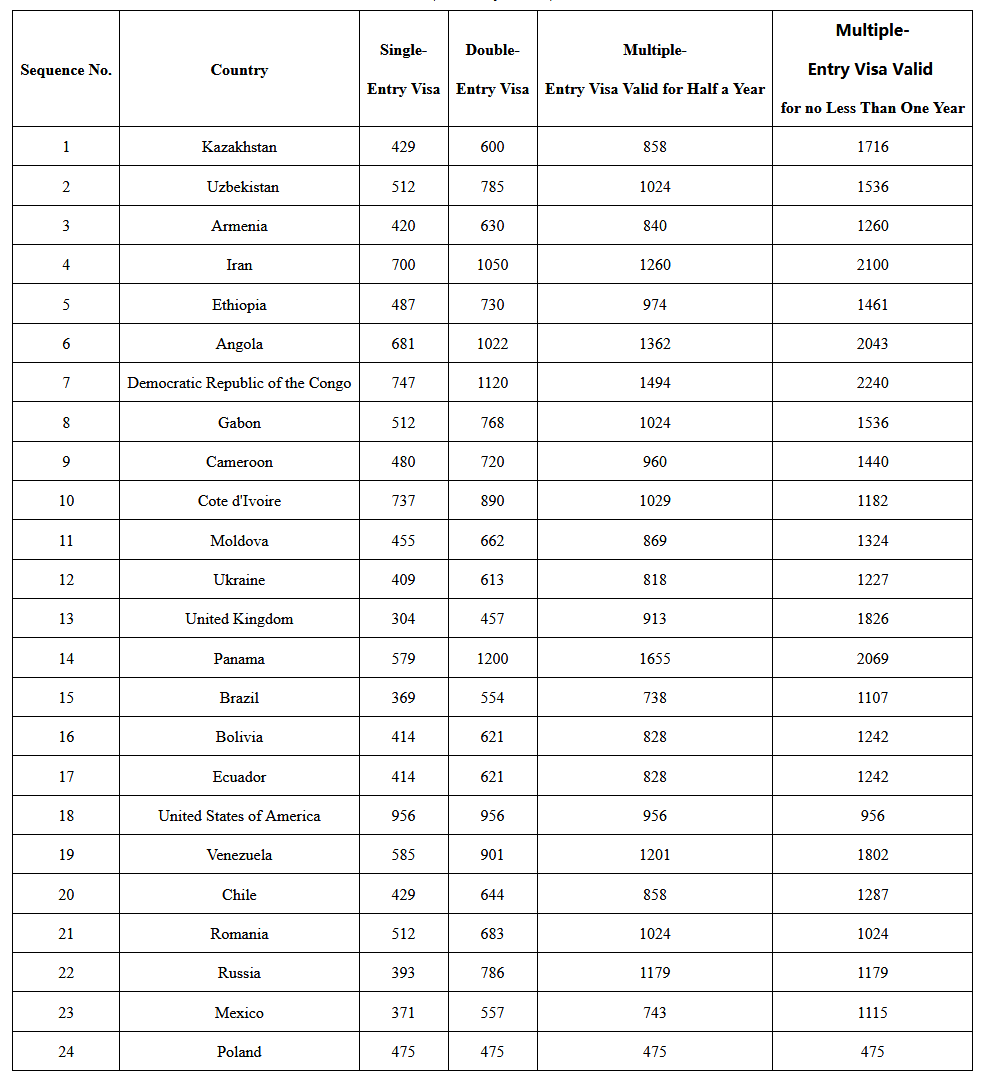
For reciprocal countries, the fees shall be charged in accordance with standards stipulated by the Ministry of Foreign Affairs.
Standards of Visa Fees by Reciprocal Countries
(Currency: CNY)
X. Results Delivery
Issued Visas for foreigners after approval, shall be claimed by the applicants in person at relevant exit-entry departments of public security organs with the acceptance receipts.
XI. Circumstances in Which Visas Shall not be Issued
According to Article 21 of the Exit and Entry Administration Law of the People's Republic of China, foreigners who fall under any of the following circumstances shall not be granted visas:
1. Those who were deported, or were repatriated upon decision, and the No-Entry-into-China period has not expired;
2. Those who are suffering from serious mental disorder, infectious tuberculosis, or any other infectious disease that may result in great harm to public health;
3. Those that may endanger China's national security and interests, disrupt public order or engage in other illegal or criminal activities;
4. Those who resort to deceit in the visa application process or fail to guarantee the expenses needed during their stay in China;
5. Those failing to submit relevant materials required by the visa authorities;
6. Other circumstances in which the visa authorities consider a visa should not be issued.
In the case of rejecting to issue a visa, the visa authority may not explain reasons.
According to Article 31 of the Exit and Entry Administration Law of the People's Republic of China, foreigners who fall under any of the following circumstances shall not be granted residence permits:
1. The visa held does not belong to the type for which a foreigner’s residence permit should be issued;
2. Those who resort to deceit in the application process;
3. Those who fail to provide relevant supporting materials as required;
4. Those who are not eligible for residence in China due to violation of relevant Chinese laws and administrative regulations;
5. Other circumstances in which the issuing authorities consider a foreigner's residence permit should not be issued.
Specialized talents and investors who meet the requirements of the State or other foreigners who need to change their stay to residence for humanitarian and other reasons, may apply for foreigners' residence permits upon the approval of the exit-entry departments of public security organs of the local people's governments of cities divided into districts at or above the prefectural level.
According to Article 36 of the Exit and Entry Administration Law of the People's Republic of China, the decision made by the exit-entry departments of the public security organs on not granting extension, change, or reissuance of the foreigners' visa, or on rejecting issuing foreigners’ stay or residence permits, extending their duration of residence shall be final.
XII. Rights and Obligations of the Administrative Counterpart
1. In accordance with relevant laws and regulations, an applicant shall be entitled to the following rights:
a. Those who meet the legal conditions and criteria are entitled to equal rights to obtain an administrative license in accordance with law;
b. They shall have the right to make statements and defend against implementation of the administrative license by an administrative authority;
c. Other rights stipulated by laws and regulations.
2. In accordance with relevant laws and regulations, an applicant shall perform the following obligations:
a. Applicants shall submit relevant materials and reflect the reality truthfully to the administrative authority, and shall be held responsible for authenticity of substantive content of the application materials;
b. Applicant shall cooperate with administrative authorities to verify the authenticity of the application materials through interviews, telephone inquiries, field investigations, etc.;
c. Other obligations stipulated by laws and regulations.
XIII. Other Matters for Attention
1. Definition of family members: spouse, parents, spouse's parents, children, siblings, paternal grandparents, maternal grandparents, paternal grandchildren, maternal grandchildren, and children's spouses.
2. Proof of family relationship and kinship shall include marriage certificate, birth certificate, adoption certificate and other kinship certificate issued by competent authorities of relevant countries and related notary public authentication; or the marriage certificate, birth certificate, kinship certificate and certification on the change of name or other personal information issued by the embassy or consulates of the applicant's country in China.
3. Marriage certificates, birth certificates, kinship certificates, or certifications on the change of name or other personal information issued by the competent authorities or notary authorities of a foreign country shall be authenticated by the Chinese embassy or consulate in that country.
4. Identity certificates. Identity certificates of Chinese mainland residents refer to household register certificates or certificate of residence that prove the actual places of residence for over 6 months as well as resident ID cards. Overseas Chinese identity certificates refer to Chinese passports and certificates of overseas residence. Identity certificates of Hong Kong and Macao residents refer to the Mainland Travel Permit for Hong Kong and Macao Residents. Taiwan resident identity certificates refer to the Mainland Travel Permit for Taiwan Residents. Foreigner identity certificates refer to the Foreigner's Permanent Residence Card. Overseas Chinese as well as Hong Kong, Macao and Taiwan residents shall also submit the certificate of residence that prove the actual places of residence for over 6 months.
5. Relevant supporting materials in foreign languages shall be translated into Chinese.
XIV. Flow Chart for Visa Extension, Change and Reissuance for Foreigners
Notice: The English version is only for reference. To learn more, please refer to the authoritative Chinese version.
The major regional visa-free entry policies for foreign nationals in China are as follows.
I. 144-Hour Visa-Free Entry Policy for Foreign Tourist Groups Traveling from Hong Kong and Macao Special Administrative Regions (SARs) to Guangdong Province. Citizens holding ordinary passports from countries with diplomatic relations with China may enter nine mainland cities in the Guangdong-Hong Kong-Macao Greater Bay Area, along with Shantou, without a visa, provided that they will enter Hong Kong or Macao SAR first and then enter Guangdong Province as part of their tourist groups organized by the travel agencies registered in any of the two SARs. The permitted stay areas for these tourists include Dongguan, Foshan, Guangzhou, Huizhou, Jiangmen, Shantou, Shenzhen, Zhaoqing, Zhongshan and Zhuhai. The tourists concerned shall enter and exit the Chinese mainland with their tourist groups via the exit-entry ports in these ten cities, and can stay for a maximum of 144 hours.
II. Visa-Free Entry Policy for Tourist Groups Entering Guilin, Guangxi Zhuang Autonomous Region from ASEAN Member States. Any tourist group consisting of two or more persons from any of the member states (i.e. Brunei, Cambodia, Indonesia, Laos, Malaysia, Myanmar, the Philippines, Singapore, Thailand, and Vietnam) of the Association of Southeast Asian Nations (ASEAN) may enter and exit China through the airport in Guilin without a visa, provided that the tourist group is organized and received by a local travel agency in China and all the members of the tourist group hold ordinary passports. The tourists concerned shall enter and leave China with their tour groups, and can stay within the administrative region of Guilin, Guangxi Zhuang Autonomous Region for a maximum of 144 hours.
III. Visa-Free Entry Policy for Foreign Tourist Groups Traveling by Cruise Ships. Any foreign tourist group consisting of two or more individuals, which is organized and received by a Chinese travel agency, may enter China without a visa by a cruise ship via one of the cruise ports in the following 13 cities: Beihai (Guangxi Zhuang Autonomous Region), Dalian (Liaoning Province), Guangzhou (Guangdong Province), Haikou (Hainan Province), Lianyungang (Jiangsu Province), Qingdao (Shandong Province), Sanya (Hainan Province), Shanghai, Shenzhen (Guangdong Province), Tianjin, Wenzhou (Zhejiang Province), Xiamen (Fujian Province) and Zhoushan (Zhejiang Province). Foreign tourist groups shall continue their journey to the next scheduled ports and depart China with the same cruise ship as scheduled. The tourists concerned are permitted to travel within Beijing and 11 coastal provinces, autonomous regions, and municipalities directly under the Central Government, namely Fujian, Guangdong, Guangxi, Hainan, Hebei, Jiangsu, Liaoning, Shandong, Shanghai, Tianjin, and Zhejiang. Additionally, tourists covered by this policy may stay in China for a maximum of 15 days.
IV. 30-Day Visa-Free Entry Policy for Hainan Province for Foreign Citizens of 59 Countries. Citizens holding ordinary passports from 59 countries may enter and stay within the administrative region of Hainan Province for a maximum of 30 days without a visa for short-term stays for tourism, business, visits, family visits, medical treatment, conferences and exhibitions, sports competitions, etc. The policy does not apply to those who intend to enter for working or studying. The exit-entry ports for the foreign nationals concerned include all the open ports in Hainan. The 59 countries are Albania, Argentina, Australia, Austria, Belgium, Belarus, Bosnia and Herzegovina, Brazil, Brunei, Bulgaria, Canada, Chile, Croatia, Cyprus, Czech Republic, Denmark, Estonia, Finland, France, Germany, Greece, Hungary, Iceland, Indonesia, Ireland, Italy, Japan, Kazakhstan, Latvia, Lithuania, Luxembourg, Malaysia, Malta, Mexico, Monaco, Montenegro, the Netherlands, New Zealand, North Macedonia, Norway, the Philippines, Poland, Portugal, Qatar, the Republic of Korea, Romania, Russia, Serbia, Singapore, Slovakia, Slovenia, Spain, Sweden, Switzerland, Thailand, Ukraine, the United Arab Emirates, the United Kingdom and the United States.
V. 144-Hour Visa-Free Entry Policy for Foreign Tourist Groups Entering Hainan Province from Hong Kong and Macao SARs. Citizens holding ordinary passports from countries with diplomatic relations with China can enter Hainan Province from Hong Kong or Macao SAR and stay for no more than 144 hours within the administrative region of the province for tourism purposes in a tourist group without a visa, provided that the tourist group consist of at least two persons and is organized by a travel agency legally registered in Hong Kong or Macao SAR. The foreign nationals covered by this policy must enter and exit with their tourist groups, while the exit-entry ports for them include all the open ports in Hainan.
The stay period specified in any of the aforementioned policies begins at 0:00 on the day after the day of entry. For the individuals who meet the requirements specified in the bilateral visa exemption agreements with China and those covered by the unilateral visa exemption policies of China, the relevant regulations shall prevail.

The National Immigration Administration (NIA) announced today that it will fully relax and optimize the visa-free transit policy, which is effective immediately. The stay duration for foreign nationals eligible for visa-free transit has been extended from the previous 72 hours and 144 hours to 240 hours (10 days). Additionally, 21 ports of entry and exit have been added for visa-free transit individuals, further expanding the allowed areas for visa-free transit travelers. Individuals from 54 eligible countries, including Russia, Brazil, the United Kingdom, the United States of America, and Canada, traveling from China to a third country (region), can enter visa-free through any of the 60 open ports in 24 provinces (autonomous regions and municipalities), and stay within the allowed areas for visa-free transit travelers for no more than 240 hours.
The 21 newly added ports for the visa-free transit policy are Taiyuan Wusu International Airport in Shanxi Province, Su'nan Shuofang International Airport and Yangzhou Taizhou International Airport in Jiangsu Province, Wenzhou Longwan International Airport and Yiwu Airport in Zhejiang Province, Hefei Xinqiao International Airport and Huangshan Tunxi International Airport in Anhui Province, Fuzhou Changle International Airport, Quanzhou Jinjiang International Airport, and Wuyishan Airport in Fujian Province, Nanchang Changbei International Airport in Jiangxi Province, Jinan Yaoqiang International Airport, Yantai Penglai International Airport, and Weihai Dashuipo International Airport in Shandong Province, Zhangjiajie Hehua International Airport in Hunan Province, Nanning Wuxu International Airport and Beihai Fucheng Airport in Guangxi Zhuang Autonomous Region, Haikou Meilan International Airport and Sanya Phoenix International Airport in Hainan Province, Chengdu Tianfu International Airport in Sichuan Province, and Guiyang Longdongbao International Airport in Guizhou Province. The number of opened ports has increased from the original 39 to 60.
The fully relaxed and optimized 240-hour visa-free transit policy has further expanded the allowed areas for visa-free transit travelers. The number of provinces (autonomous regions and municipalities) that can be visited under this policy has increased from the original 19 (Beijing Municipality, Tianjin Municipality, Hebei Province, Liaoning Province, Heilongjiang Province, Shanghai Municipality, Jiangsu Province, Zhejiang Province, Fujian Province, Shandong Province, Henan Province, Hubei Province, Hunan Province, Guangdong Province, Guangxi Zhuang Autonomous Region, Chongqing Municipality, Sichuan Province, Yunnan Province, and Shaanxi Province) to 24 (with Shanxi Province, Anhui Province, Jiangxi Province, Hainan Province, and Guizhou Province added to the list). In the newly added five provinces, the allowed areas for visa-free transit travelers in Anhui Province, Hainan Province, and Guizhou Province include the entire province. In Shanxi Province, the areas are limited to Taiyuan and Datong, and in Jiangxi Province, the areas cover Nanchang and Jingdezhen. The areas in Fujian Province, Hubei Province, and Shaanxi Province are expanded to the entire respective provinces, and in Guangxi Zhuang Autonomous Region, the area expands to the administrative regions of Nanning, Liuzhou, Guilin, Wuzhou, Beihai, Fangchenggang, Qinzhou, Guigang, Yulin, Hezhou, Hechi, and Laibin. Foreign nationals entering China through the visa-free transit policy can make cross-province travels within the allowed areas for visa-free transit travelers in these 24 provinces (autonomous regions and municipalities).
According to an NIA official, the recent relaxation and optimization of the visa-free transit policy is a significant step taken by NIA in line with its commitment to thoroughly learning and implementing the instructions from the Central Economic Work Conference, aiming to proactively serve and promote a high-standard opening up while facilitating the exchanges between Chinese and foreign nationals. This initiative is beneficial for accelerating cross-border flows of people, promoting international communication and cooperation, and injecting new momentum into the high-quality development of the economy and society. Going forward, the NIA will continue to deepen the institutional openness of immigration management, continually optimize and improve the policies facilitating entry and exit for immigrants, and enhance the convenience for foreign nationals to study, work, and live in China. NIA invites more foreign friends to come to China and experience the beauty of the country in this new era firsthand.

I. Q: Mutual visa exemption agreements signed between China and other countries state that those eligible for visa exemption may "stay in China for no more than 90 days within any 180-day period". How should this provision be understood and how are the periods calculated?
A: The provision "No more than 90 days within any 180-day period" means that the total number of days a foreign national stays in China must not exceed 90 within 180 days prior to any date. The 90-day period does not include the days spent in China under visa, residence permit and other visa documents or APEC Business Travel Card. The visa-free entry will not be granted to any foreigner whose cumulative duration of visa-free stay has reached 90 days within a 180-day period. In the case where a foreigner's cumulative duration of stay has not reached 90 days while the remaining period is less than 30 days, the visa-free stay period for the foreigner concerned for this entry shall not exceed the remaining visa-free stay period.
II. Q: If a foreign national has successfully entered China under a mutual visa exemption agreement but subsequently lost his/her passport verified and stamped by a border inspection authority, can he/she leave China with an emergency travel document issued by the embassy of his/her home country in China?
A: The types of documents accepted are specified in the mutual visa exemption agreements between China and other relevant countries, which in most cases, are passports. Some of these agreements also permit the use of temporary travel documents and other international travel documents. If a foreign national has lost his/her international travel document required by the corresponding mutual visa exemption agreement after entering China without a visa, he/she can leave the country with a re-issued document, provided that the document is one of those specified in the agreement and that he/she has not overstayed the visa-free stay period. However, if the visa-free stay period has expired or the new travel document is not covered by the agreement, the foreign national concerned will have to obtain a stay permit from the exit/entry administration of a public security organ, and then leave China within the period specified in the permit.
III. Q: After a foreign national has entered China under a mutual visa exemption agreement, what should he/she do if he/she needs to extend his/her stay in China beyond the visa-free stay period?
A: Any foreign national having entered China under a mutual visa exemption agreement must leave the country before his/her visa-free stay period expires. Those seeking to extend their stay in China due to emergencies or force majeure of other kinds must apply at the exit/entry administrations of public security organs before their visa-free stay periods expire.
IV. Q: For a foreign national who has entered China under a mutual visa exemption agreement, does he/she need to register his/her accommodation?
A: Article 39 of the Exit and Entry Administration Law of the People's Republic of China stipulates that, for any foreigner staying in a hotel in China, the hotel concerned shall register his/her accommodation in accordance with the regulations on the public security administration of the hotel industry, and submit the foreigner's accommodation registration information to the public security organ in the place where the hotel is located. For any foreigner who resides or stays in a domicile that is not a hotel, he/she or the person who accommodates him/her shall, within 24 hours after the foreigner's arrival, complete the registration at the public security organ in the place of residence. According to the aforementioned regulations, foreign nationals who have entered China under mutual visa exemption agreements still need to register their accommodation.
The ARRIVAL CARD, which must be completed to enter China, provides clear information regarding accommodation registration in the "Important Notes" section in both Chinese and English. Foreign nationals shall complete accommodation registration in accordance with the information on the card and the relevant laws. The immigration management authorities and public security organs in China have streamlined the registration process, and are working to further simplify the registration and declaration procedures by utilizing the Internet and other related technologies for foreign nationals visiting China and those intending to stay in the country.
The National Immigration Administration (NIA) announced that, starting June 12, 2025, nationals of Indonesia may enter China under the 240-hour visa-free transit policy. This brings the total number of eligible countries to 55.
Citizens of 55 countries, including Indonesia, Russia, and the United Kingdom, may transit through China using 240-hour vise-free transit policy if they hold valid international travel documents and interline tickets with confirmed dates and seats to a third country or region. They may enter China through any of the 60 open ports across 24 provinces (autonomous regions and municipalities directly under the central government),such as Beijing and Shanghai, and stay in designated areas for up to 10 days. During this period, visa-free transit travelers may engage in tourism, business, exchange visits, or family visits. Activities such as work, study, or news reporting still require prior approval and appropriate visas.
According to the NIA, adding Indonesia to the list of countries eligible for the 240-hour visa-free transit policy is a significant measure to implement the principles established in the central conference on work related to neighboring countries and China's commitment to deepening regional cooperation with ASEAN countries. This measure will further strengthen bilateral ties, facilitate trade and investment, and promote cultural exchange and mutual understanding between China and Indonesia. Moving forward, the NIA will continue to deepen the institutional openness of immigration management, continually improve the policies facilitating entry and exit for immigrants, and enhance the convenience for foreign nationals to study, work, and live in China. With improved management and service measures, the NIA invites more international friends to come to China.

1. Exit-Entry Reception Hall, Changsha Public Security Bureau, Hunan Province [湖南省长沙市公安局出入境接待大厅]
Address: No.30 Jindun Road, Yuhua District, Changsha, Hunan [湖南省长沙市雨花区金盾路30号]
2. Hexi Government Service Center, Changsha, Hunan Province [湖南省长沙市政务服务中心]
Address: No.20 Jinxing North Road 1st Section, Yuelu District, Changsha, Hunan [湖南省长沙市岳麓区金星北路一段20号]
3. Exit-Entry Reception Hall, Public Security Bureau of Furong District, Changsha, Hunan Province [湖南省长沙市芙蓉区公安局出入境接待大厅]
Address: No.369 Wanbao Avenue, Furong District, Changsha, Hunan [湖南省长沙市芙蓉区晚报大道369号]
4. Exit-Entry Reception Hall, Public Security Bureau of Tianxin District, Changsha, Hunan Province [湖南省长沙市天心区公安局出入境接待大厅]
Address: No.35 Liujiachong North Road, Tianxin District, Changsha, Hunan [湖南省长沙市天心区刘家冲北路35号]
5. Exit-Entry Reception Hall (Xianfeng Police Station), Furong District Branch, Changsha Public Security Bureau, Hunan Province [湖南省长沙市公安局天心区分局出入境接待大厅(先锋派出所受理点)]
Address: Next to Xingwei building material market, Xindian Road, Tianxin District, Changsha, Hunan [湖南省长沙市天心区新电路兴威建材市场旁]
6. Exit-Entry Reception Hall, Liuyang Public Security Bureau, Hunan Province [湖南省浏阳市公安局出入境接待大厅]
Address: Area D, Second floor, Citizen Home, No.8 Baisha East Road, Liuyang, Hunan[湖南省浏阳市白沙东路8号市民之家二楼D区]
7.Exit-Entry Reception Hall, Zhuzhou Public Security Bureau, Hunan Province [湖南省株洲市公安局出入境接待大厅]
Address: First Floor of Citizen Service Center, No.399 Shennong Avenue, Tianyuan District, Zhuzhou, Hunan [湖南省株洲市天元区神农大道399号株洲市民中心一楼公安专区]
8. Exit-Entry Reception Hall, Xiangtan Public Security Bureau, Hunan Province [湖南省湘潭市公安局出入境接待大厅]
Address: No.168 Ji'an Road, Yuetang District, Xiangtan, Hunan [湖南省湘潭市岳塘区吉安路168号]
9. Exit-Entry Reception Hall, Shaoyang Public Security Bureau, Hunan Province [湖南省邵阳市公安局出入境接待大厅]
Address: No.1 Longshan Road, Beita District, Shaoyang, Hunan [湖南省邵阳市北塔区龙山路1号]
10. Exit-Entry Reception Hall, Hengyang Public Security Bureau, Hunan Province [湖南省衡阳市公安局出入境接待大厅]
Address: No.28 Zhengshui Avenue, Zhengxiang District, Hengyang, Hunan [湖南省衡阳市蒸湘区华兴街道蒸水大道28号]
11. Exit-Entry Reception Hall, Yueyang Public Security Bureau, Hunan Province [湖南省岳阳市公安局出入境接待大厅]
Address: No.188 Xueyuan Road, Yueyanglou District, Yueyang, Hunan [湖南省岳阳市岳阳楼区学院路188号]
12. Exit-Entry Reception Hall, Changde Public Security Bureau, Hunan Province [湖南省常德市公安局出入境接待大厅]
Address: Citizen Home, Langzhou Road, Changde, Hunan [湖南省常德市朗州路市民之家]
13. Population & Exit-Entry Reception Hall, Zhangjiajie Public Security Bureau, Hunan Province [湖南省张家界市公安局出入境接待大厅]
Address: Sixth Floor, Zhangjiajie Citizen Service Center, No.618 Yongding Avenue, Yongding District, Zhangjiajie, Hunan [湖南省张家界市永定区永定大道618号市政务服务中心六楼]
14. Exit-Entry Reception Hall, Yiyang Public Security Bureau Heshan Branch, Hunan Province [湖南省益阳市公安局赫山分局出入境接待大厅 ]
Address: First Floor of Fuze Building, No.188 Yiyang Avenue, Heshan District, Yiyang, Hunan [湖南省益阳市赫山区益阳大道188号福泽大厦一楼]
15. Exit-Entry Reception Hall, Chenzhou Public Security Bureau, Hunan Province [湖南省郴州市公安局出入境接待大厅]
Address: Second Floor of Office Building of Chenzhou Public Security Bureau, No.318 Qingnian Avenue, Chenzhou, Hunan [湖南省郴州市青年大道318号郴州市公安局办公大楼二楼]
16 Exit-Entry Reception Hall, Yongzhou Public Security Bureau, Lengshuitan District, Yongzhou, Hunan Province [湖南省永州市公安局出入境接待大厅]
Address: Yongzhou Citizen Service Center, Intersection of Yongzhou Avenue and Yingbin Road, Yongzhou, Hunan [湖南省永州市冷水滩区永州大道与迎宾路交叉口(永州市市民服务中心)]
17. Exit-Entry Reception Hall, Huaihua Public Security Bureau, Hunan Province [湖南省怀化市市民服务中心]
Address: Fifth Floor, Building C, Yongzhou Citizen Service Center, No.2 Fuqian Road, Hecheng District, Huaihua, Hunan [湖南省怀化市鹤城区府前路2号(怀化市民服务中心C栋5楼)]
18. Exit-Entry Window, Loudi Government Service Center, Hunan Province [湖南省娄底市公安局出入境接待大厅]
Address: Shuangke Street, Louxing District, Loudi, Hunan [湖南省娄底市娄星区双科街]
19. Exit-Entry Reception Hall, Public Security Bureau of Xiangxi Tujia and Miao Autonomous Prefecture, Hunan Province [湖南省湘西土家族苗族自治州公安局出入境接待大厅]
Address: Third Floor, Xiangxi Citizen Service Center, No.9 Wulingshan Avenue, Xiangxi Economic Development Zone, Hunan [湖南省湘西土家族苗族自治州武陵山大道9号州政务服务中心三楼]
Updated on July 8, 2024
In order to further facilitate foreign business people coming to Hunan for business activities, the following special visa facilitation measures will be taken for eligible foreign business people.
I. Who can benefit
The foreign business people in this Notice primarily refer to "foreign nationals who need to frequently come to China for business activities and have made positive contributions to Hunan's international business and trade cooperation, as well as their spouses and children". Inviting organizations include state-owned, private and foreign-invested enterprises registered within the administrative region of Hunan Province (hereafter referred to as the inviting organizations).
II. What is it about
The Foreign Affairs Office of the People's Government of Hunan Province offers a special invitation letter for eligible foreign business visitors, allowing them to apply for a five-year multiple-entry M visa with a 180-day stay per trip. With this invitation, Chinese visa-issuing authorities abroad may grant the corresponding M visa (or an equivalent visa type). Applicants are exempt from fingerprint collection and may entrust others to apply on their behalf. Only the fee for a one-year multiple-entry visa will be charged.
III. How to apply
1. The inviting organization must sign up on the “Hunan Province Foreigners'Visa Invitation Letter Information Management System”. (Existing account holders may log in directly to apply). After entering relevant information, the inviting organization shall submit their application to Foreign Affairs Office of the cities or Xiangjiang New Area where they are registered.
2. Foreign Affairs Offices of cities in Hunan Province and Xiangjiang New Area are responsible for reviewing the qualifications of inviting organizations and the eligibility of the foreign business visitors as applicants. Once approved, the application shall be forwarded to the Foreign Affairs Office of the People's Government of Hunan Province.
3. The Foreign Affairs Office of the People's Government of Hunan Province will subsequently issue a Special Invitation letter for the approved foreign business visitors.
4. The inviting organization shall download the Special Invitation Letter from the "Hunan Province Foreigners'Visa Invitation Letter Information Management System" and send it to the foreign business visitors.
5. The foreign business visitors shall use the Special Visa Invitation Letter to apply for a visa at the relevant Chinese visa-issuing authorities abroad within three months.
IV. What materials are required during application
1. Official application letter (Issued on an official letter of the inviting organization, bearing the signature of the person in charge and an official seal. The content shall include: basic introduction of both the inviting organization and the foreign personnel who are invited, purpose of visit to China, relationship between the two parties, and sources of funding)
2. Application Form of Inviting Foreigners to China (Pre-filled online application form generated automatically upon completion of the online submission)
3. Introduction of the inviting organization.
4. Letter of commitment and authorization.
5. Scanned copy of the information page of the passport of foreign personnel being invited.
6. Inviting organization's unit qualification certificate (Including copies of business license or organization code certificate, tax payment records, foreign trade operator registration record, etc.)
7. Supporting documents that can prove a genuine and direct business relationship between the inviting organization and the foreign business visitors (stamped with the company seal of the inviting organization); marriage certificate and birth certificate(s) if the spouse and children are invited.
8. Travel itinerary for the visitor's first trip to Hunan.
V. Things to note
1. An inviting organization shall only file visa applications for those invited by itself to visit China for business activities, and shall not arbitrarily expand the scope or apply for those coming to China for non-business purposes.
2. If a foreign business person benefiting from this visa facilitation engages in illegal and criminal activities in China, the Foreign Affairs Office of the People's Government of Hunan Province shall revoke the application qualifications of relevant enterprises in accordance with the law.
VI. Others
1. A Special Visa Invitation Letter shall be issued by the Foreign Affairs Office of the People's Government of Hunan Province for eligible foreign business people within three days after the inviting organization submits the application as required.
2. No fee is charged for the processing of the Special Visa Invitation Letter.
VII. Contact information
Hunan Provincial People's Government Office of Foreign Affairs
March 17, 2025

I. Do China’s port visas equal the commonly known “visas on arrival”? Which ports are authorized to issue port visas?
Answer: China’s port visas are similar to the “visas on arrival” of some other countries. The term refers to a “way” or “method” to apply for visas, rather than a specific type of visa like "business visa" or “tourist visa”. Regardless of the names, every country sets corresponding application conditions and processing procedures according to its laws for foreign nationals to apply for visas in this way.
According to the relevant Chinese laws and regulations, foreign nationals holding ordinary passports, who have urgent needs to enter China but do not have enough time to apply for visas at Chinese embassies or consulates abroad, can apply for port visas for entry. Foreign nationals applying for port visas can submit applications in advance to the port visa authorities by themselves or through inviting parties, or apply on site upon arrival at ports in China.
To facilitate the applications, avoiding situations where applicants are unable to obtain approval for entry due to legal reasons such as being legally ineligible for visa issuance or entry upon arrival at ports, which may affect travel arrangements and increase economic and time costs, it is recommended that foreign nationals submit their applications in advance to the port visa authorities in the intended destinations, obtain preliminary approval from the port visa authorities, and then go to the corresponding ports for applying for visas. For foreign tourist groups applying for port visas, the Chinese travel agencies responsible for the reception should apply for them in advance at the port visa authorities.
As of now, port visa services have been provided at 99 ports in 72 cities nationwide with a large number of international flights and a high volume of foreign nationals entering China. (For the details of the major port visa authorities in China and their contact information, please visit the official website of the National Immigration Administration.)
II. What are the “situations of urgent needs of entering China” that are eligible to apply for Chinese port visas?
Answer: Any foreign ordinary passport holder who has an urgent need to travel to China for business cooperation, visits and exchanges, investment and entrepreneurship, visiting relatives and handling private affairs, etc., or for humanitarian reasons such as attending funerals or visiting critically ill patients, and are unable to obtain a visa from Chinese embassies or consulates abroad in time, can apply for a port visa at a port visa authority in China.
III. What documents are required to apply for a port visa in China?
Answer: A foreign national who plans to apply for a port visa at a port visa authority is required to submit his/her valid passport or any other international travel document, along with relevant supporting documents that evidence the urgent reason(s) for his/her entry into China. Once the visa is issued, he/she may enter China from the port where the visa application is made. As for the supporting documents, a foreigner entering China for urgent business activities, for example, shall submit the inviting party’s invitation letter explaining the business purposes, details of emergency, and main itinerary arrangements, as well as relevant proof of the emergency. For more information, please contact the port visa authority at the intended port of entry.
IV. What types of visas can be extended, renewed, and re-issued for foreign nationals in China in their vicinity?
Answer: Foreign nationals coming to China for short-term non-diplomatic and non-official activities such as business cooperation, visit and exchange, investment and entrepreneurship, visiting relatives, tourism, or private matters, etc., and have legitimate reasons for extending their stays may submit applications to the nearest exit-entry administrations of the public security organs located in the places where they stay for the extension, renewal, and re-issuance of their business visas (M visas), visit visas (F visas), short-term private affair visas (S2 visas), and short-term family visit visas (Q2 visas), as well as for the extension and re-issuance of their tourist visas (L visas).
V. How to apply for group tourist port visas?
Answer: For foreign tourist groups consisting of two or more people applying for group tourist port visas, the Chinese travel agency responsible for organizing and receiving such groups must submit invitation letters, lists of personnel, and tourist reception plans to the relevant port visa authorities in advance. The above tourist groups can enter and exit from all open ports in China.
Updated on June 26, 2024
Source: National Immigration Administration
A foreign citizen can enter China without a visa under any one of the following circumstances:
1) Direct Transit
A foreign citizen who is transiting through China by air is exempted from a visa if he/she will stay only in the airport for no more than 24 hours and has a valid connecting ticket with confirmed seating on an international flight.
Citizens with passport or other international travel document, confirmed interline ticket and valid visa to the third country or region (if required) of the following 45 countries ,can apply to stay in Beijing or Shanghai for 72 hours without visa on direct transit via Capital Airport, Shanghai Pudong Airport and Hongqiao Airport from January 1, 2013:
Argentina, Austria, Australia, Belgium, Brazil, Brunei, Bulgaria, Canada, Chile, Cyprus, Czech Republic, Denmark, Estonia, Finland, France, Germany, Greece, Hungary, Iceland, Ireland, Italy, Japan, Latvia, Lithuania, Luxembourg, Malta, Mexico, Netherlands, New Zealand, Poland, Portugal, Qatar, Romania, Russia, Singapore, Slovakia, Slovenia, South Korea, Spain, Sweden, Switzerland, United Arab Emirates, Ukraine, United Kingdom, United States.
Citizens with passport or other international travel document, confirmed interline ticket and valid visa to the third country or region (if required) of the following 45 countries ,can apply to stay in Guangdong Province for 72 hours without visa on direct transit via Guangzhou Baiyun Airport from August 1, 2013:
Argentina, Austria, Australia, Belgium, Brazil, Brunei, Bulgaria, Canada, Chile, Cyprus, Czech Republic, Denmark, Estonia, Finland, France, Germany, Greece, Hungary, Iceland, Ireland, Italy, Japan, Latvia, Lithuania, Luxembourg, Malta, Mexico, Netherlands, New Zealand, Poland, Portugal, Qatar, Romania, Russia, Singapore, Slovakia, Slovenia, South Korea, Spain, Sweden, Switzerland, United Arab Emirates, Ukraine, United Kingdom, United States.
2) Visiting the Pearl River Delta or Hainan Island
A. A foreign citizen holding an ordinary passport issued by any country with diplomatic relations with China is exempted from a visa if he or she is already in Hong Kong or Macao and joins a tourist group organized by a travel agency, which is registered in Hong Kong or Macao, for a visit to the Pearl River Delta region (including Guangzhou, Shenzhen, Zhuhai, Foshan, Dongguan, Zhongshan, Jiangmen, Zhaoqing and Huizhou) and his/her stay is no more than 6 days.
B. A foreign citizen holding an ordinary passport issued by any of the following countries is exempted from a visa if he or she joins a tourist group (of 5 or more persons) organized by an international travel agency registered in Hainan with the approval of China National Tourism Administration to visit Hainan Province and his/her stay is no more than 15 days: Australia, Austria, Canada, Denmark, Finland, France, Germany, Indonesia, Italy, Japan, Kazakhstan, Malaysia, Netherlands, New Zealand, Norway, Philippines, Republic of Korea, Russia, Singapore, Spain, Sweden, Switzerland, Thailand, the U.K., Ukraine and the United States of America.
Citizens of Germany, Republic of Korea and Russia may join an international tourist group (of 2 or more persons) and can stay up to 21 days.
3) Citizens of Singapore, Brunei and Japan
A citizen of Singapore, Brunei or Japan with an ordinary passport is exempted from a visa if he/she visits China's mainland for tourism, business, or meeting with friends or relatives, and if he/she enters China through ports open to foreigners, and stays for no more than 15 days.
However, a visa is required for citizens of these three countries under any of the following circumstances:
A. An ordinary passport holder visits China for tourism, business, or meeting with friends or relatives, and stays for more than 15 days.
B. An ordinary passport holder visits China for the purpose of study, work, permanent residency, official visits and news coverage.
C. A Japanese citizen travels with a diplomatic or official passport.
4) Holders of Valid APEC Business Travel Card
The APEC Business Travel Card is a substitute of a multiple-entry visa valid for 3 years. A card holder who presents a valid passport whose image and biographic data exactly matches that on the APEC Business Travel Card can enter China multiple times during the validity of the card for a stay of no more than 2 months each time.
5) Foreigner's Permanent Residence Card Holders
6) Holders of Residence Permit for Foreigners issued by the Ministry of Public Security
Foreign citizens entering China for the purpose of study or employment or as resident foreign journalists must apply for a residence permit at local public security authorities within 30 days of entry into China. Permit holders may stay in China and enter or exit China multiple times without the need of a visa during the validity period of the permit.
7) Bilateral Agreement
Based on bilateral agreements signed or reached between China and foreign countries, foreign citizens of some countries who meet certain requirements may visit China without a visa. Please see the list of agreements on visa exemption signed between China and foreign countries for more information.
Source: www.china-embassy.org
Chinese tourists are welcomed by local officials and ground staff at Velana International Airport, Maldives Jan 18, 2023.
The mutual visa exemption between China and Maldives has taken effect from Friday, according to an official release from the Department of Consular Affairs of the Chinese Foreign Ministry.
The policy allows Chinese citizens visa-free stay or transit in the country for no more than 30 days for business and travel purposes.
Source: China Daily