-- Article list --
I. Daily Management
1. Decree of the Ministry of Education, the Ministry of Foreign Affairs and the Ministry of Public Security of the People’s Republic of China (No. 42) Administrative Measures for the Enrolment and Cultivation of International Students by Schools (in Chinese)
Source: Ministry of Education
http://www.moe.edu.cn/srcsite/A02/s5911/moe_621/201705/t20170516_304735.html
The Central People’s Government of the People’s Republic of China
http://www.gov.cn/xinwen/2017-06/02/content_5199249.htm
2. Notice on Regulating Higher Education Institutions’ Enrolment of International Students (Ministry of Education, Jiao Wai Lai No. 83, 2009) (in Chinese)
Source: Ministry of Education
http://www.moe.gov.cn/srcsite/A20/moe_850/200911/t20091117_152311.html
II. Scholarship Management
1.Measures of Annual Review of Chinese Government Scholarship Status- Attachment I to Notice on Implementing Annual Review System of Chinese Government Scholarship (Ministry of Education, Jiao Wai Lai No. 29, 2000) (in Chinese and English)
Source: Ministry of Education
http://www.moe.edu.cn/publicfiles/business/htmlfiles/moe/moe_279/200408/2661.html
III. Visa Management
1. Exit and Entry Administration Law of the People’s Republic of China - Order of the President of the People’s Republic of China (No. 57) (in Chinese and English)
Source: The Central People’s Government of the People’s Republic of China
http://www.gov.cn/flfg/2012-06/30/content_2174944.htm
China Consular Service (in Chinese and English)
http://cs.mfa.gov.cn/zlbg/flfg/crjxg/t1054650.shtml
http://www.gov.cn/zwgk/2013-07/22/content_2452453.htm
2. Regulations of the People’s Republic of China on Administration of the Entry and Exit of Foreigners - Decree of the State Council of the People's Republic of China (No. 637)
Source: The Central People’s Government of the People’s Republic of China
http://www.gov.cn/zwgk/2013-07/22/content_2452453.htm
China Consular Service (in Chinese and English)
http://cs.mfa.gov.cn/wgrlh/lhqz/sblhqz_660598/t1060665.shtml
IV. Social Management
1. Rules for the Implementing of the Provisions on the Administration of Religious Activities of Aliens Within the Territory of the People’s Republic of China (promulgated on August 11, 2000 in No. 1 decree of the State Administration for Religious Affairs and amended in No. 9 decree of the State Administration for Religious Affairs dated November 29, 2010) (in Chinese)
Source: The State Administration for Religious Affairs of the People’s Republic of China
http://www.sara.gov.cn/xxgk/gsgg20170904204343165711/469741.htm
2. Administrative Measures of Foreigners Participating in Performing Activities in China (Ministry of Culture, Decree of the Ministry of Culture (No. 15) (in Chinese and English)
Source: The Central People’s Government of the People’s Republic of China
http://www.gov.cn/banshi/2005-08/21/content_25130.htm
What rules and regulations do I need to abide by when studying in China?
International students’ behaviors in China are governed by China’s national and local laws and regulations on foreigners as well as the university’s rules and regulations on international students. The local exit/entry administration, police station and college/university share the responsibilities of student management.
Before the formal beginning of studies, students will be instructed in the guidelines on their code of conduct and the school’s rules & regulations for freshmen. In addition, the exit/entry administration and police station will also give lectures on public safety.
To comply with the provisions of the law, foreigners (international students) can refer to the “Chinese Laws and Regulations” section of the website: http://124.205.165.218:8423/zh/news/index10026.html
If I want to participate in off-campus internship program, what should I pay attention to?
If an international student holding X visa needs to participate in an off-campus internship program or get a part-time job during his/her stay in China, he/she shall first obtain the consent of the school, and then submit the consents of both the school and the employer on off-campus internship program or part-time job to the exit-entry administration to apply for adding a note on such information to his/her residence permit. Only after this, he/she can engage in off-campus internship activities. Otherwise, the activities, such as working outside school in a work-study program or an internship program, are not allowed. Please note that your internship date cannot exceed the validity of your residence permit.
If you want to find an internship, please resort to professional and formal platforms, such as the student service center or the information platform of your school.
Finally, wish you a fruitful, happy, progressive and memorable stay in China!
What should I do after I arrive in China?
Normally, international students come to China by air. It is also possible that they come by rail, boat, bus and other means of transportation. The first task after his/her arrival is to pass China’s border control.
1. China’s border control
China’s border control is divided into a variety of channels, including Chinese citizen channel and foreign citizen channel. International students should enter through the latter. Before entering the country, you must fill out the Application Form for Entry of Foreigners and hand it to the inspector of Customs Office. Inspectors may ask you about your travel purpose, contact and address in China. Please prepare your responses in advance and bring relevant documents with you.
After entering the country, you are forbidden to stay at the border control office. Baggage should be claimed as soon as possible. Please do cooperate in security check.
2. How do you get to school?
After entering China, you can take taxi, subway, bus and other means of transportation to school, and you may also need to take an inter-city train or a follow-up flight to the destination city. Please consult the school for details.
Where can I stay after arriving at school?
An international student usually stays in dormitory on campus, or rents an apartment outside school.
Please note that students who fail to register for dormitory within the deadline set by the school may need to arrange for their accommodation by themselves. Please double check with the school for details.
What do I need to know about freshman registration?
After a freshman arrives in China, he/she should promptly go to the relevant department to complete the registration procedure. For details with regard to the time, place and materials needed for such registration, please refer to the school’s Admission Notice.
1. The following documents are required in general for freshman registration:
Original and photocopy of valid passport and visa (X1 or X2);
Original and photocopy of Admission Notice;
Original of Visa Application for Study in China (JW201 or JW202);
Photo of the size in passport;
Fees, including registration fee, tuition, medical insurance premium, accommodation fees; and
Original of Physical Examination Record for Foreigners and Blood Test Report (which must be submitted by students who will study in China for more than 6 months).
*Please prepare and submit the materials according to the requirements of the school.
2. The procedures of registration usually include:
1) Accommodation: register for accommodation and move into dormitory;
2) Payment: pay tuition, registration fees and other related fees;
3) Medical insurance purchase: present a valid passport and the admission notice, and pay medical insurance premium;
4) Student registration: fill in relevant forms for student registration;
5) Physical examination: attend physical examination arranged by the school;
6) Visa interview: attend the visa interview arranged by the school for the first-time residence permit applicants; and
7) Residence permit: apply for a residence permit after obtaining your medical examination result and passing the visa interview.
*Registration procedures may vary from school to school. Please consult your own school for more details.
Do I have to take a physical examination?
According to the provisions of relevant laws and regulations of the Chinese government, international students entering China with X1 visa must take a health check. Alternatively, international students may choose to take physical examinations in their own country before coming to China, but they need to submit the original Physical Examination Record of Foreigners in Chinese or English at the time of student registration, and then go to the local Health Center of the Entry-Exit Inspection and Quarantine Bureau to have the aforesaid form reviewed. If the submitted document does not conform with the specifications or requirements or no medical examination has been conducted before entering China, they are required to re-take a health check at the Health Centre of the local Entry-Exit Inspection and Quarantine Bureau. Then the centre will issue the Certificate on Verification of Physical Examination Record for Foreigners, which is one of the preconditions for obtaining a residence permit in China. For physical examination, the following materials may be required:
passport
certificate of physical examination taken before entering China
2-inch bareheaded ID photo, which may also be taken at the site of physical examination
admission notice (photocopy) or a certificate verifying admission issued by the school
Under normal circumstances, the school will arrange medical check-ups for students. If you miss the checkup, you need to go to the Entry-Exit Inspection and Quarantine Bureau to complete this procedure. A holder of X1 visa must apply for a residence permit within 30 days upon the date of entry; therefore it is necessary to complete the medical examination as soon as possible after entry. International students with X2 visa do not need medical examination.
Do I have to buy medical insurance?
According to the relevant regulations of China, international students whose duration of studies in China exceeds six months should purchase medical insurance in China. The school will provide students with advice and services for medical insurance purchase. Insurance liability please refer to: http://lxbx.net/tbzn/coverage2-e.html, Claims guide Scheme please refer to: http://lxbx.net/lpsm/claims2-e.html.
What is residence permit for foreigners? What should I pay attention to in this regard?
Residence Permit for Foreigner in the People’s Republic of China is issued to foreigners residing in the People’s Republic of China for more than one year. International students with X1 visa must change it to residence permit within 30 days upon the date of entry. The permit shall be applied for to the Exit-Entry Administration of the Public Security Bureau of his/her place of residence. For details, please refer to Regulations of the People’s Republic of China on Administration of Entry and Exit of Foreigners and the relevant provisions promulgated by the local Exit-and-Entry Administration.
You may need to pay attention to:
When applying for residence permit, you need to submit Certificate on Verification of Physical Examination Record for Foreignersissued by the local inspection and quarantine department. Therefore, please complete the medical examination as soon as possible after entering the country and bring the necessary materials to the local Exit-Entry Administration Bureau.
The police station needs to check your original passport when handling your application for residence permit. At the same time, some other procedures may also require your original passport, such as applying for bank cards and mobile phone/Internet access. Therefore, please make relevant arrangement in advance.
What can I do if I cannot arrive at school before registration deadline?
If a student cannot arrive at the school before the registration deadline prescribed by the school, he/she should contact the relevant school administrator in advance to consult the alternative time for registration.
If I want to study in China, what should I do?
Studying in China is the same as studying in other countries in the world. An international student needs to visit the website of the university/department which he/she wants to apply for, and understand the requirements and qualifications, and then begin to prepare the materials.
The basic materials for application:
Application form
Highest degree certification and transcript
Reference letter
Study plan
If any specific material is needed, please prepare and submit such document according to school’s requirements.
After completing your application procedure, you can go on applying for scholarship. For more information, please read the “Scholarship Guide” column of this website.
If you have completed the aforesaid procedures, please be patient and wait for the result. If you want to know the result of scholarship application, please contact the relevant department.
What do I need to do if I am already admitted to a Chinese college or university?
When you receive the admission notice, you should start preparing for the following aspects before coming to China:
1. Go to local Chinese embassy to apply for study visa
Please make sure to apply for a study visa (X visa) for studying in China. The X1 visa is a long-term convertible visa and must be converted into a residence permit within 30 days after entering China. The X2 visa is a short-term non-convertible visa. A holder of such visa is only allowed to go to China and back once and stay in China for 180 days at most. Therefore, if you will study in China for more than 180 days, you need to apply for X1 visa (residence permit); if less than 180 days, you need to apply for X2 visa.
The materials for visa application usually include:
One original and one photocopy of passport (Please make sure your passport is valid for at least 6 months and has blank visa pages.)
One original and one photocopy of Application Form for Foreign Students Studying in China (JW 201 or JW 202)
One original and one photocopy of Admission Notice issued by the Chinese college/university
For more details, please visit the following website:
Ministry of Foreign Affairs of China: http://www.fmprc.gov.cn/mfa_eng/
China Consular Service: http://cs.mfa.gov.cn/wgrlh
*An international student must hold a Study Visa (X visa). If a Tourist visa ( L Visa) holder wants to convert it to study visa after he/she enters the country, he/she may be required to re-enter after leaving China. Therefore, this practice is not recommended.
2. Read Admission Notice carefully and contact your school timely
Admission Notice usually contains admission information such as major, duration of studies and language used in teaching, and registration information such as time, place and materials needed for freshman registration.
*Freshmen are encouraged to confirm their accommodation arrangement with the school in advance, so as to avoid the situation of being unable to stay in the dorm due to room shortage. The usual ways to contact school are email and telephone.
3. Items you may need during your stay in China
1) Electronic devices: laptop and accessories, power adaptor, AC adaptor, portable charger, etc. (The standard voltage in China is 220V. The picture below shows the standard power socket in China. Please bring your own voltage conversion devices.)

2) Bedding: bed sheet, duvet cover, pillowcase, duvet, mattress, etc.
3) Toiletries: lippers, bath towel, towel, toothbrush, toothpaste, etc.
4) Clothing: China has a vast territory; thus there are great climate differences in different areas and it is difficult to provide tips for what clothes to wear. Please prepare your clothes according to the geographic location of your school.
5) Common drugs: drugs for respiratory and digestive diseases, painkillers, anti-inflammatory drugs, mosquito repellent, moisturizer and so on.
6) It is advisable to bring some cash (RMB) with you to pay the basic expenses for transport from airport to school and daily necessities.
* We suggest that items such as electronic devices and daily necessities be purchased on campus or nearby shopping malls.
In addition, according to the regulations of the Chinese government, opium, morphine, heroin, marijuana and other addictive narcotic drugs and psychotropic drugs, as well as all kinds of weapons, simulated weapons, controlled knives, ammunition and explosives are all prohibited from being brought into China. For more information, please refer to the following websites:
Decree of the General Administration of Customs of the People’s Republic of China (No.43) - Tables of Items Prohibited and Restricted from Entry/Exit: http://www.customs.gov.cn/publish/portal0/tab517/info10510.htm
Announcement of the General Administration of Customs of the People’s Republic of China (No. 46, 2013) - Interpretations on Issues Concerning Table of Items Prohibited from Entry/Exit and Table of Items Restricted from Entry/Exit: http://www.customs.gov.cn/publish/portal0/tab399/info623247.htm
4. Others
1) Chinese currency
The legal currency of China is RMB (¥). Its basic unit is yuan, which can be subdivided into jiao and fen: 1 yuan = 10 jiao, 1 jiao = 10 fen. Currently, the banknotes in use include 1 jiao, 5 jiao, 1 yuan, 5 yuan, 10 yuan, 20 yuan, 50 yuan, 100 yuan, and the coins in circulation include 1 jiao, 5 jiao and 1 yuan.
2) Convertible currencies & place for conversion
The following foreign currencies are convertible to RMB: GBP, USD, EUR, JPY, KRW, CAD, AUD, CHF, SGD, SEK, NOK, DKK, PHP and THB. For other currencies, you can first convert them into USD in your own country and then convert USD into RMB after entering China. For more information, please visit the official website of Bank of China: http://www.boc.cn/en/index.html
3) Allergen memo and anti-allergy drugs
Usually, allergy information is not marked on food packaging in China, so please be careful. It’s better for you to keep your allergy memo and prepare the relevant drugs.
4) Common language - Chinese
China uses Chinese (mandarin) as its common language, but it has a few local dialects in minority ethnic regions. To avoid communication difficulties, we recommend that you have the following contact information written in Chinese beforehand: your liaison person in China, school administrator, destination, etc.
In order to strengthen mutual understanding and friendship between the Chinese and people around the world and promote China’s exchange and cooperation with other countries in various fields, the Chinese government sets up scholarships for talented students and scholars to pursue higher education or conduct research in Chinese universities.
The China Scholarship Council (hereinafter referred to as “CSC”), entrusted by China’s Ministry of Education, is responsible for the admission, enrollment and administration of Chinese Government Scholarship recipients.
I. Scholarship Categories and Application
(I) Bilateral Program
The program accords with the cooperation and exchange agreements or consensus reached by the Chinese government and the governments and institutions of other nations. It is open to undergraduates, postgraduates, general and senior scholars.
An applicant shall file an application with the dispatching department of their home countries.
(II) University Program
The program is designed to finance the study of talented international students in China that are directly ***ed and recommended by designated Chinese universities. The supporting student categories are various which is subject to the requirements of each of these universities.
An applicant shall file an application with Chinese universities undertaking this program.
(III) Designated Scholarship Programs
These programs are set up in accordance with cooperation agreements between China and international organizations and institutions.
An applicant shall file an application with the international organizations and institutions concerned.
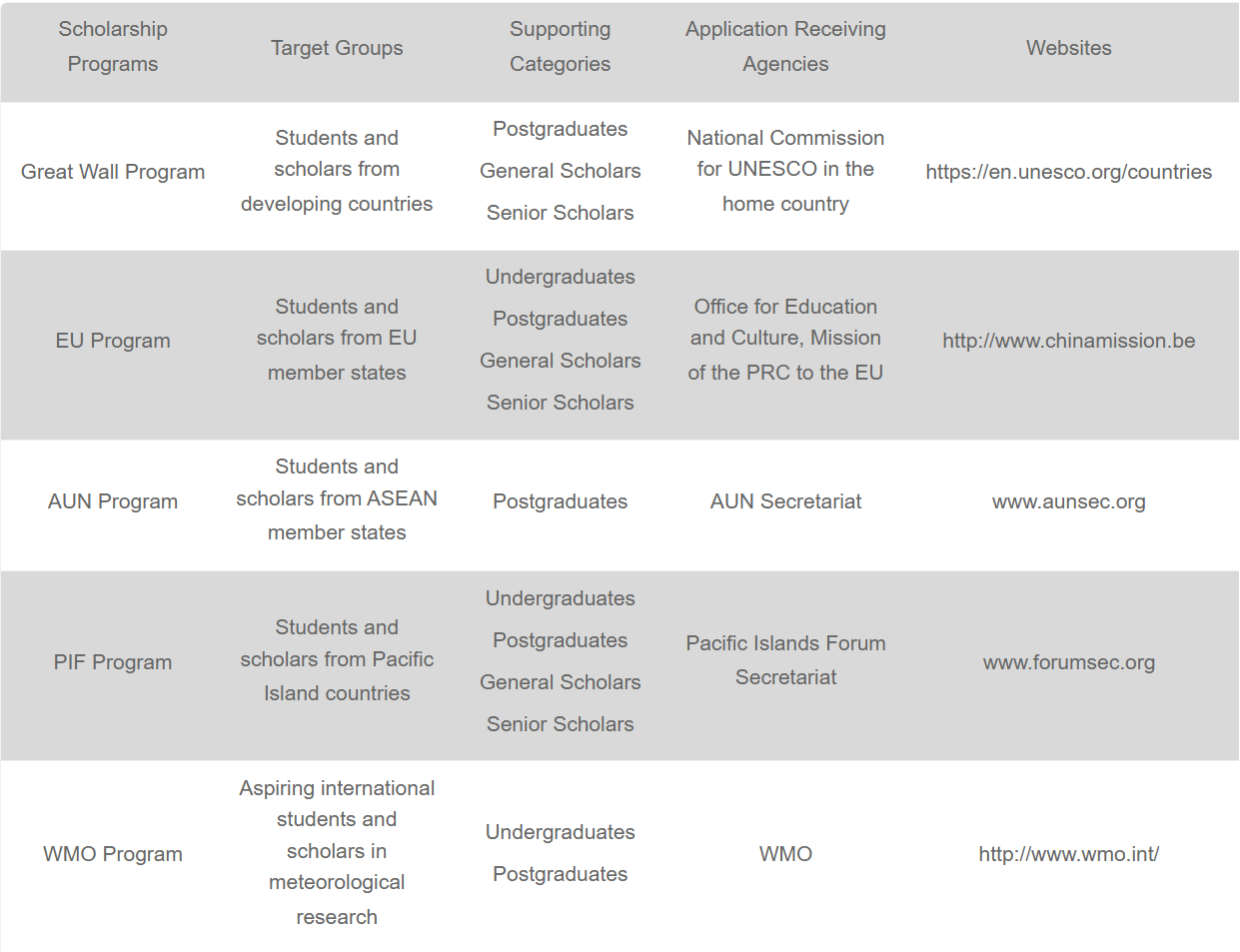
(IV) Student Exchange Program
The program, launched in accordance with exchange and cooperation agreements between Chinese universities and foreign partners, is designed to support general and senior scholars for a training session of no more than 12 months.
An applicant shall file an application with Chinese universities and their foreign partners.
II. Supporting Categories, Duration, Institutions, and Majors
(I) Supporting Categories
Chinese Government Scholarship programs sponsor undergraduates, postgraduates, general and senior scholars.
(II) Duration
The Chinese Government Scholarship covers both major study and Chinese language (preparatory) study. The language courses last one year, whereas the duration of the scholarship for major study conforms to that as required.
(III) Institutions and Majors
Designated Chinese universities offer scholarship recipients academic programs in science, engineering, agriculture, medicine, economics, law, management, education, history, literature, philosophy, and fine arts, among others. Please visit the website (http://www.campuschina.org) for further information about designated Chinese universities and majors they offer.
III. Scholarship Coverage
1. Tuition fees;
2. Free university dormitory or accommodation subsidy;
3. Stipend:
Undergraduates: CNY 2,500 per month;
Master’s students/general scholars: CNY 3,000 per month;
Doctoral students/senior scholars: CNY 3,500 per month.
4. Comprehensive medical insurance:
CNY 800 per person per year;
CNY 400 per person (for programs lasting less than six months)
IV. Eligibility
To be eligible, an applicant must:
1. be a citizen of a country other than the PRC and in good health both mentally and physically;
2. be an academically excellent holder of high school diploma or its equivalent under the age of 25 when applying for an undergraduate program;
3. be an academically excellent holder of a Bachelor’s degree or its equivalent under the age of 35 when applying for a Master’s program;
4. be an academically excellent holder of a Master’s degree or its equivalent under the age of 40 when applying for a doctoral program;
5. be a holder of a high school diploma (or higher) under the age of 45 when applying for a general scholar program;
6. be a master’s degree holder or an associate professor (or above) under the age of 50 when applying for a senior scholar program;
7. take the "China Scholastic Competency Assessment (short as CSCA)" and upload a valid score report when applying for bachelor programs (Official website of CSCA: www.csca.cn );
8. have passed the HSK (Level 3) when applying for a Chinese-taught general scholar program (excluding Chinese language majors);
9. have passed the HSK (Level 3) when applying for a Chinese-taught senior scholar program;
10. have passed the HSK (Level 4) when applying for a Chinese-taught master's or doctoral program;
11. meet the admission requirements of the university of preference in terms of language proficiency and academic ability, among others, when applying for a program taught in a language other than Chinese.
V. Application Process
1. An applicant shall learn about designated Chinese universities and majors they offer by visiting websites (http://www.campuschina.org) or other means, and identify the preferred scholarship program, designated university and major;
2. An applicant shall reach the designated university for admission documents;
3. An applicant shall reach an application receiving agency for a recommendation;
4. An applicant shall fill in and submit the Application Form for Chinese Government Scholarship online via the Chinese Government Scholarship Information System(http://www.campuschina.org);
5. The application receiving agency shall submit the recommended candidates list and their application documents;
6. The CSC will organize designated universities and experts concerned to examine applicants’ eligibility and academic performance before finalizing the short-list candidates;
7. The CSC will notify the admission results to the application receiving agency that will subsequently have the applicant informed.
VI. Application Documents
1. Application Form for Chinese Government Scholarship (filled in online);
2. Applicants are required to submit a clear scanned copy of the information page of their ordinary passports. If the validity period of the currently held passport is less than 12 months (calculated from the expected start date of study), please renew the passport and use it to complete the scholarship application. An applicant who fails to apply for a passport due to objective reasons may submit valid documentation or documentary evidence that carries information about the full English name, gender, nationality and date of birth of the applicant upon the approval of the application receiving agency;
3. Diploma and certificate of highest education (notarized photocopy). An applicant who is a current university student shall submit the certificate of expected graduation or student status issued by his/her university;
4. Academic records. Academic records in languages other than Chinese or English shall be attached with notarized translations in Chinese or English;
5. Language qualification certificates. Applicants for master's, doctoral, general scholar, and senior scholar programs taught in Chinese must submit a valid HSK score report that meets the corresponding Chinese language proficiency requirements. Applicants for programs taught in other languages are required to provide relevant language proficiency certificates, such as IELTS or TOEFL score reports, in accordance with the requirements of each university;
6. CSCA Score Report. Applicants seeking to pursue a bachelor's degree must register for and take the CSCA before the application deadline, and obtain a valid Score Report. Please contact the target institution to inquire about and obtain the required test subjects for the applied major;
7. Pre-Admission Documents. All applicants must provide a pre-admission document issued by the universities applying. Pre-admission documents include pre-admission notice issued by the international students’ admission department or invitation letter from the schools or professors, etc.
8. A study or research plan written in Chinese or in English (no less than 200 words/characters for undergraduates; no less than 500 words/characters for scholars; no less than 1000 words/characters for postgraduates);
9. Recommendation letters. An applicant for a postgraduate program or for academic education as a senior scholar shall submit two recommendation letters in Chinese or in English from professors or associate professors;
10. An applicant for the arts or design program shall provide his/her own works (such as videos and paintings);
11. An applicant under the age of 18 shall submit the legal documents of his/her legal guardian(s) in China;
12. An applicant to study in China for more than six months shall submit a photocopy of the Foreigner Physical Examination Form (the original document, printed by Chinese quarantine authorities, shall be filled in in English and kept by the applicant). The medical examinations must cover all the items listed in the Foreigner Physical Examination Form. Incomplete records or those without the signature of the attending physician, the official stamp of the hospital, or a sealed photograph of the applicant are invalid. Medical examination results are valid for only six months;
13. An applicant shall submit a valid Certificate of Non-Criminal Record (or Police Clearance Certificate) issued by the local public security (such as the police station), usually issued within six months prior to the submission date of the application.
VII. Contact Information
Asia
Tel: 0086-10-66093584
E-mail: asia-admission@csc.edu.cn
Africa
Tel: 0086-10-66093924
E-mail: africa-admission@csc.edu.cn
Europe
Tel: 0086-10-66093921
E-mail: europe-admission@csc.edu.cn
America & Oceania
Tel: 0086-10-66093578
E-mail: americas-admission@csc.edu.cn
oceania-admission@csc.edu.cn
Fax: 0086-10-66093972
Website: http://www.campuschina.org
Address: Division of International Students Admission and Cooperation Programs, China Scholarship Council
Level 13, Building A3, No.9 Chegongzhuang Avenue, Beijing, P.R China
Postcode:100044
Tuition and accommodation fees are generally paid on the basis of a school year. According to Chinese laws and regulations, international students are not allowed to be employed during the study time. And what's more, work-study opportunities are rare. So, self-financed students must be well prepared in finances before coming to China.
The following form contains general fees of self-financed foreign student. As for the details, please see the admission guidebook made by the accepting school.
Fee Items | Classification of Foreign Student | Fee Standard (per person per year) |
Schooling Cost of Liberal Arts Student | undergraduate student (junior and senior), Chinese-learning student, visiting students | US$1700-3200 |
Master degree students, senior visiting students | US$2200-3700 | |
Ph.D. students | US$2700-4100 | |
Short-term Student (1 month) | US$360-580 | |
Schooling Cost of Science or Engineering Student | undergraduate student (junior and senior), visiting students | US$1800-4100 |
Postgraduate or advanced student | US$2400-4700 | |
Ph.D. students | US$2900-5300 | |
Short-term student (1 month) | US$400-750 | |
Schooling Cost of Medicine, Sports and Arts Student | undergraduate student (junior and senior), visiting students | US$2550-6300 |
Postgraduate or advanced student | US$3250-7250 | |
Ph.D. students | US$4000-8200 | |
Short-term student (1 month) | US$550-1150 | |
Registration | US$50-100 | |
Lodging | US$1.5-4 per person per bed (two-bed room with toilet and bath). The highest cost for two-bed room is about US$10. | |
Teaching Materials Fee | US$30-50 for liberal arts subjects, a little bit higher for subjects of science, engineering, medicine, sports and arts | |
Food Fee | About US$40-60 per person per month in foreign student's dining hall; US$35 per person per month in Chinese student's dining hall. | |
According to the requirements of Ministry of Education in China, it is compulsory for every foreign student to buy medical insurance and accident injury insurance throughout their entire planned period of study. You are free to purchase either in your own country or in China. Purchasing the Comprehensive Insurance Plan of Foreign Students provided by Ping An insurance company on the day of registration is recommended by the Chinese Ministry of Education. Students who do not have valid medical insurance are not allowed to register.
Vaccinations
The following vaccinations and applicable frequencies are recommended for students coming to China:
Hepatitis A (within the last 10 years)
Hepatitis B (within the last 5 to 10 years)
Japanese B Encephalitis (within the last 3 years)
Tetanus (within the last 10 years)
Polio (within the last 10 years)
Typhoid (once in a lifetime)
Students 55 and older should also have a Pneumococcal vaccine
Quarantine Regulations
In accordance with the details for the Implementation of Regulations of the People's Republic of China Concerning Frontier Sanitation and Quarantine, people coming to China from certain countries must produce valid documents showing they have been inoculated against smallpox, cholera, or yellow fever. People from countries newly declared as infected areas must show corresponding vaccination documentation.
For further detailed enquiries, please contact the Chinese embassy or consulate in your country.
Those who have diseases for which Chinese laws and regulations refuse entry should leave China at once for their own country, and bear all expenses for the home journey
Health Examination
A health examination is required for students holding an X1 Visa for those studying in China for more than 6 months. (X2 visa holders studying for less than 6 months do not need to undergo this test).
Health Examination in Your Own Country
If you are examined in your home country, the exam must take place in a public hospital within 6 months before coming to China. The check-up form must:
• Be the same as that used in China (obtained from the Chinese Embassy)
• Contain your photo
• Bear the hospital's official stamp
• Include doctor's signature in section containing results of examination, with the original laboratory test reports attached
Health Examination in Hunan
You may also undergo the physical examination after you arrive in Hunan. Those who pass the examination, and when confirmed by the health and quarantine authorities, will receive a Health Certificate. This is a procedure that your school will assist you with.
The series of Hanyu Shuiping Kaoshi (HSK), or Chinese Proficiency Test, is a test program organized and conducted worldwide by the Center for Language Education and Cooperation. It is a standardized Chinese proficiency test designed for non-native speakers, providing certification of various levels of proficiency to Chinese learners. Due to the pandemic, in April 2020 the Online Chinese Test (Home Edition) was made available to take online, allowing students to participate in the test according to their demands on time, facilitating their preparedness for study abroad, graduation and application for job, accommodating other demands on their time. More than 70,000 people have so far taken the online test, providing overwhelmingly positive feedback. In light of the epidemic overseas, it has been decided to set up three Online Chinese Tests (Home Edition) for foreign countries on September 25, October 30, and December 11 respectively to meet the test demands overseas. The essential information regarding the online test is as follows:
I.Targeting test takers of the online test at home
1.Test takers should reside in countries where on-site HSK, HSK Oral Test, YCT and BCT have not yet resumed.
2.Test takers should contact their local test center in the first instance in order to register for the test. Visit Chinese test official website and click Global Test Centers to find your local center.
II.Registration requirements
Before registration, please make sure that your system and environment meet the test requirements.
The test takers are required to prepare a computer and a mobile phone/tablet.
The computer will be used to type the answers and the mobile phone/tablet will be used to invigilate the test.
1. A computer running Windows 7/10.
(1) Mac OS operating systems are not supported, and Mac computers/laptops are not recommended.
(2) Screen resolution should be 1366*768 or above.
(3) High-definition PC camera (built-in or external; 300,000 pixels or above); the room should be well lit to ensure clear images.
(4) The device should be equipped with wired earphone, which the sound is clear and the sound insulation effect is good. For HSK speaking test, the earphone should be equipped with a microphone with clear sound playing, good sound insulation and reception effect.
Note: The test itself cannot be conducted on mobile devices such as mobile phones, tablets, etc. Bluetooth devices, external USB storage devices, such as USB drives and wireless receivers, are not allowed during the test.
2. Mobile phone with camera: Invigilation software should be downloaded onto the phone as directed by the test center.
(1) The test taker should enter the designated meeting room one hour before the test starts, placing the mobile phone one meter behind them and slightly to the left or the right, so that the invigilator can see both the computer screen and the test taker.
(2) The invigilator will undertake a 360-degree inspection of the test environment through the invigilating software.
(3) The test taker should ensure his or her mobile phone is connected to WiFi and turn on flight mode.
(4) The mobile phone should be fully charged to ensure normal operation for the full duration of the test.
3.Network bandwidth should be 20M and speed 150KB/s or above. During the test, please close other unrelated applications and use the direct connection network to enter the test.
4.The test should be undertaken in a closed, separate room to ensure there is no disturbance. The test may not be taken in any open environment, for example parks, Internet cafes, or restaurants. All hardware and equipment that will be used for the test should be placed in plain sight on the desk. This should include no item that is not being used for the test. No other people may enter the test room during the test. The test result shall be rendered invalid if the test taker is seen to violate any of these regulations.
5.Cross-border registration is not allowed. For instance, test takers who register for the online test with a test center in the U.S. must connect from the U.S. on the day of the test.
6.Test takers from certain countries are required to take both HSK and HSK Oral Test.
7.Please be sure to confirm whether you meet all the conditions as above before the test registration. If the test environment, equipment and other conditions are found insufficient or unmatched as above after the registration and the payment, the test service fee will not be refunded.
Note:
(1) It is not allowed to record the test questions, either on paper and/ or in any other way.
(2) With an aim to guarantee the safe operation of the test, test centers may ask for some personal details or documents, for example name, photo, or other information, and make audio- and video-recordings of the test. Data will only be collected for the purposes of the test and in accordance with all relevant data protection laws.
III. Registration and payment
1.Visit Chinese test official website to register online. While registering, the test takers should choose to register at a test center that offers online test service in their countries. Before registration, please contact the center to receive relevant information.
2.Test date and registration deadline
Test category (online test at home) | Test date | Registration deadline |
HSK HSK Oral Test YCT BCT | Sep. 25 | Sep. 11 |
Oct. 30 | Oct. 16 | |
Dec.11 | Nov. 25 |
3.The test fee for the online test at home will be increased by 30% compared with the existing test fee standard.
IV.Test formt form
The test takers should log in the client-side terminal of the online test system through their personal computer. Test invigilators of the test centers that the test takers register at will conduct remote real-time invigilation throughout the test.
V.Test admission ticket and results
Test admission ticket will be issued to test takers by the respective test center ten days prior to the test. Test takers can use the information on the test admission ticket to log in via Chinese test official website to inquire about the test result (10 days after the completion of the HSK YCT and BCT; 25 days after the completion of the HSK Oral Test). Test takers can also apply for a printed result report to be mailed to them or their institutions using the Extra Score Report service.
VI. Contacts
Each test center shall treat the online test very seriously. Please contact CTI with any queries.
Phone:
+86-010-59307609/ +86-010-59307610
Scholarship system
The Chinese government has set up government scholarships to finance students and scholars from the rest of the world to study and do research in Chinese universities, enhance mutual understanding and friendship between the Chinese people and peoples of other countries, and promote Sino-foreign exchanges and cooperation in such fields as education, science and technology, culture, economy and trade. According to the agreements or programs reached between the Chinese government and governments of other countries and international organizations, the Ministry of Education is responsible to grant the government scholarships and entrusts the Chinese Scholarships Council (CSC) with the enrollment and management of daily affairs concerning international students in China who study on the Chinese government scholarships.
I. Classifications, recipients, time limits, and application qualifications
The Chinese government scholarships are divided into the undergraduate student scholarship, the postgraduate student scholarship, the doctoral student scholarship, the learners for the Chinese language scholarship, and the Visiting Students and Senior Visiting Students scholarship, according to the classifications of students. In addition, such scholarships are also available as the Great Wall scholarship, the excellent student scholarship, the HSK winner scholarship, the short-term program for foreign teachers of Chinese and the Chinese culture research program.
The undergraduate student scholarship is granted to those who apply to study in Chinese universities for bachelor's degree, usually with a term of four school years (five years for medical students). The applicants should be equal to graduates of Chinese high schools with excellent academic records, have to pass the entrance exam for Chinese universities or are admitted through recommendations, and are below 25 years old.
The Master Degree student scholarship is granted to those who apply to study in Chinese universities for master's degree, with a term of two to three school years. The applicants should have bachelor's degree with excellent academic records. And overseas applicants should have letters of recommendation by two professors or two associate professors, while applicants in China should be those who have already been admitted by Chinese universities and are below 35 years old.
The Ph.D. student scholarship is granted to those who apply to study in Chinese universities for doctor's degree, with a term of three school years. The applicants should have master's degree with excellent academic records. And overseas applicants should have letters of recommendation by two professors or two associate professors, while applicants in China should be those who have already been admitted by Chinese universities and are below 40 years old.
The learners of the Chinese language scholarship is granted to graduates of non-Chinese majors, those without basic Chinese knowledge, and applicants who want to study Chinese in China, with a term of one or two school years. The applicants should be equal to or above graduates of Chinese high schools, and are below 35 years old.
Visiting Students scholarship is granted to those who apply to study their former majors in China, with a term of one or two school years. The applicants should be sophomores and above, or equal to college graduates, and are below 45 years old.
Senior Visiting Students scholarship is granted to those who apply to do further studies in China on a certain special subject under the guidance of Chinese tutors, with a term of one or two school years. The applicants should be equal to or above Chinese postgraduates, recommended by two professors or two associate professors, and below 50 years old.
Applicants for the above Chinese government scholarships should, in principle, have corresponding proficiency in Chinese (except learners for the Chinese language and those who are taught in foreign languages); those whose Chinese proficiency doesn't meet the requirements are asked to continue their Chinese learning, but for no more than two school years; the terms of scholarships for undergraduate, Master Degree and Ph.D students who need further Chinese learning can be extended accordingly, but the time taken by trainees on further Chinese learning is included in the required time limit of scholarships.
The Great Wall scholarship is open to the UNESCO, recruiting Visiting Students and Senior Visiting Students, with the recipients, terms and application qualifications the same as those of the CSC for Visiting Students and Senior Visiting Students.
The excellent student scholarship is granted to those who have finished their planned study programs in China, passed the entrance exam the same year to study for master, or doctor's degree, and have been of good character and academic records. The term and application qualifications are the same as those for the scholarships of postgraduate and Ph.D Students.
The HSK winner scholarship is granted to winners of the HSK held overseas who come to China to learn Chinese, with a term of no more than one school year and below 40 years old.
The short-term program for foreign teachers of Chinese finances short-term workshops for foreign teachers of Chinese, including four weeks of classroom studies and two weeks of free and voluntary teaching tour in China; the applicants should be equal to or above college graduates and have engaged in Chinese teaching for more than three years running, and below 50 years old.
The Chinese culture research program finances foreign scholars engaged in Chinese culture research to take short-term visits to China and do some research either under the guidance of Chinese tutors or in collaboration with Chinese scholars, with a term of no more than five months. The applicants should have doctor's degree or be equal to or above the post of an associate professor, published monographs or theses on the Chinese language, culture, and history, and below 55 years old.
II. Contents of the Chinese government scholarships
1.The Chinese government scholarships are divided into full scholarships and partial scholarships.
2.Contents of the Chinese government scholarships:
Free from registration fees, tuitions, experiment fees, fieldwork fees, basic teaching materials fees and lodging fees;
Free medical service same as Chinese students;
Living expenses in the scholarship and one-off settlement allowances;
Hard-seat train tickets (hard sleepers for all-night trains) from the entry city to the city where the accepting school is, from the city of the school where the recipient is going to take on further Chinese studies to the city of the school where the recipient is going to study for his or her major, and from the city of the school where he or she graduates from to the exit city;
The international travel fees of the scholarship recipients are, in principle, borne by the employers, and will be arranged otherwise according to agreements, if any.
3.Following is detailed standards of living expenses in the scholarships and one-off settlement allowances:
Living expenses for undergraduate students are 800 yuan per person every month;
Living expenses for Master Degree students are 1,100 yuan per person every month;
Living expenses for Ph.D students are l,400 yuan per person every month;
Living expenses for learners of the Chinese language are 800 yuan per person (1,l00 yuan per person every month for those who are second year college graduates or above);
Living expenses for Visiting Students are 1,l00 yuan per person every month;
Living expenses for Senior Visiting Students are 1,400 yuan per person every month.
Recipients of the above scholarships whose study terms last one school year are given 600 yuan of one-off resettlement allowances per person when the school opens; those whose study term is less than one year are given 300 yuan of one-off resettlement allowances per person when the school opens.
The partial scholarships cover one or several items of the above full scholarships.
The Great Wall scholarships are the same as the full scholarships for Visiting Students and Senior Visiting Students
The excellent student scholarships are the same as the full scholarships for postgraduate or Ph.D
students.
The HSK winner scholarships are the same as the full scholarships for learners of the Chinese language.
The Chinese culture research program is free from registration, research, lodging, and emergency medical services, and offers 3,000 yuan of research subsidies per person every month, 750 yuan of one-off allowances for books and reference materials, and 1,000 yuan of one-off allowances for academic tours.
The short-term program for teachers of Chinese is free from registration, tuition, lodging, and emergency medical services, and offers 2,000 yuan of one-off allowances for living expenses; those taking part in group teaching tours are free from lodging and transportation, and are given 650 yuan of food allowances per person.
The Chinese government will adjust the scholarship standards at irregular intervals. For more information, please check the CSC-made admission guidebook of the Chinese government scholarships for international students in China.
III. Application channels, time and methods
Scholarships for undergraduate, master degree or Ph.D. students, learners for the Chinese language, and Visiting Students and Senior Visiting Students, can be applied for to the government departments in charge of overseas study affairs in the applicant's own country, related organizations, and Chinese embassies. The application time is between February and April. The application channels and methods for other special scholarships Me as follows:
The Great Wall scholarships can be applied for to the UNESCO headquarters through the national committee of UNESCO in the applicant's own country. The application time is between February and April;
The excellent students scholarships can be applied for to the CSC through the applicant's own school. The application time is between April and June;
The HSK winner scholarships can be applied for to the CSC through the HSK organizers or Chinese embassies and consulates general. The application time is between February and April;
The Chinese culture research program can be applied for at any time to the CSC through Chinese embassies, consulates general, or cooperating Chinese universities and scholars;
The short-term program for teachers of Chinese can be applied for to the CSC through Chinese embassies and consulates. The application time is usually from February to April.
The applicant should submit the following materials when applying for the Chinese government scholarships:
1. The application form of the Chinese government scholarships, made by the CSC;
2. Notarized credentials of the highest diplomas and academic records; schooling or employment credentials by the school or employer if the applicant is still a student or being employed;
3.Those who apply to study in China for more than six months (including six months)have to submit health checkup records for foreigners made by Chinese health quarantine departments;
4.Plans for studying and doing research in China (no less than 200 Chinese characters);
5.Overseas applicants to study for master' and doctor's degree, or Senior Visiting Students have to submit letters of recommendation by two professors or two associate professors; applicants in China to study for master' and doctor's degree have to submit the admission notice of the recruiting school;
6.Applicants to study music and the fine arts have to submit recordings or pictures of his or her works;
7.In addition, overseas applicants to study natural sciences, engineering, agriculture, and medicine in China have to submit results reports of the test for mathematics, physics and chemistry organized by Chinese embassies, or school reports of high school graduation examinations in the applicant's own country; applicants to study economics and management for undergraduate students have to submit test credentials for mathematics proficiency; applicants in China have to submit test credentials for admission examinations and the admission notice of related schools;
8.Applicants for the Chinese culture research program have to submit catalogues of their major monographs or theses that have been published.
The China Scholarship Council
Address:160 Fuxingmennei Street, Beijing, Division of Foreign Student's Affairs CSC
Postcode:100031
Tel:86-10-66413253
Fax:86-10-66413255
E-mail:laihua@csc.edu.cn
The following excerpt is based on the Chinese source released on the official website of the Department of Education of Hunan Province.
Chapter V Scholarships
Article 34 The institutions of higher education that undertake the task of cultivating the students awarded the Chinese government scholarship and Hunan provincial scholarship shall give priority to the enrollment of students under Chinese Government Scholarship Programs and Hunan Provincial Scholarship Programs.
Article 35 The institutions of higher education may set up scholarships for international students. They shall, in accordance with the relevant provisions of the state, formulate a scholarship management system for international students and strictly assess the academic performance and moral character of the scholarship recipients.
Chapter VI Social Administration
Article 36 Where a foreigner applies for studying at a school as mentioned in Article 2 of these Measures, he or she shall, before entry, apply for an X1 or X2 visa to the Chinese embassy or consulate in his or her country of nationality or the country of residence or other China's institution stationed abroad authorized by the Ministry of Foreign Affairs according to his or her duration of study, and submit relevant documents as required.
Article 37 Where an international student needs to apply for a residence certificate after the study visa he or she holds is indicated with “entry,” he or she shall, within 30 days from the date of entry, apply for a foreigner residence certificate for study to the entry and exit administrative department of the public security organ at the place where he or she is to reside.
Article 38 If the Ministry of Foreign Affairs has otherwise provided for an application for study in a school filed by any person of a foreign diplomatic mission or consulate in China or the representative office of an international organization stationed in China or any of his or her accompanying family members, such provision of the Ministry of Foreign Affairs shall prevail. Whoever fails to undergo the relevant formalities as required may not be enrolled by a school.
Article 39 To enroll an international student who is under the age of eighteen and whose parents do not permanently reside within the territory of China, a school shall require his or her parents to formally authorize a foreigner who permanently resides within the territory of China or a Chinese to act as the international student's guardian, and provide the relevant certification materials.
Article 40 A higher education institution (HEIS) may accept the international students who come to China in a group for short-term study, provided that such HEIS has concluded an agreement in advance with the foreign entity that dispatches these international students, or has cooperative programs with the foreign entity.
Article 41 International students shall, when entering schools, undergo the confirmation formalities for a Foreigner's Physical Examination Record with the health and quarantine departments in China or take physical examinations in accordance with the provisions of the health administrative departments in China. Where it is confirmed in a physical examination that an international student suffers from serious mental disorder, infectious pulmonary tuberculosis or any other infectious disease that may cause serious damage to the public health as prescribed in the Exit-Entry Administration Law of the People's Republic of China, the public security organ shall handle the issue in accordance with the law.
Article 42 A HEIS shall implement the system under which all international students shall be covered by insurance. International students must be insured in accordance with the relevant provisions of the state and the requirements of the HEIS. An international student who fails to purchase insurance in accordance with the relevant provisions shall be insured within a prescribed time limit; otherwise, he or she shall not be enrolled by the HEIS. If the student has already studied at the HEIS, he or she shall be dropped out of the HEIS or shall not be registered.
Article 43 HEIS should establish emergency response plans for international students and deal with the emergencies. In case of any of the following circumstances, it shall report to the competent departments of education, foreign affairs and public security in a timely manner:
(1) International students violating Chinese laws or regulations;
(2) Death, injury, missing of enrolled international students;
(3) The international students enrolled are engaged in illegal religious activities in violation of the Provisions on the Administration of Religious Activities of Aliens within the Territory of the People's Republic of China and its implementation rules; and,
(4) Other major emergencies.
Legal Basis: Administrative Measures for the Enrollment and Cultivation of International Students by Schools (Decree No. 42 of the Ministry of Education of P.R.C, Ministry of Foreign Affairs of P.R.C, and Ministry of Public Security of P.R.C)
Chinese source: hunan.gov.cn; gjjlc.gov.hnedu.cn
Chinese Government Scholarship—Chinese University Program is a full scholarship established by MOE to support Chinese universities in specific provinces or autonomous regions to enroll outstanding international students for graduate studies in China. At present, a total of 273 Chinese universities are designated to undertake this program.
I Supporting Categories, Duration and Instruction Language
1. This scholarship only supports master’s students for no more than 3 years or doctoral students for no more than 4 years.
2. Duration of the scholarship, which covers both major study and Chinese language/preparatory study, as specified in the Admission Letter, cannot be extended in general.
3. Scholarship students can register for either Chinese-taught program or English-taught program if applicable.
Program Search can help you find your interested program and university.
II Scholarship Coverage
This is a full scholarship which covers
-tuition waiver;
-accommodation;
-stipend;
-medical insurance
Please refer to Introduction to CGS—Coverage and Standard for details of each item.
III Where to Apply and Deadline
You should apply to the designated Chinese universities undertaking this program between January and early April. Please consult your target university for its specific deadline.
IV Eligibility To be eligible, applicants must:
- be a citizen of a country other than the People’s Republic of China, and be in good health;
-be a bachelor’s degree holder under the age of 35 when applying for master’s programs;
-be a master’s degree holder under the age of 40 when applying for doctoral programs.
This program generally does not support registered students who are studying in China when applying for this scholarship.
V Application Procedure
1. Apply directly to your target university.
2. Complete the online application procedure at CSC Online Application System for International Students, submit online the completed Application Form for Chinese Government Scholarship and print a hard copy.
3.Submit all your application documents to your target university before the deadline.
You can check VI. Application Documents for a detailed checklist.
NOTE:
Only applications of recommended candidates from designated Chinese universities will be considered by CSC. No other applications or individual application directly sent to CSC will be considered. Please consult your target university for the Instructions of the CSC Online Application System for International Students and Agency Number.
VI.Application Documents (in duplicate)
1.Application Form for Chinese Government Scholarship(written in Chinese or English);
Ensure you have both submitted it online and printed the hard copy.
2.Notarized highest diploma (photocopy);
Prospective diploma winners must submit official document issued by your current school to prove your current student status or expected graduation date.
Documents in languages other than Chinese or English must be attached with notarized Chinese or English translations.
3.Academic transcripts (written in Chinese or English);
Transcripts in languages other than Chinese or English must be attached with notarized Chinese or English translations.
4.A Study Plan or Research Proposal (written in Chinese or English);
This should be a minimum of 800 words.
5.Two Recommendation Letters (written in Chinese or English);
Applicants must submit two recommendation letters signed by professor or associate professor.
6.A CD of your own works (only required for arts students);
Applicants for music studies are requested to submit a CD of their own musical works. Applicants for fine arts programs must submit a CD of their own works which include two sketches, two color paintings and two other works.
7.Foreigner Physical Examination Form (photocopy);
The physical examinations must cover all the items listed in the Foreigner Physical Examination Form. Incomplete forms or forms without the signature of the attending physician, or the official stamp of the hospital, or a sealed photograph of the applicant are considered as invalid.
Please carefully plan your physical examination schedule as the result is valid for only 6 months.
Pleases keep the original copy of the Form for school registration.
8.Valid HSK Certificate (if available).
NOTE:All the documents should be bound together on top left corner in the order of 6.1 to 6.8.
You should submit TWO sets of bound documents to your target university before the deadline.
Application documents should be sent to CSC by Chinese universities before April 30th.
No application documents will be returned.
VII Scholarship Confirmation
1.University reviews the application documents and decides the nominated candidates.
2. CSC reviews eligibility and qualifications of nominated candidates, approves the List of Scholarship Winners, and sends the admission documents to universities before June 30th.
3.Each scholarship winner—even when admitted by multiple universities—will be granted with no more than one scholarship.
CSC reserves the rights to decide the host university for scholarship winners with multiple offers.
4. University sends the admission documents (Admission Letter and Visa Application Form for Study in China (JW201)) to scholarship winners.
5.Scholarship winners shall not change their host university, field of study, or duration of study unless they give up the grant.
6.Scholarship will not be reserved if scholarship winner cannot register before the registration deadline.
VIII.A List of 273 Designated Chinese Universities Undertaking This Program
Contact Information of CSC
Tel: 0086-10-66093970 66093978
Fax: 0086-10-66093915 66093972
E-mail:wtyao@csc.edu.cn
ysun@csc.edu.cn
Website:http://www.csc.edu.cn/laihua ;
http://www.campuschina.org
Address:Division of International Students Affairs, China Scholarship Council
Level 13, Building A3, No.9 Chegongzhuang Avenue, Beijing, P.R.China
Postcode:100044
Source: csc.edu.cn
Order No. 9 of the Ministry of Education, the Ministry of Foreign Affairs and the Ministry of Public Security
(January 31, 2000)
Chapter 1 General Provisions
Article 1 With a view to enhancing the understanding and friendship between Chinese and foreign people, promoting the international exchange and cooperation among Universities and Colleges and strengthening the administration on acceptance and cultivation of Foreign Students, these Provisions are hereby formulated in accordance with the Education Law of the People's Republic of China, the Higher Education Law of the People's Republic of China and the Law of the People's Republic of China on Control of Entry and Exit of Aliens.
Article 2 For the purpose of these Provisions, "Universities and Colleges" shall mean ordinary universities and colleges approved by the Ministry of Education to provide full-time higher education; "Foreign Students" shall mean foreign citizens with foreign passports which have been registered in Chinese Universities and Colleges for receiving degree courses or non-degree courses.
Article 3 Universities and Colleges shall follow the guidelines of "deepening reform, enhancing administration, guaranteeing quality and making active and steady progress" in the acceptance and cultivation of Foreign Students.
Article 4 Universities and Colleges which accept Foreign Students shall possess the necessary teaching and living facilities, and shall have corresponding teaching, research and administrative capacity.
Article 5 When accepting and cultivating Foreign Students, Universities and Colleges shall follow national policies on foreign affairs, and safeguard national sovereignty, security and public interests.
Chapter 2 Administrative System
Article 6 The Ministry of Education, in charge of the administration of Foreign Students throughout this Country, is responsible for formulating guidelines and policies relating to the acceptance of Foreign Students, administering Chinese Government Scholarships, providing coordination and guidance on the acceptance of Foreign Students by Universities and Colleges in all localities, and evaluating the quality of administration and education thereof.
The Ministry of Education entrusts the China Scholarship Council with the enrollment and the specific administration of Foreign Students who fall within the State plan.
Article 7 The acceptance of Foreign Students by each University or College shall be subject to the examination and approval by the education administration department of the people's government of the relevant province, autonomous region or municipality directly under the Central Government in conjunction with the foreign affairs department and the public security departments at the same level, and shall be filed with the Ministry of Education. The acceptance of Foreign Students which are entitled to Chinese Government Scholarship shall be subject to the examination and approval by the Ministry of Education.
Article 8 The education administration department of each province, autonomous region or municipality directly under the Central Government shall be responsible for the coordination and administration on the acceptance of Foreign Students by Universities and Colleges within its administrative area. The foreign affairs department, public security departments and other departments concerned shall assist the education administration departments as well as Universities and Colleges in the administration on Foreign Students.
Article 9 Universities and Colleges shall be responsible for the enrollment, education and routine administration of Foreign Students. Each
University or College shall appoint a leader at university or college level to take charge of the works relating to Foreign Students, shall establish the Foreign Students management system in accordance with the relevant provisions, and shall set up management body or management post for matters relating to Foreign Students.
Chapter 3 Classification, Enrollment and Admission of Foreign Students
Article 11 Universities and Colleges shall formulate the measures for enrollment of Foreign Students, publish the enrollment rules for Foreign Students and admit Foreign Students in accordance with such rules.
Article 12 The number of Foreign Students accepted by Universities and Colleges shall not be subject to enrollment limitations under the State enrollment plan.
Article 13 Universities and Colleges shall, in accordance with the relevant provisions of the State, set and publish itemized and standardized fees to be collected from Foreign Students. Fees shall be collected in RMB.
Article 14 The majors with respect to which Universities and Colleges accept Foreign Students shall be those which are open to Foreign Students. Establishment of any major under degree education exclusively for Foreign Students shall be subject to the examination and approval of the Ministry of Education.
Article 15 A foreign citizen applying for studying and training in Chinese University or College shall have requisite qualifications, meet entrance requirements, provide credible proof of economic support and a guarantor for his/her activities in China.
Article 16 Universities and Colleges shall review, examine or assess the applicants' qualifications for entrance. The criteria for admission shall be determined by each University or college itself. Foreign Students applying for degree education in the Chinese language shall be subject to Chinese language proficiency tests.
Article 17 Decisions on acceptance of Foreign Students shall be made by each University or college itself. Universities and Colleges shall give priority to Foreign Students who fall within the State Enrollment Plan. Universities and Colleges may, at their own discretion, admit Foreign Students in connection with international exchange programs and self-funded Foreign Students.
Article 18 Each University or College may accept any Foreign Student who has already been admitted by other University or College, provided that the consent from the University or College which originally admits such Foreign Student shall be obtained in advance.
Chapter 4 Scholarship System
Article 19 The Chinese government has established the Chinese Government Scholarships for Foreign Students studying in China.
Chinese Government Scholarships may be classified as undergraduate student scholarships, graduate student scholarships and training course scholarships.
The Ministry of Education may, where necessary, set up other scholarships for special research or training courses.
Article 20 The Ministry of Education shall make plans concerning the enrollment of Foreign Students funded by Chinese Government Scholarship in accordance with the agreements concluded between China and foreign governments and on the basis of the needs for exchange between China and foreign countries.
Article 21 Foreign Students funded by Chinese Government Scholarships shall be subject to annual appraisals of their scholarship eligibility. The appraisals are to be carried out by Universities and Colleges pursuant to the relevant provisions. For those Foreign Students who fail to receive a satisfactory appraisal, eligibility to receive a Chinese Government Scholarship shall be suspended or rescinded in accordance with the relevant provisions.
Article 22 Local governments as well as Universities and Colleges may singly or jointly set up scholarships for Foreign Students. Chinese and Foreign enterprises, institutions, associations, other social organizations, and individuals, with the consent of Universities and Colleges and of provincial-level education administration departments, may also establish scholarships for Foreign Students, provided no unreasonable conditions may be affixed to such scholarships.
Chapter 5 Teaching Management
Article 23 Each University or College shall make arrangement for Foreign Students'study in accordance with its unified teaching plan, and shall carry out teaching activities in consideration of the psychological and cultural characteristics of Foreign Students. Under the precondition that the teaching quality is ensured, each University or College may make appropriate adjustment to Foreign Students' compulsory and elective courses.
Article 24 Both Chinese Language and Overview of China shall be compulsory courses for Foreign Students receiving degree education; Political Theory shall be a compulsory course for Foreign Students majoring in philosophy, politics or economics; other Foreign Students may apply for exemption.
Article 25 Chinese language shall be the basic teaching language to be adopted by Universities and Colleges for cultivating Foreign Students. For those Foreign Students which fail to meet the requirement in the aspect of the level of Chinese language, Universities and Colleges shall provide the necessary conditions for them to improve their Chinese language skills.
Universities and Colleges may, on the basis of actual conditions, set up for Foreign Students the professional courses wherein English or other foreign languages are used. With respect to Foreign Students which use foreign languages in receiving diploma education, the abstract of their thesisses shall be written in Chinese language.
Article 26 When making arrangement for internship and social practices, Universities and Colleges shall, according to the teaching plans, place Foreign Students together with Chinese students; however, site selection for internships and social practices shall be carried out in accordance with the provisions relating to foreign affairs.
Article 27 Universities and Colleges shall, as required by teaching, provide appropriate learning conditions for Foreign Students. In case any Foreign Student needs to use any equipment or get access to any material that are not included in the teaching plan, such Foreign Student shall make application therefore, and such application shall be subject to the examination and approval by the university or college in accordance with the relevant provisions and procedure.
Article 28 Universities and Colleges shall manage the academic files of Foreign Students in accordance with the relevant provisions. The decision of any University or College to order a Foreign Student to leave or to cancel a Foreign Student's student status shall be filed with the provincial-level education administration department; in case such Foreign Student is a foreign student falling within the State Enrollment Plan, such University or College shall also inform in writing the China Scholarship Council thereof.
Article 29 Universities and Colleges shall, in accordance with the relevant provisions, issue to Foreign Students the graduation certificate (certificate of completion, certificate of attendance) or descriptive study certificate, and issue to Foreign Students to which degree has been granted the degree certificates. Universities and Colleges may, on the basis of actual needs, provide translations for such certificates.
Chapter 6 In-campus Administration
Article 30 Each University or College shall, in accordance with the relevant laws and regulations of the State as well as its regulations and rules, give education to and carry out administration on Foreign Students. Universities and Colleges shall instruct Foreign Students to abide by the laws and regulation of China as well as the rules and disciplines of Universities and Colleges and to respect the social ethics and customs of China.
Article 31 In general, Universities and Colleges will not make arrangement for Foreign Students to participate in political activity, but may make arrangement for Foreign Students to participate in public-welfare labor and other similar activities on voluntary basis.
Article 32 Universities and Colleges shall permit and encourage Foreign Students to participate in the cultural and sport activities organized by the student union; Foreign Students may also voluntarily participate in the celebration activities of this Country during holidays and festivals; in cities and regions where there are lots of Foreign Students, the relevant departments as well as Universities and Colleges shall hold cultural and sport activities which are beneficial to mental and physical health for Foreign Students.
As approved by Universities and Colleges, Foreign Students may set up friendship groups within Universities and Colleges and carry out activities within the scope as specified in the lawsand regulations of China, provided that they shall be subject to the direction and administration by the leaders of Universities and Colleges. In case any Foreign Student intends to set up any cross-university or cross-region organization, such Foreign Student shall apply with the competent departments of Chinese government.
Article 33 Universities and Colleges shall respect the ethnic customs and religious belies of Foreign Students, but will not provide places for holding religious ceremonies. It is prohibited to carry out activities such as missionizing and religious meeting within Universities and Colleges.
Article 34 As approved by Universities and Colleges, Foreign Students may, within the place and scope as designated, held activities for celebrating their country's important traditional festivals, provided that such activities may not involve any content which opposes or attacks any other country or goes against the public ethics.
Article 35 Universities and Colleges shall provide Foreign Students with necessary lodging, accommodation and other living facilities, and shall set up and publish management rules for management on such service facilities in accordance with the relevant provisions.
Article 36 During the study in Universities and Colleges, Foreign Students may not take up an occupation, engage in trade or carry out other profit-making activities, but may participate in part-time work for the purpose of economically supporting study in accordance with the provisions of Universities and Colleges.
Chapter 7 Social Administration
Article 37 The social administration with respect to Foreign Students shall be undertaken by the relevant administrative departments. Universities and Colleges shall assist the relevant administrative departments in social administration on Foreign Students.
Article 38 Foreign Students may take off-campus accommodation, provided that they shall go through the registration formalities with local public security organs in accordance with the relevant provisions.
Article 39 The relevant departments shall provide convenience for Foreign Students to carry out normal study and social practices, and the charging standards shall be the same as those for Chinese students.
Article 40 When carrying out activities such as publication, association, meeting, parade, demonstration within the territory of China, Foreign Students shall comply with the provisions of the relevant laws and regulations of China. When carrying out religious activities within the territory of China, Foreign Students shall comply with the Provisions on Administration of Religious Activities of Aliens within Territory of the People's Republic of China.
Article 41 When carrying or mailing any article out of the territory of China, Foreign Students shall comply with the relevant provisions of China.
Chapter 8 Entry, Exit and Residence-related Formalities
Article 42 In general, Foreign Students shall go through registration formalities by presenting ordinary passport and visa marked with letter "X" or "F". Foreign Students which will study in China for no less than six months shall, by presenting the Chinese Visa Application Form for Foreign Students (Form JW201 or Form JW202), the Admission Notice issued by University or College and the Physical Examination Record for Foreigners, apply with Chinese visa-granting agencies abroad for visa marked with letter "X"; Foreign Students which will study in China for less than six months shall, by presenting the Chinese Visa Application Form for Foreign Students (Form JW201 or Form JW202) and the Admission Notice issued by University or College, apply with Chinese visa-granting agencies abroad for visa marked with letter "F"; foreigners coming to China in group for short-term study may also apply for group visa marked with letter "F" by presenting invitation letter issued by authorized organizations.
Article 43 In case any foreigner coming to China with foreign diplomatic passport, public affairs passport, official passport or special passport and Chinese diplomatic visa, Chinese public affairs visa or courtesy visa needs to study or get trained in any University or College, such foreigner shall apply with the relevant provincial-level foreign affairs department of China by presenting the note which is issued by the foreign affairs agency of his/her country and states that all privileges and immunity will be waived during study or training in China, and, after his/her application is approved, obtain the visa marked with letter "X" or "F" from the entry & exit administration department under local public security organ by presenting the approval document issued by the said foreign affairs department; in case any foreigner which holds foreign diplomatic passport, public affairs passport, official passport or special passport and comes to China without visa in accordance with the bilateral agreement needs to study or get trained in any University or College, such foreigner shall change his passport to ordinary passport and then obtain the visa marked with letter "X" or "F" from the entry & exit administration department under local public security organ; in case any foreigner coming to China with ordinary passport and any visa other than the visa marked with letter "X" or "F" needs to study or get trained in any University or College, such foreigner shall apply with the entry & exit administration department under local public security organ for changing his/her visa to the visa marked with letter "X" or "F". When accepting the application from any foreigner mentioned above, the foreign affairs department and the entry & exit administration department under local public security organ shall check the Chinese Visa Application Form for Foreign Students (Form JW201 or Form JW202), the Admission Notice issued by University or College and the Physical Examination Record for Foreigners.
Article 44 The family members of any Foreign Student may, by presenting the invitation letter issued by the University or College which accepts such Foreign Student, apply with Chinese embassy or consulate for the visa marked with letter "L" for the purpose of accompanying such Foreign Student during study in China. The entry & exit administration departments under local public security organs shall, on the basis of the official letters issued by Universities and Colleges which accept Foreign Students, extend the visa for the accompanying family members, and the stay period for accompanying family members may not exceed the validity term of Foreign Students' residence permit.
Article 45 After coming to China, Foreign Students of which the study period is no less than six months shall, with the time limit specified, go through the formalities for confirming the Physical Examination Record for Foreigners with local health & quarantine departments. Foreign Students which fail to present the Physical Examination Record for Foreigners shall accept physical examination at local health & quarantine departments, and those which are confirmed through examination as suffering from any disease with respect to which entry is prohibited by the laws of China shall leave China immediately.
Article 46 Foreign Students entering into China with the visa marked with letter "L" shall, within 30 days after entering into China, apply with the entry & exit administration departments under local public security organs for the Residence Permit for Foreigners. In case any information recorded on the residence permit changes within the study period, Foreign Students shall, within 10 days of such change, go through the modification formalities with the entry & exit administration departments under local public security organs.
Article 47 In case any Foreign Student transfers to another University or College in another city, such Foreign Student shall go through the moving-out formalities with the entry & exit administration department under the public security organ of the original place. After arriving at the destination place, such Foreign Student shall, within 10 days, go through the moving-in formalities with the entry & exit administration department under local public security organ.
Article 48 In case any Foreign Student temporarily exits from China during his/her study period, such Foreign Student shall, before exiting from China, go through the re-entry formalities. In case any Foreign Student needs to study or stay in China after the expiration of his/her visa or residence permit, such Foreign Student shall, prior to the expiration of his/her visa or residence permit, go through the renewal formalities.
Article 49 After graduation, completion of study, attendance of study or drop-out of study, Foreign Students shall exit from China within the time limit specified. With respect to any Foreign Student which is ordered to drop out of study or whose student status is cancelled, the relevant University or College shall duly inform the entry & exit administration department under local public security organ thereof, and the said entry & exit administration department shall legally take over the Residence Permit for Foreigners held by such Foreign Student or shorten the stay period of such Foreign Student.
Chapter 9 Supplementary Provisions
Article 50 The acceptance of Foreign Students by any education institution other than ordinary Universities and Colleges which provide full-time higher degree education shall be subject to the examination and approval by the Ministry of Education, and the relevant administrative measures will be formulated separately.
Article 10 Universities and Colleges may provide Foreign Students with degree education and non-degree education. Foreign Students for degree education may be classified as junior college degree candidates, bachelor's degree candidates, master's degree candidates or doctoral degree candidates; Foreign Students for non-degree education may be classified as training-course attendants or visiting scholars.
Source: english.gov.cn
1. Materials for verifying: triplicate form of Visa Application for Study in China (Form JW202), the application form shall be signed and sealed by the executive branch leader of the provincial education department.
2. Approval and issuing: the specialized staff in school shall submit verifying materials to the principal of the Administration Office of Foreign Affairs or the deputy director who are in charge for approval and signature.
3. Stamping: Submitting Form JW202 on the verified yellow page to the staff in the Administration Office of Foreign Affairs for stamping its official seal; retaining the blue page in the Administration Office of Foreign Affairs; stamping the official seal of Foreign and Overseas Chinese Affairs Office on the white page in certificate hall on the third floor.
Time limit: Within 2 working days
1. What’s the purpose of recruiting and training international students to study for a graduate degree in China? Which kinds of units have the right to recruit international students to study for a graduate degree in China?
Recruiting and training international graduates in China is one of the vital avenues of operating external educational communication and cooperation to cultivate high level talents for friendly nations.
Colleges and universities approved by the State Education Commission to accept international graduate students, which contain disciplines or subjects with the right to grant master degree or doctor degree, can recruit and train foreign graduates in China.
2. What are the Principles of recruiting and training foreign graduate student in China? What is the regulations of applying, examination and recruiting?
To recruit international graduates in China need to stick to the standards, assure the quality and consider the actual situation of the sending country and international students to loosen the requirements at the same time.
For fresh graduates to apply for a master's degree in their own undergraduate school, they need to take a national examination forgraduate students in China or examinations organized by the university itself. For those students who excel in study and behavior, school authorities can recruit by recommendation without testing.
Foreign university graduates in China who apply for master's degrees in their original school need to submit their undergraduate diploma, learning courses and transcripts in university, two recommendations written by professional teachers above associate professors. School authorities will recruit by examinations in Chinese or foreign language after examining applicants’ qualification. But major of Chinese language and literature and history should be tested in Chinese.
Applicants for PhD Degree Programs should obtain Master’s degree or the degree qualify to the master degree in China and submit the diploma, research project plan, two professors’ recommendations. School authorities will recruit by examinations in Chinese or foreign language after examining applicants’ qualification. But major of Chinese language and literature and history should be tested in Chinese.
International graduates are excused from an examination of Marx's Theory Course and foreign language. There will be two to three subject tests in entrance examinations. At present, the topics and instructions are only provided in English .
3.Regulations of Study and Conferring of Degrees for international graduate students in China during their study
International graduates who graduate in China or foreign applicants majoring in Chinese language, literature and history, will be taught or instructed in Chinese after enrollment and write or defend their thesis in Chinese.
Master's degree students required to complete the curriculum between 2-3 years. The length of schooling of doctor’s degree students is 3 years. Courses will be justified according to the actual situation and the school is responsible for the formulation of the specific teaching plan.
International graduates who pass the master degree examinations and thesis defense will be granted with master degree once they are qualified for the requirement of the 5th Article of the “Regulations of the People's Republic of China on Academic Degrees”.
International graduates studying for PhD who pass PhD course examinations and thesis defense will be granted with PhDs once they have reachedthe requirements of the 6th Article of the “Regulations of the People's Republic of China on Academic Degrees”. If they are not qualified ,a master degree will be granted based on their grades and thesis.
General situation of international students education
The education of International students in New China began in 1950, and has witnessed great development in recent years. Statistics show that 363 universities in 31Chinese provinces, autonomous regions and municipalities (not including Taiwan Province, Hong Kong and Macao special administrative regions) received 61,869 students from l69 countries to study in China in 2001.
Chinese universities provide both diploma education and non-diploma education, with the former including senior and junior undergraduate students, Master Degree Students, and Ph.D Students, and the latter including trainees and research scholars.
Chinese universities teach different types of students with different methods. Junior undergraduate students are required to study for two or three school years according to teaching programs, together with their Chinese counterparts in the same class, and conferred diplomas after they pass examinations.
Senior undergraduate students are required to Study for four or five school years according to teaching programs, and taught separately or together with their Chinese counterparts according to subject requirements. And meanwhile, some optional courses are cut to cater to varying conditions of each student, or separate courses are added to meet different needs. These students are conferred bachelor`s degree after passing examinations and graduation thesis. Master degree students are required to study for two or three school years according to teaching programs. International students have to finish all courses set in teaching plans under the guidance of their tutors and pass examinations and graduation defence before being conferred master`s degree.
Ph.D students are required to study for two or three school years according to teaching programs. International students have to finish all courses set in teaching plans under the guidance of their tutors and pass examinations and graduation defence before being conferred doctor`s degree.
Visiting students are required to study for one or two school years and are taught either separately or together with their Chinese counterparts according to their subjects. They are conferred refresher certificates after passing examinations or proficiency assessment.
Senior Visiting Students are required to study for one or two school years. The school must offer a tutor for each of them to direct their research according to different research projects. They are conferred refresher certificates after finishing their studies and research programs.
Research scholars are offered a liaison teacher each according to their research projects. They have to depend mainly on themselves for research, and the research time is decided according to the requirements of monographic research projects.
Chinese language learners, who are equal to graduates from high schools in China, are usually required to study for one or two school years, and are conferred refresher certificates after finishing their studies.
Chinese universities encourage International students to come to China and study for master, and doctor`s degrees. Some universities are able to offer courses directly in foreign languages.
Types and qualifications of foreign students accepted
The applicant shall be 18 years old and healthy.
Entrance exams and proficiency
Visiting Students and Senior Visiting Students are admitted according to their diploma credentials, based on competitive selection. Undergraduate students of liberal arts are admitted according to their diplomas, academic record credentials, and the medium stage C-level credentials for the HSK test, after passing entrance exams or proficiency assessment, based on competitive selection. Undergraduate students of science, engineering, agriculture and medicine are admitted according to their diplomas, academic record credentials, and the primary stage C-level credentials for the HSK test, after passing entrance exams or proficiency assessment, based on competitive selection. Master Degree or Ph-D Students are admitted by related universities according to their bachelor, or master`s degrees, academic record credentials, and recommendation letters by two associate professors or professors, after passing exams or proficiency assessment. Those who apply for enrollment out of China and are admitted without the entrance exam have to finish all courses and pass corresponding examinations before obtaining qualifications to work on graduation thesis. They would otherwise have to graduate as trainees. Applicants in China have to take part the entrance exam for graduate students. Graduating senior undergraduate or Master Degree Students in China, who have met the requirements of being recommended to study for master, or doctor`s degrees without the entrance exam, can be admitted by related universities according to corresponding regulations. Undergraduate, Master Degree or Ph.D students and Visiting Students applying to major in disciplines of arts, have to offer the pictures, recordings, and audio-visual materials of their own works of art, as well as letters of recommendation. Admission priority will be given to graduates who once studied in China and apply for further studies again.
Preparatory education on the Chinese language for International students in China
Chinese is the major teaching language for International students in Chinese universities. Books, periodicals, and reference materials in university libraries and archives are mostly in Chinese. International students have to have a command of Chinese to a certain level in order to finish their studies smoothly. Undergraduate, Master Degree or Ph.D students and Visiting Students who didn`t learn Chinese or whose Chinese proficiency doesn`t meet the needs of subject studies before coming to China, have to learn basic Chinese for one or two school years upon arrival. Visiting Students and graduate students who are taught directly in foreign languages, still need to pick up some Chinese for the convenience of daily life and study.