-- Article list --

The Second Nanyue Temple Fair Shehuo Festival kicked off at the Nanyueli Temple Fair Cultural Food Street in Hengyang City. The seven-day folk cultural carnival will run through January 1, 2026, presenting residents and visitors with a New Year cultural tourism feast that blends traditional charm with modern vitality.
This year's Shehuo Festival centers on two themes: "Staging Shehuo Folk Performances" and "Visiting the Temple Fair." While deeply exploring the thousand-year-old temple fair culture of Nanyue, the event innovatively incorporates trendy elements beloved by younger generations.
During the event, visitors can not only enjoy intangible cultural heritage performances such as stilt walking, dragon and lion dances, fire tiger dances, and fireworks puppet shows, but also participate in interactive activities like the "A Thousand-Lantern Parade," "Three Gods of Fortune, Prosperity and Longevity Bringing Auspiciousness," and "Street Exploration." Tourists can also join in a dance around the bonfire and a party blending traditional Chinese elements with electronic music. On New Year's Eve, festivities will continue until midnight, including ceremonial events like a thousand people releasing wish balloons, creating a vibrant and festive atmosphere to welcome the new year.
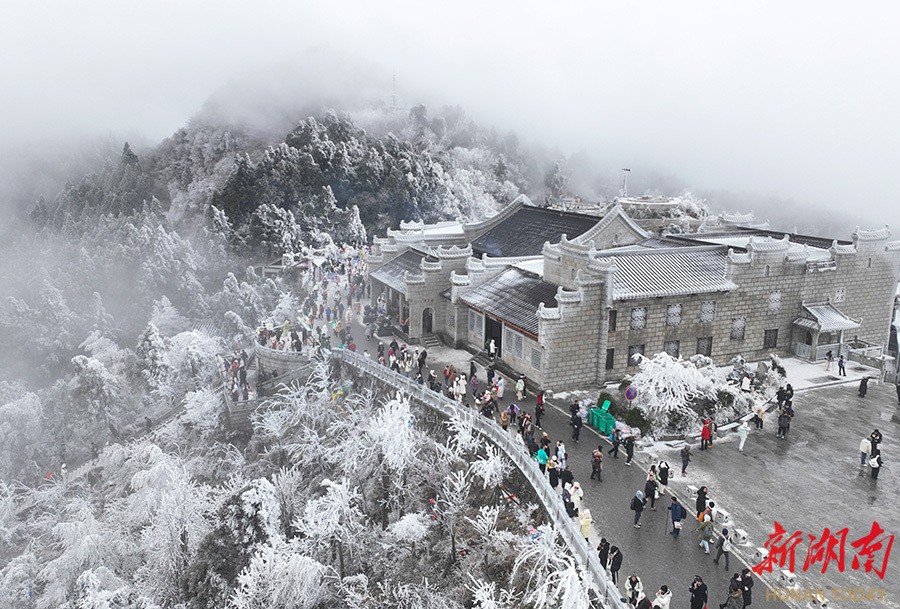
Rime ice is a stunning natural phenomenon in southern China. Crystal-clear icicles envelop the red ribbons and dark-tiled roofs of ancient temples, creating a unique winter wonderland on Mount Hengshan.
Highlights: enjoy rime scenery, pray for blessings, and admire the snowy scenery of ancient architectures atop the mountain.


Situated in Hengyang City, Hunan Province, Mount Hengshan is one of China’s Five Sacred Mountains. The mountain range runs 150 km from Hengyang to Changsha. Of the cluster of 72 peaks, the most known is Zhurong Peak. For a long time, Mount Hengshan is acknowledged as a holy place of religions, the Civilization Special Area, the Shou Mountain and the most scenic mount of the Five Sacred Mountains in China. Besides, this mountain is awarded the National Scenic Spots and the Historical Sites, a model of National Civilized Scenic spots and the AAAAA Tourist Destination.

Beautiful Natural Scenery
Mount Hengshan has always been a favorite destination, a summer resort and leisure place for tourists for its religious reputation and gorgeous landscapes. More than 1,200 kinds of plants, 9 primitive forests, and more than 150 kinds of precious trees were identified in the area. The Four Wonders of Mount Hengshan: Zhurong Peak, Water Curtain Cave, Fangguang Temple and Sutra Collection Hall are famous for their height, oddity, depth and elegance separately. Mount Hengshan is pleasant for tourists all round the year. They can appreciate exotic flowers in spring, amazing cloud sea in summer, grand sunrise in autumn and flying snow flakes in winter.

Famous Religious Holy Place
Both Buddhism and Taoism coexist in Mount Hengshan, which forms the chief religious feature of the mount. Historically, Buddhism and Taoism practice in Mount Hengshan are of great importance. As early as in the late East Han Dynasty (25AD-225AD), Taoists had started their practice in the blessing spots in Mount Hengshan. The Tang Dynasty (618AD-917AD) witnessed the prosperities of ten large Taoist temples and eight hundred bamboo houses. Many Taoists at that time were those with high culture cultivation and profound metaphysics. They wrote books and developed theories of their own. Buddhism was introduced to Mount Hengshan about 200 years later. From 421AD, the second year after the establishment of the South Dynasty (420AD-589AD), large groups of famous monks appeared in Mount Hengshan. They followed rituals sacredly and gradually formed principles of their own, of which the Tiantai Sect (Principles of the Lotus Sutra) was most influential and had been spread to as far as Japan. Additionally, Buddhists in Mount Hengshan also developed the Weiyang Sect, Linji Sect, Caodong Sect, Yunmen Sect, and Fayan Sect, the five principles in the development process of Buddhism in Chinese history. Each had significant influence on religious practice in Southeast Asia and even the whole world.

Civilization Special Area
Mount Hengshan has a long and profound history. Most of the legendary emperors in ancient China had connection with Mount Hengshan. For example, Emperor Yan, Emperor Huang, Emperor Yao, Emperor Shun, and Emperor Yu were said to have visited the mountain, demonstrating the importance of Mount Hengshan in the history of China. Mount Hengshan gradually became a center of religious practice in south China when Taoism and Buddhism were introduced to Mount Hengshan successively. With the passage of the Song Dynasty, more than 20 academies were established in this area, forming a unique academy culture of schooling. The emerging Huxiang School can find its origin in this mountain. Even today, influence of these philosophical thinking can be identified in modern schools. It was the vice minister Guan Daxun of the Ming Dynasty (1368-1683) who had first approved the favorite place of Mount Hengshan for its combination of civilization and special area.
Shou Mountain of China
The Shou Culture (Longevity Culture) of Mount Hengshan can be dated back to records of Xingjing (the earliest great work of astronomy in the world): Mount Hengshan corresponds to the Zhen Star of the 28 Star Mansions, a star in charge of the life span of being in the world; therefore Mount Hengshan derived the name of Shou Mount. Emperor Huizong (the eighth emperor of Song Dynasty) inscribed the two characters of Shou Mountain for the massive stone carve.
The two characters can still be seen in the Emperor Rock of Jinjian Peak. The poem On Restoring the Temple Stone of Mount Hengshan written by Emperor Kangxi (1661-1722) stated that Mount Hengshan is a giant town in south China, which corresponds to the North Star Yuheng, hence the name Shou Mountain.
Transport: From Changsha take a train or a bus directly to Hengshan. From Hengyang train, bus and taxi can also take you there.
Tel: 0734-5663760
Admission (for reference): RMB 80 yuan/adult
Favorite season to travel: All-year around
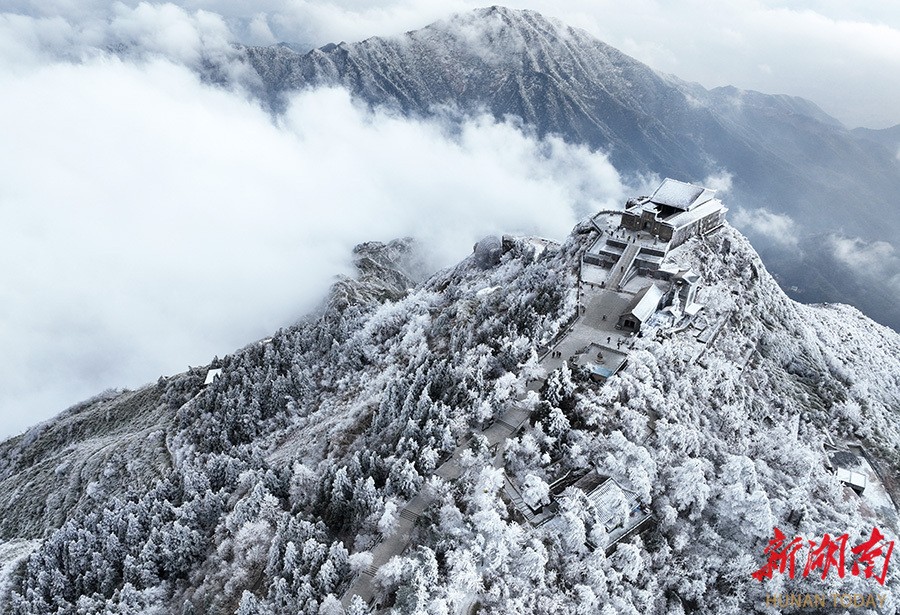
As a strong cold front comes, Nanyue Mount Heng Scenic Area greeted a magnificent sea of clouds. The clouds blurred the edges of Zhurong Peak, making it a worthwhile trip.
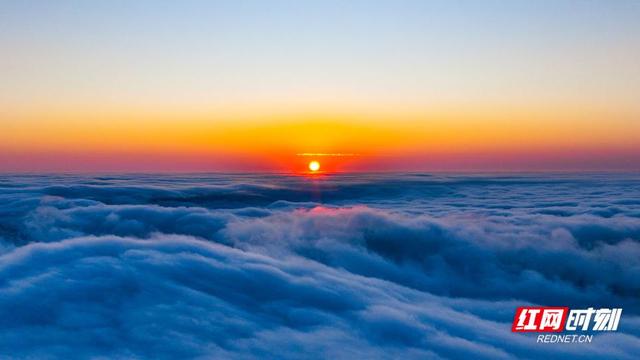
Nanyue Mount Heng is covered by mists and clouds for over 200 days throughout the year. After a sudden rise or fall in temperature or rainfall, a sea of clouds will appear.
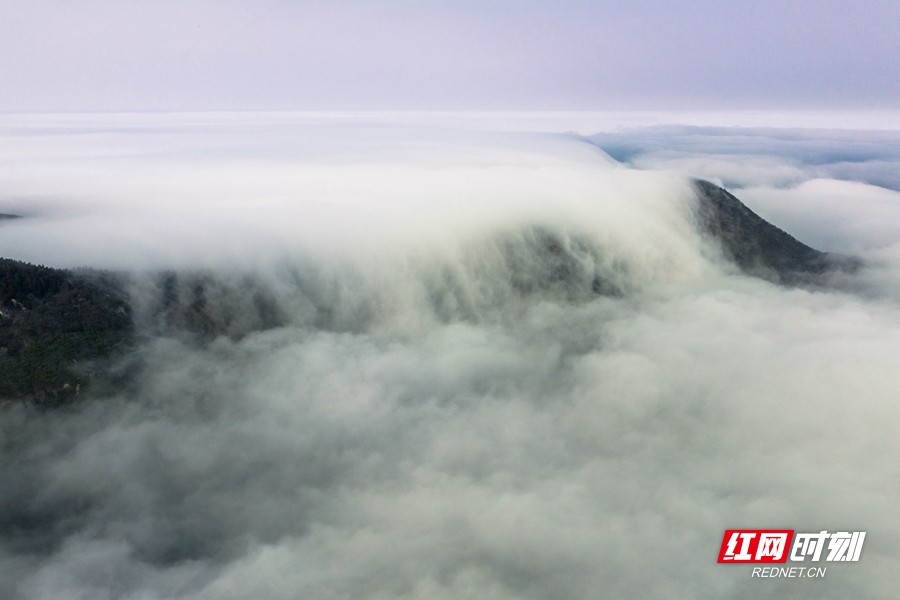
The meteorological department of the scenic area forecast that a sea of clouds will probably reappear in the following week.
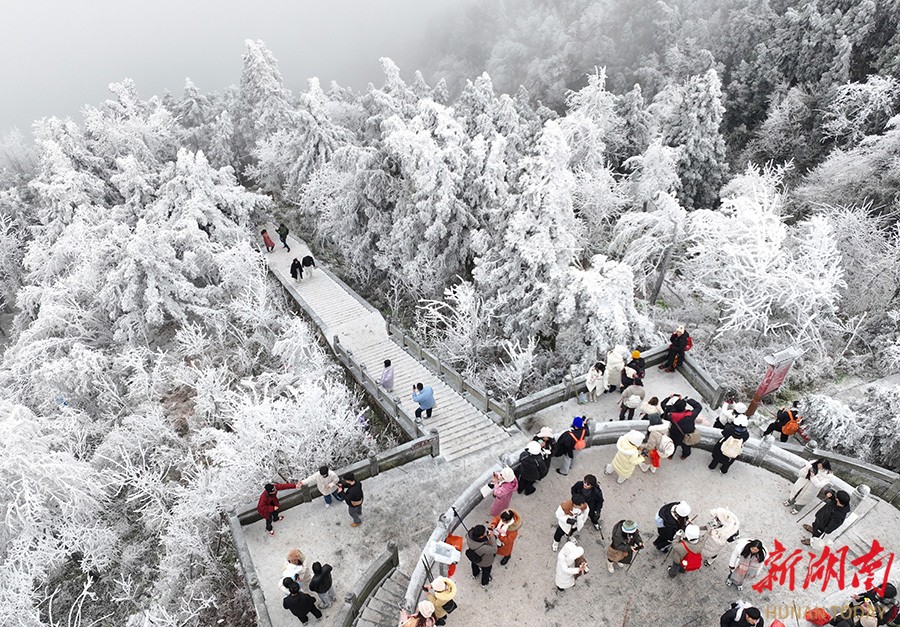
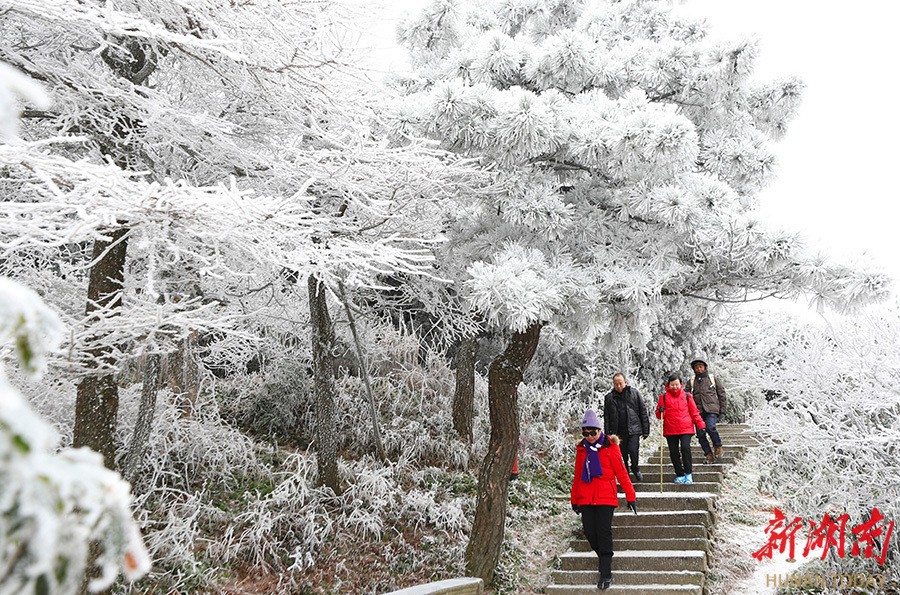
Photos show visitors enjoying the beautiful scenery of snow and rime at Mount Hengshan Scenic Area in Hengyang City.
Affected by consecutive days of low temperatures, ice, snow and rime views often appear at the scenic area. The peaks covered with snow are faintly visible in the clouds, and the trees and branches are crystal clear. Tourists walking in the world of ice and snow seem to be in a fairy tale world.