-- Article list --
As a national hub for commercial grain, edible oil, and hog production, Hengyang leads China in tea oil cultivation. Its culinary heritage features: Traditional Delicacies: Yulin Xiangyao (spiced pork waist), Hengyang Snail Cuisine, Fish Head Tofu, Hengdong Earth Pot Dishes, Zhajiang Vegetarian Mutton, Hengyang Fish Vermicelli. Local Specialties: Wulian Black Lotus Seeds, Qidong Daylily, Changning Seven-Vinegar, Leiyang Rice Noodles, Nanyue Cloud Mist Tea, Dashanxiang Tea Oil, Sanzhang Imperial Chili, Maoshi Shaobing (Baked Sesame Flatbread), Flat Rice Cake. Cultural Foods: Shigu Crispy Mooncakes, Tanzicai Pickled Vegetables Beverages: Zhangfei Liquor, Huxiang Rice Wine.
Hengshan, with a long history, is a remarkable place producing outstanding people. The famille-rose porcelain of Hengshan Kiln pioneered the use of powder coated glazed decorative porcelain in China. Nowadays, the traditional making techniques of Hengshan kiln are being continued and developed by Hengshan people.
Hengshan kiln sites are densely distributed, with a total of 16 large and small kiln piles. It’s famous for its unique famille-rose porcelain, which started in the late Northern Song Dynasty in the years of Daguan and Zhenghe and ended in the middle of the Yuan Dynasty.
In recent years, Hengshan kiln has been continuously excavated and protected. In February 2023, the traditional making techniques of Hengshan kiln were selected into the eighth batch of representative projects of municipal intangible cultural heritage in Hengyang city.
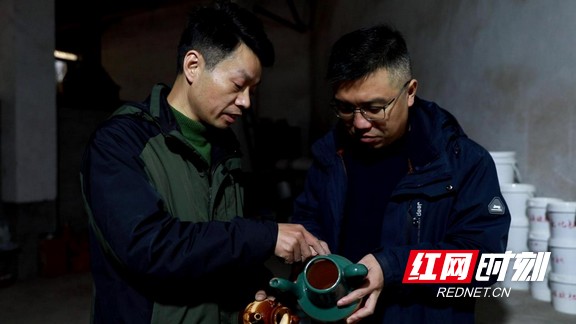
In the Sanhe Porcelain Factory, ceramic tiles with different colors are placed on the table. Next to them are piles of bottles and jars used to make porcelain. This simple “laboratory” is where Duan Yongming and Yuan Shuiquan work every day.
Sanhe Porcelain Industry originally focused on the production and operation of ancient architectural glazed tiles. In 2023, under the leadership of the government, Duan Yongming, Yuan Shuiquan and others came up with the idea of exploring the production process of Hengshan kiln.
The key to exploring Hengshan kiln technique lies in coating the surface of the embryo with a thin layer of clay, which is then painted and fired to form a famille-rose porcelain ware with a beautiful color.
Duan Yongming and Yuan Shuiquan also applied this technique to the production of glazed tiles, making products more diversified, the glaze colors more complete, and more popular among consumers.
Regarding the future, Yuan Shuiquan, the chief craftsman of Sanhe Ceramics, is full of expectations. “We are preparing to establish the Hengshan Kiln Studio and invite like-minded ceramic enthusiasts who are interested in Hengshan Kiln to study and promote it together, so that Hengshan Kiln can shine again in the new era.”
Zhou’s needle weaving technique is an intangible cultural heritage item in Hengyang City.
This technique has been passed down from generation to generation in the Zhou family. Xiao Yuelian, who has lower limb disabilities, has truly mastered it. Nowadays, she teaches the technique to help many special groups like her find jobs, making it a shining brand of Hengyang.
This technique will be showcased at the upcoming 3rd Hunan Intangible Cultural Heritage Expo, where visitors can enjoy the exquisite works up close and appreciate the unique style that combines simplicity, nature, practicality, and beauty.
Made from beans, flour and varied vegetables, vegetarian dishes are delicate and delicious. Some dishes taste just like those cooked with meat. All these nutritious and attractive vegetarian dishes are another good example to demonstrate the profound influence of Buddhism upon local culture and society.


In Hunan, many people start their day with a bowl of rice noodles. However, a bowl of rice noodles, along with a fried glutinous rice cake, is a more authentic breakfast for people in Hengshan County of Hengyang City.

Fried glutinous rice cake is a traditional handmade snack with a history of over 1,000 years. The main raw materials include glutinous rice, medicinal koji, oil, sugar, etc. Through multiple production processes, the kneaded rice balls are finally pressed into flat round pieces. They are then fried in a hot oil pan until both sides turn golden. Nowadays, it has also become a must for Hengshan people to treat guests.

Based on the cooking skills of their ancestors, inheritors also add ingredients that nourish the stomach, control sugar, and aid digestion in the production process to make the fried glutinous rice cake more delicate and healthier, further promoting the development of Hengshan’s fried glutinous rice cake production techniques.
Zhajiang rice noodles often provokes Hengyang people’s nostalgia for their homeland. Nowadays, more and more tourists visit Hengyang just for a bowl of fresh and delicious Zhajiang rice noodles.

The aroma of rice noodles fills the air in the main store of Hunan Zhajiang Rice Noodles Industry Co., Ltd.
“Zhajiang rice noodles, as thin as silk and as white as snow, are made through 18 processes like washing, soaking, grinding, aging, pressing, and cooling,” said a staff member.
The store serves Zhajiang rice noodles with fish soup and fermented chilies, which are highly favored by tourists. Vendors set up small stalls at the entrance of the store. They dry Zhajiang rice noodles and sell them, which is known as a “side job” for local people.
In 2022, Zhajiang rice noodles was listed as a time-honored brand in Hunan. In recent years, Hengyang County has made efforts to explore the transformation and upgrading of the Zhajiang rice noodles industry, and empower traditional industries with modern technology and marketing management concepts, to inject new vitality into time-honored brands.
Recently, a large truck carrying 60 boxes totaling 1,200 kilograms of Hengyang Fish Balls departed from Hengyang City, Hunan Province and arrived at Guangzhou after a 15-hour journey. The fish balls were then shipped to the European Union, and served on the dining tables overseas.

“For overseas residents, Hengyang Fish Balls are a nostalgic dish. Whenever I visit Hengyang, I always bring back several bags of fish balls. It used to be difficult to find Hengyang Fish Balls overseas, but now that they are exported, it’s much more convenient for us to purchase them,” said a European Union customer.
Hengyang Fish Balls differ from the traditional round fish balls commonly found in the market and instead have a shuttle-like shape.
Renowned for their unique appearance and taste, Hengyang Fish Balls are an indispensable dish for birthdays, celebrations, and festivals among the locals. The history of making fish balls in Hengyang is long-standing, and the local government is focusing on promoting this “nostalgic dish” as a local specialty to expand its market.
Hengyang Boge Modern Agricultural Technology Co., Ltd. is the largest fish ball production company in Hengyang. According to Zhou Bo, the company’s chairman, Hengyang Fish Balls are made from large yellow-skinned grass carp.
They are boneless and have a deliciously chewy texture, making them a geographic indication product of Hengyang. The company has improved the production process of Hengyang Fish Balls, preserving their original flavor while making them suitable for large-scale industrial production and ensuring their freshness and quality.
Currently, Hengyang Fish Balls have been approved to use the trademark of the “National Geographic Indication Product” and their production techniques have been recognized as an intangible cultural heritage project in Hengyang City’s Zhuhui District.
“Freshly cooked fish balls are smooth, tender and white as fat. The freshness of grass carp, the fragrance of scallions and ginger, and the smooth egg whites create a truly delicious taste,” said diners.
In recent years, local companies have actively participated in agricultural product exhibitions, actively promoting Hengyang Fish Balls.
At the same time, they have established the Douyin livestreaming bases and collaborated with internet celebrities to promote sales through livestreaming. The product has gained popularity among customers.
This export to the European Union is the first time that Boge Modern Agricultural Technology Co., Ltd. has sold its fish balls overseas. “We hope that overseas Chinese can taste Hengyang Fish Balls and find memories of their hometown,” Zhou Bo explained.
Currently, the company has supported 129 entrepreneurs, and created jobs for 280 people, with an annual sales revenue of 20 million yuan.

Yulin pork kidney sounds like a fancy dish in Chinese but actually it is also called Tutouwan by local people, which is usually served first in local banquets. The delicacy rich in materials puts many varieties of snacks in only one bowl, piling up like a pagoda with seven layers from bottom to top. Apart from beautiful design, it also boasts diverse tastes.
No.12 Zhu Ling Lai Fu
Restaurant: Heng Dong Bai An Restaurant
Producer: Chen Li-qing
This dish borrows the name of Zhu Ling Hole and its relation with the local people’s custom; "Lai Fu" is the reputation of the dog. One of the Eight Immortals Scenery in Hengyang is to appreciate poetry in Zhu Lin Hole. One day, while one of the Eight Immortals in the legend, Lv Dong-bing was appreciating poetry in the hole, he was greatly surprised by one of the dogs running out. From then on, the dog meat has become one of the best dishes at table, which spread the flavor throughout the whole city. Now Hengdong chefs take full advantage of domesticated dog meat to cook the delicious dish, which features in soft meat, good flavor, rich nutrition.
No.11 Green Fir and Jade Bamboo
Restaurant: Hua Tian Restaurant
Producer: Dai Zhi-qiang
Green Fir and Jade Bamboo is a famous dish commonly known as green vegetables fried bamboo shoots. Raw materials are mainly bamboo shoots from Nan Yue mountains and vegetables from the countryside gardens. After being cooked, it has become one of the tastiest and most refreshing dishes in the feast, also suitable for both Buddhists and Taoists. There is a poem to give evidence: green fir and jade bamboo, stem from the natural wood; Buddhists and Taoists gather together, harmoniously sharing the dish.
No.10 Empress Auspicious
Restaurant: Zheng Xiang Immortal Dragon Restaurant
Producer: Yang Zhong-qiu
Empress auspicious is commonly known as Zha Jiang false mutton. In Zhajiang Town Hengyang County, the unique taste of local pepper-type, is an important seasoning in cooking Zha Jiang false mutton. Such pepper is warm but not dry, and its taste is not too heavy, which can be accepted by local people. According to legend, Song Hui-zong, the King in Dynasty was once captured by Jing soldiers, while the Empress took refuge in Zhajiang Town. When arriving here, she caught a cold and felt ill. So the local authorities ordered local chefs to do a dish to drive out her cold feeling. As soon as he got the order, Local chefs quickly picked the best meat from head of pork and dried peel of red potato, combined with the local pepper soup. They cooked "zhajiang fake meat" for the Empress. After the instant sweating, the Empress felt relaxed and comfortable. From then on, "zhajiang Fake Meat" has been handed down to this day.
No.9 Aunt Ma Longevity Thick Soup
Restaurant: Nan Yue Telegraphy Restaurant
Producer: Liu Peng
According to legend, immortal Magu lives in the middle area of Nan Yue Mountain. There once has been a sudden plague one year. Magu has tried various therapeutic approaches to relieve people’s ache but failed. Finally, she has to take out her millennium collection, a medicinal fungus, along with corn and spring to boil with God (bighead carp) fish for three days and three nights. After the thick soup of the dish has been distributed to people there, the epidemic has been controlled. From then on, Ma Gu Longevity Thick Soup has become one of the most cherished dishes in the immortal families. Now with innovative cuisine, the soup is more distinctive, with characteristics of fragrance, smoothness, richness in nutrition and taste.
No.8 Incredible Dish
Restaurant: Nan Yue Telegraphy Restaurant
Poducer: Liu Peng
Incredible dish, usually called the prime vegetarian pork, is a leading Southern Mountain Buddhist vegetarian dish. According to legend, Emperor Huizong in Song Dynasty ate it in the Southern Mountain Road. The dish is made with winter melon, but sometimes it is hard to distinguish it from pork. Viewing the food’s shape and color, it is no difference with the real pork in the bowl. Taste it, it is like meat, but it is not meat. Emperor Huizong kept saying "incredible". Nowadays, Incredible food is the dish made with melon.
No.6 Shigu Red Jade
Restaurant: Electric Power Restaurant
Producer: Zhang You-qing
Shigu Red Jade has got another local name Red Bean Curd of Crown City. Bean curd is also called plasm, which cannot be served at the table on the ceremony in principle. Hengyang chef wants to change the traditional practices. They use red yeast rice to make color in the production process, which makes the dish full of auspiciousness. In order to promote deliciousness, tenderness and taste, broth and snake soup are added to the dish, which makes it one of the most famous local dishes as well as the favorite food of the old and the young.
No.5 The Treasure Filling the Hall
Restaurant: Dao Xiang Village
Producer: Huangjiang
The treasure filling the hall, usually named sea eggs, is one of the most famous feasts in local traditional custom. The dish is characterized by fresh savory and crispy taste. There is a poem to give evidence: Gold and silver, load the jade bowl; the host get the guests drunk, being joyful complacently.