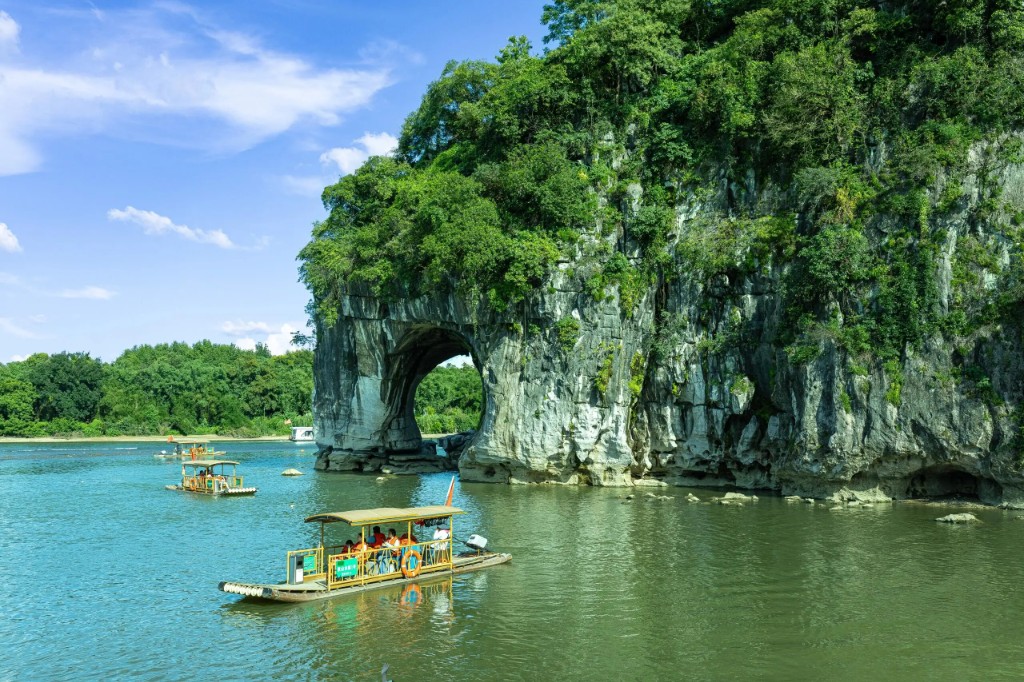
Guilin is a world-renowned tourist city in northeastern Guangxi Zhuang Autonomous Region, covering an administrative area of ~27,800 km² and home to a permanent population of roughly 4.95 million (2025). For millennia, its karst landscape has defined the city’s identity—so famously that the Chinese saying “Guilin’s scenery is the finest under heaven”has become shorthand for its global appeal.
This is a city where geography and history have long conversed. For over two thousand years, since its founding during the Qin Dynasty, Guilin has been a crossroads of cultures and civilizations. The ancient Lingqu Canal, a feat of early hydraulic engineering, still whispers of the empire’s reach, while the echoes of drum towers and folk songs from the Zhuang, Yao, Miao, and Hui communities add layers of human texture to the natural grandeur. The city carries the weight of its designation as a National Historical and Cultural City with quiet dignity, its streets and riverbanks lined with the quiet evidence of dynasties passed.
Yet Guilin is far from a relic. It thrives as a living canvas where ecological stewardship meets modern ambition. The karst formations that earned it a place on the UNESCO World Natural Heritage list as part of the South China Karst are fiercely protected, ensuring that the river’s Class II water quality and the region’s near sixty-five percent forest coverage remain intact. Visitors find themselves drifting between worlds: gliding past fishing cormorants at dawn, exploring the illuminated chambers of Reed Flute Cave by afternoon, or watching the terraced rice fields of Longji blush gold under the harvest sun. Evenings unfold to the rhythms of impression-style light shows or the simpler pleasure of a bowl of Guilin rice noodles, savored at a street-side stall.
Guilin positions itself as both a scenic icon and a livable eco-destination: reported forest coverage ~64.99%, with the Lijiang River mainstream maintaining Class II water quality year-round. Beyond sightseeing, the destination offers a layered product mix—river cruises & bamboo rafting, countryside cycling & hiking, cave exploration, terraced-field culture (e.g., Longji), ethnic Zhuang/Yao/Miao/Hui community experiences, gastronomy (Guilin rice noodles & more), and night-time spectacles/impression-style performances—supported by a national comprehensive transport hub anchored by Guilin Liangjiang International Airport (KWL/ZGKL) and high-speed rail/expressway corridors
Today, Guilin positions itself not just as a destination, but as an experience—a place where the phrase "Guilin’s scenery is the finest under heaven" feels less like a slogan and more like a lived truth. As a national comprehensive transport hub, it welcomes the world with the ease of an international gateway, yet retains the intimacy of a city that measures its wealth in mountains and rivers rather than skyscrapers. Whether hosting dignitaries or backpackers, Guilin continues to offer what it always has: a profound sense of scale, where humanity feels both small against the ancient stone peaks and deeply connected to the timeless flow of the river below.