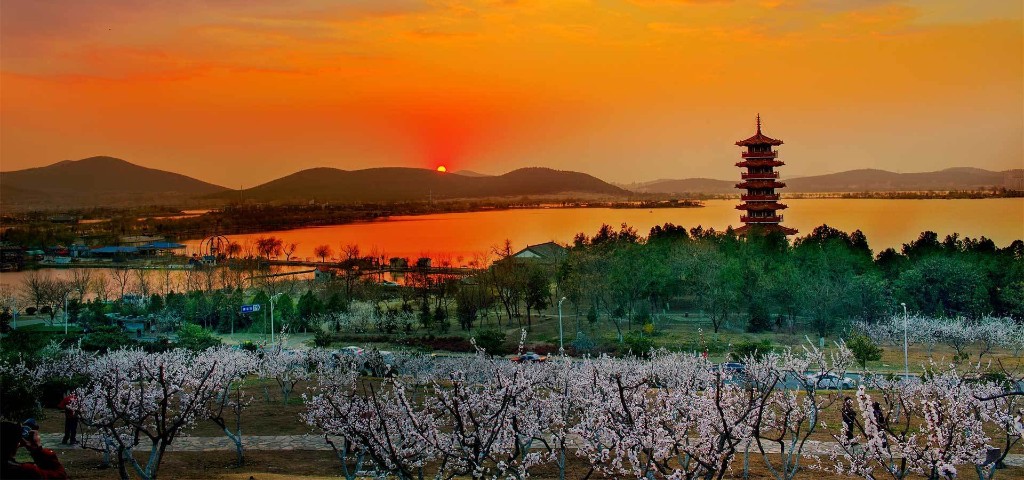
Xuzhou sits at the crossroads of northern Jiangsu and the vast North China Plain, a place where ancient roads, the Grand Canal and the great rail trunk lines still seem to hum with the memory of armies, merchants and scholars who once called this “the gateway of five provinces.” Yet what defines the city today is less its strategic map coordinates than its cultural gravity: if you want to understand why Chinese people speak of Hanas more than a dynasty—as a sensibility—you come to Xuzhou, the old Pengcheng, where the silhouette of that civilisation is visible not behind glass alone, but in hillsides, underground chambers, and the rhythm of daily life.
What strikes a visitor first is how the city wears its age without turning into a museum. You feel it on Yunlong Mountain, where paths wind above Yunlong Lake and the skyline keeps negotiating with greenery rather than erasing it; you feel it again in the Pengcheng historic spine where projects like “Pengcheng Qili”try to stitch together living streets, courtyard shadows and landmarks such as Huanglou, the Confucian Temple precinct, Huibu Mountain, and older neighbourhoods like Huilongwo, so that history reads like a continuous sentence instead of a series of exhibits. And then you go underground, into the calm, almost theatrical corridors of the city’s Han princely tombs and burial complexes (places locals proudly describe as an “oriental pyramid” landscape), and into institutions like the Xuzhou Museum, where a gold-thread jade burial suit and Han pottery figures do not merely attest to craftsmanship, but to a worldview—orderly, symbolic, oddly modern in its restraint.
Because Xuzhou tends to treat heritage as something you inhabit, its cultural diplomacy works the same way. The city has spent nearly forty years turning “being open to the world” into a habit, and today its international network is spoken of in round numbers you can hear from the city’s own podium: 20 international sister cities and roughly 40 international friendship/exchange cities, a total “circle of friends” that has grown to about 62–63 pairs, spread across five continents.
But in Xuzhou’s telling, a sister‑city tie is not a plaque on a wall. It becomes a working language of exchange: joint exhibitions and youth art programmes (the long‑running Xuzhou–Handa youth painting exchange is one local byword); university and vocational linkages anchored by institutions like China University of Mining and Technology and Jiangsu Normal University; medical and public‑health collaboration channels; and, increasingly, green/liveability themes, where Xuzhou has used platforms like the International Garden Expo to invite sister cities to design gardens that carry a piece of their own landscape onto Xuzhou soil. More recently, the city packaged this ethos into a significant programme—“Talking to the World” Sister Cities Cross‑Cultural Exchange—explicitly framed around Han music, Han dance, ICH (intangible cultural heritage) and two‑way promotion, delivered partly through virtual classrooms that turn a Han‑style city into a shared stage rather than a one‑way showcase.