In the soft, humid heart of Côte d’Ivoire, where the forested inland plateaus loosen into savannah and the roads begin to smell of red earth and diesel, Yamoussoukro insists on being unlike anywhere else in the country. It is the political / administrative capital—the city where the state’s symbols are planted—while the country’s economic pulse still lives closer to the sea in Abidjan. That dual-centre arrangement gives Yamoussoukro a strange, beautiful calm: it feels less like a crowded megacity, more like a capital that chose space over density, and then tried to fill that space with monuments, boulevards, and silence.
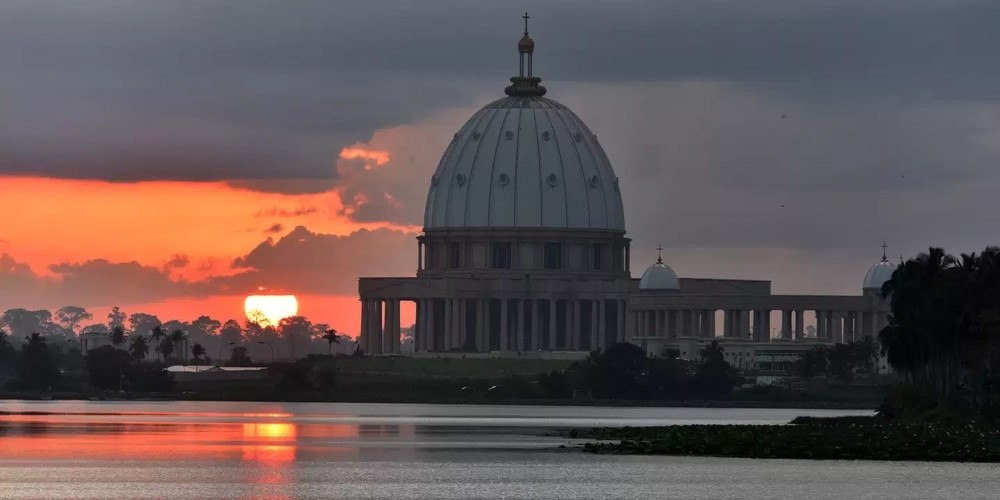
The image most travelers carry here is inevitable: the Basilica of Our Lady of Peace (Basilique Notre-Dame de la Paix), its pale dome and colonnades rising above trimmed gardens as if a slice of Rome had been lifted and set down in the tropics. Built between the mid-1980s and 1989, consecrated in 1990, the basilica is huge in scale, lavish in material, and unapologetically photogenic; whether you come as pilgrim, architecture buff, or curious visitor, the effect is less about doctrine and more about the theater of light on marble and stained glass, and the surreal contrast between that gleaming ensemble and the quiet, sun-baked avenues around it.
But Yamoussoukro’s real charm is how quickly the “capital” mood slips into something earthier. Turn away from the grand axis and the city reveals itself as a working inland hub—neighbourhood markets where Baoulé and Dioula rhythms of trade never really stop; roadside chop bars bright with attiéké and grilled fish; and long, straight roads that seem to end in heat haze rather than rush hour. It is a place where the state is present, but nature and rural life are never far: you can step out of the ceremonial core and into mango shade, then keep going into the wider Lacs district countryside, where rivers, reservoirs, and scattered villages set the tempo instead of traffic lights.
For the culturally curious, Yamoussoukro works best as a gateway rather than a checklist. Within reasonable reach lie experiences that explain why this region feels like the country’s interior soul: the vast shimmer of the Kossou Lake / Kossou Dam area to the south, where fishing canoes dot a reservoir that rewrote local geographies; and, a little farther afield, managed bush country such as the Abokouamékro Wildlife Reserve, where guided drives trade the capital’s formalism for dust, scrub, and the slower thrill of wildlife seen in the open. Meanwhile, the city’s own cultural layering shows up in small, human ways—cloth markets, roadside weavers, and the occasional ceremonial drumming that reminds you this is Baoulé country as much as it is a seat of government.
Come for the basilica’s spectacle; stay for the inland atmosphere that refuses to be glossy. Yamoussoukro doesn’t perform for tourists—it receives them, with wide streets, heavy heat, and the sense that you’ve stepped off the coastal script and into the part of Côte d’Ivoire where the land still decides the pace.