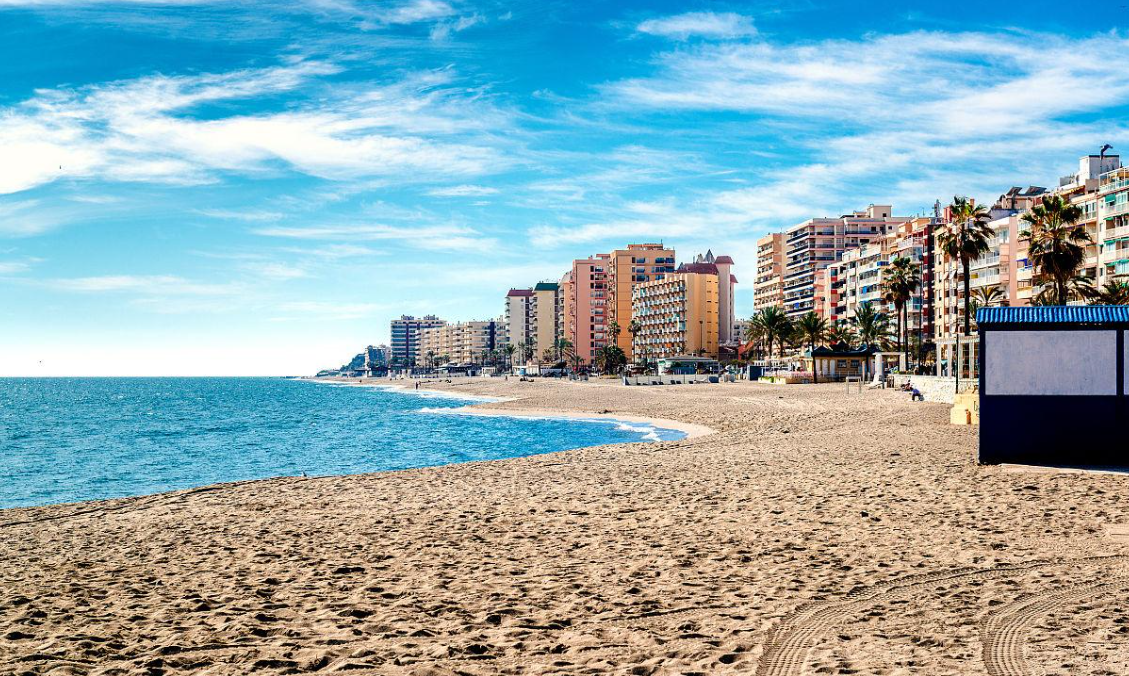
Sun on the Mediterranean does not feel like a promise in Fuengirola so much as a default setting. Set along a narrow, eight-kilometre ribbon of coastline on the Costa del Sol, the town arranges itself around light, salt air, and a long, confident stride of a seafront: the Paseo Marítimo Rey de España, a palm-lined promenade that runs for roughly 7–8 km from the vicinity of Sohail Castle eastward past a succession of well-kept beaches—Los Boliches, Las Gaviotas, Santa Amalia, San Francisco, El Ejido/Playa del Castillo—until the terrain drifts toward Torreblanca/Carvajal. It is the kind of walkway that doubles as a social calendar: morning runners and cyclists, late-afternoon paseo, then the slow golden-hour pause at a chiringuitowhere the grilled-fish smell is basically the town’s signature perfume.
But Fuengirola is not only “sun and sea.” Its floorplan conceals older strata if you know where to look. On a low hill above the river mouth, Castillo de Sohail—with origins traditionally tied to the 10th century and the era of Abd al-Rahman III—still guards the coast with fragmentary walls and a commanding view; today the fortress is less a defensive hinge than a cultural stage, hosting concerts and open-air events against a backdrop of sea and stone. Scattered nearby are reminders that this place has been a landing point and crossroads for a very long time: traces linked to Phoenician presence, the Roman site of Suelon the castle hillside, and Roman baths and villa remains at locations such as Finca del Secretario and Torreblanca, layered quietly beneath a modern, service-rich resort town.
Back down at sea level, the town’s more intimate centre is the human-scale Plaza de la Constitución, where café tables spill into the square and the white façade of the Iglesia de Nuestra Señora del Rosario (Parroquia del Rosario) anchors the old-town rhythm. It is a space made for people-watchingas much as sightseeing—the kind of square where a coffee can easily turn into lunch, and where the Andalusian habit of lingering feels less like a lifestyle choice and more like civic duty. Side streets and pockets such as Santa Fe de los Boliches keep that popular architecture and fishing-quarter memory alive even as the wider strip thrums with hotels, apartments, and a genuinely international everyday life.
What gives Fuengirola its contemporary cultural weight, though, is how it blends a classic resort toolkit with a few unexpected, strongly “curated” experiences. The Bioparc Fuengirola is the clearest example: what began as a rethinking of an older zoo model was transformed from 2001 onward into a “zoo-immersion”—vegetation, water, and sightlines used to dissolve bars and cages so that visitors move through simulated tropical ecosystems (Madagascar, equatorial Africa, Southeast Asia/Pacific islands) rather than past rows of cells. Conservation and education sit at the core—part of the park’s identity as a modern bioparc rather than a spectacle-only zoo—and it has continued to evolve, with recent expansions leaning into reefs, aquatic environments, and narratives tied to exploration and biodiversity.
Then there is the city’s social texture, which may be its most distinctive selling point: Fuengirola lives as an international, highly cosmopolitan community, and it celebrates that identity openly. The best expression is the Feria Internacional de los Países / Feria de los Pueblos (FIP), staged each spring at the Recinto Ferial, where dozens of countries run casetas with food, drink, music, and dance, and the whole town briefly feels like a low-barrier world tour—parade through the streets, rhythms from five continents, and an atmosphere that is as much about coexistence as entertainment. Add the maritime Virgen del Carmen processions in summer and the October Rosario/patron festivities, and you get a resort town that knows how to throw a party andkeep a liturgical calendar.
So Fuengirola reads as a place of contrasts held together by the sea: Phoenician and Roman roots → Moorish fortress → fishing quarter → 20th-century resort growth → today’s multicultural, family-friendly, event-driven Costa del Sol hub. Come for the long beach days and the promenade; stay for the castle-lit evenings, the old-square coffees, and the sense that in this corner of Andalusia, the world has already arrived—and been invited to set the table.