You notice the silhouette before you notice the city. Five heavy, square towers—unexpected, a little stubborn, and unmistakably Tournai—rise above a soft fold of roofs and the slow, grey-green drift of the Scheldt (Escaut). This is the Cité des Cinq Clochers, a nickname the city wears with quiet pride: the towers belong to Notre-Dame Cathedral, whose mass and skyline have been the city’s defining line for the better part of a millennium.
What makes Tournai feel older than most Belgian cities isn’t a plaque—it’s the ground itself. The site began as Turnacum, a Roman administrative and military crossing-point at a key road-river junction; later, it became the kind of place rulers kept close. In the Merovingian era, Tournai mattered enough to be a royal seat—think Childeric I, and the early arc of Clovis’s story—before the political centre eventually slid toward Paris and the city reinvented itself as an episcopal and trading power on the Scheldt. That dual identity—borderland fortress + riverborn merchant-bishopric—still explains the texture of a walk here: stone that feels defensive, but a riverfront that insists on sociability.
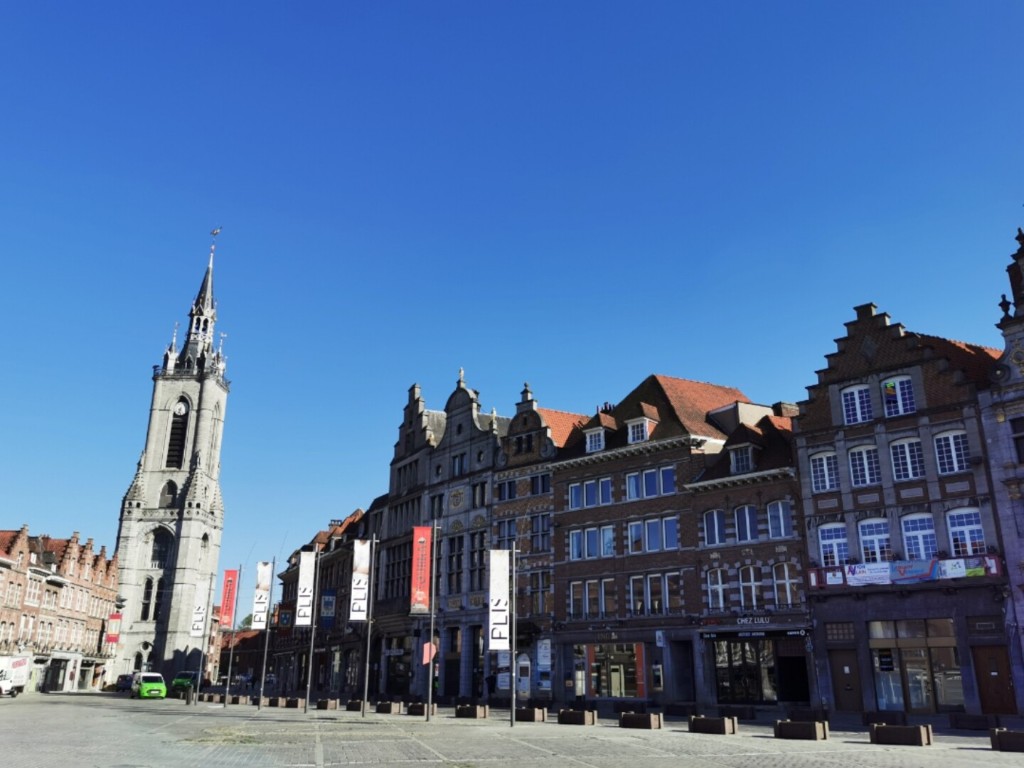
The walk itself tends to start on the Grand Place, where the city’s civic stage is set. Crowning the square is the Belfry (Beffroi)—often described as the oldest belfry in Belgium, a squat, serious, fiercely symbolic tower that once watched for danger and fire, and now mostly watches over café terraces and market-day noise. A short drift downhill or sideways will bring you to the Pont des Trous, the medieval bridge-defence pair with turreted towers straddling the Scheldt—less a photo-op than a reminder that Tournai once had to guardthe very river that fed it.
Then there’s the cathedral itself—Notre-Dame de Tournai—which is less a single “style” than a conversation between centuries. The Romanesque nave and transept belong to the 12th-century vision of a city that wanted to look immovable; the Gothic choir, reshaped under the bishops of the 13th century, opens the interior upward and eastward with a lighter, more vertical ambition that clearly listened to the great cathedrals of northern France. Inside, the eye catches the kind of details that turn a visit into a memory: the Renaissance rood screen in black Tournai marble, the glow of stained glass, the treasury’s liturgical art—objects that explain why this building didn’t just serve a diocese, but helped broadcast the city’s status. (UNESCO lists the cathedral as a World Heritage Site, which is why the “five towers” never feel like mere decoration.)
But Tournai’s cultural gravity also lives in things that aren’t cathedrals. The Museacute;e des Beaux-Arts, designed by Art Nouveau architect Victor Horta, gives the city a very different kind of façade—less fortress, more curatorial light—and houses paintings that span from the medieval to the modern, tying Tournai back into the larger Flemish/Walloon art narrative without ever losing its own accent. Add smaller, quirkier anchors—tapestry heritage, archaeology, natural history—and the city reveals itself as a place that collected objects and storiesthe way a river collects tributaries.
You leave Tournai understanding why locals call it Belgium’s oldest city in spirit if not in trivia-night technicality: it doesn’t perform antiquity; it inhabits it. Come for the five towers and the river light; stay because the Grand Place still knows how to pour a drink and watch the bells; and if you time it right, you’ll realize the best souvenir isn’t a postcard of the skyline—it’s the way the stone here feels like it’s been waiting for you since the road first crossed the Scheldt.