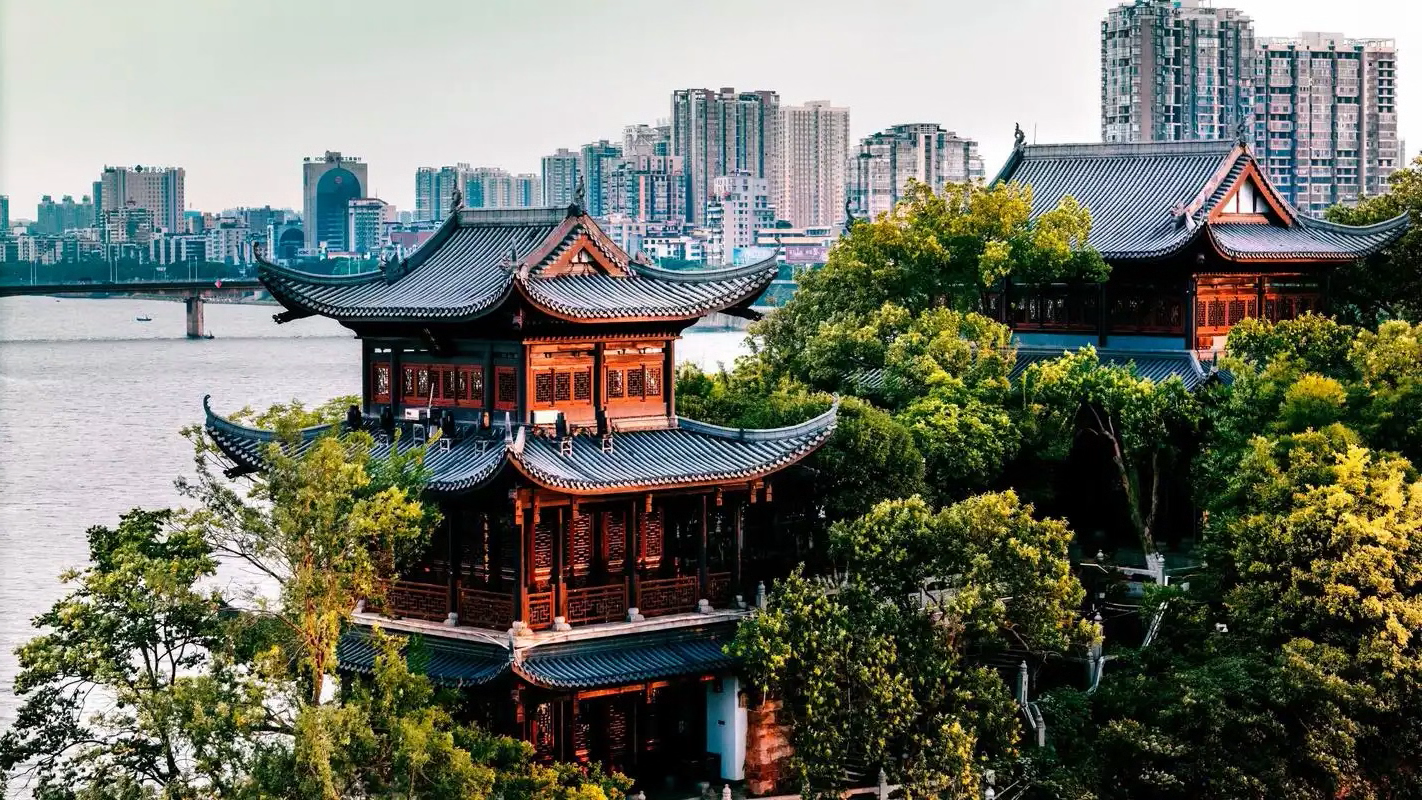
Since ancient times, Hengyang has been endowed with a rich cultural heritage and produced numerous outstanding talents. In history, there were figures such as Jiang Wan, the minister who assisted the Shu Kingdom; Cai Lun, the inventor of papermaking; Wang Fuzhi (also known as Wang Chuanshan), the renowned thinker; and Peng Yulin, the commander of the Xiang Army's naval forces.
During the Northern Song Dynasty, Zhou Dunyi's Explanation of the Supreme Ultimate laid the foundation for Neo-Confucianism, putting forward crucial perspectives on exploring the origin of the universe and exerting a profound influence on the formation and development of the Huxiang School. As one of the four major schools of Neo-Confucianism in the Song and Ming dynasties, the rise of Hunan's culture is deeply rooted in the spread of the Huxiang School and the nurturing of Huxiang culture. In the late Ming and early Qing dynasties, Wang Fuzhi (style name Ernong), together with Gu Yanwu and Huang Zongxi, was known as one of the Three Great Thinkers. His strong national consciousness embodied in his character had a profound impact on later generations. The image of the scholar—wearing wooden clogs, holding an oiled-paper umbrella, refusing to stand under the sky of the Qing Dynasty or tread on its soil—vividly expressed his loyalty to the Ming Dynasty. Tan Sitong praised him as "the only scholar in five hundred years who truly understands the principles of the world," and lauded his thoughts as "unparalleled throughout history." Though the great man has passed away, his former residence, Xiangxi Thatched Cottage in Caitangwan, Xiangxi Village, Qulan Township, Hengyang County, and his tomb on Mount Daluo remain for people to pay their respects.
Hengyang boasts many other famous historical sites, including the Former Residence of Marshal Luo Ronghuan in Nanwan Village, Ronghuan Township, Hengdong County; the Former Residence of Zeng Guofan; and the Former Residence of Xia Minghan in Hongshi Township. With its abundant cultural resources, Hengyang can form an excellent regional tourism network by integrating with the pilgrimage tourism of Mount Nanyue and other industrial tourism projects. The planning and construction of the Shigu Cultural Zone has further provided a head start in creating diversified tourism forms and achieving good connectivity with surrounding areas.
During the long revolutionary struggle, the Southern Hunan Students' Federation in Hengyang produced a large number of revolutionary martyrs, including Xia Minghan, Jiang Xianyun, Huang Jingyuan, Zeng Zhongsheng, Chen Weiren, Wu Yunfu, Zhang Jichun, He Baozhen, Guan Zhonglian, Mao Zejian, Jiang Hua, Huang Kecheng, and Tian Ji.
In modern times, the nostalgia of Qiong Yao is vividly expressed in her works, as she never forgets "Hengyang Road" in Taipei. Luo Fu, the "Poetry Devil," declared: "I am not a coward; I am a man from Hengyang!" The famous writer Lung Ying-tai said: "Hengyang is my eternal dreamland." The great photographer Chen Changfen stated: "I guard my hometown Hengyang." Wu Shaozu, former Director of the State Sports Commission, said: "My roots are in Hengyang." The great painter Zhong Zengya proudly claimed: "I am proud to be a Hengyang native."
There is also a host of other cultural celebrities from the Huxiang region, such as Ma Jigao, Bai Shuxiang, Zi Huajun, Teng Wensheng, Long Xinmin, Tang Haoming, Guan Chufei, Wang Zhi, Xie Lisi, Wu Yujuan, Li Li—Hunan's "Zhang Haidi," and Tan Qianqiu—the "Earthquake Hero." Additionally, Hengyang is a cradle of sports champions. World champions Li Jing, Ling Jie, Liu Yuxiang, and Luo Xihe—who defeated the "Stone Buddha" Lee Chang-ho—are all stars hailing from Hengyang.
Today, the ancient city of Hengyang has been designated as one of the first batch of Historical and Cultural Cities in Hunan Province and a key cultural tourism city in Hunan's 10th Five-Year Plan for Tourism Development. Leveraging "Red Tourism" centered around the former residences of great men, Hengyang promotes historical and cultural tourism sites such as the "City of Anti-Japanese War Memorial," the "Hunan Students' Federation," and the "Lu Family New Residence." It integrates resources between Shigu Academy and Chuanshan Academy, utilizes the landscapes along both banks of the Xiang River and water resources to innovate thematic elements, and plans a grand tourism circle that effectively connects with surrounding areas. With a favorable cultural landscape and a harmonious social atmosphere, Hengyang is building a high-quality cultural brand and expanding its urban influence.
Cultural Institutions
By the end of 2024, there were 10 art performance troupes, 13 mass art galleries and cultural centers, 14 public libraries, and 20 museums and memorials in Hengyang. The city has 7 national-level and 49 provincial-level intangible cultural heritage protection projects.
At the end of the year, there were 8 radio stations, 19 FM and TV rebroadcasting transmitters, 9 TV stations, and 562,500 cable TV subscribers.
There were 19,224 sports facilities, including 6 large-scale gymnasiums, 1,069 athletics fields, 160 swimming facilities, and 257 gyms. The number of regular participants in physical exercise reached 2.638 million, with 10,801 national fitness events held. Athletes from Hengyang won 7 world championships, 6 Asian championships, and 12 national championships.
Ethnic Groups
Hengyang is a region with scattered ethnic minorities. The Tashan Yao Township in Changning is the only ethnic minority township in the city. The main focus of Hengyang's ethnic work is on the Tashan Yao Township and the Hui community in urban areas, emphasizing rural and urban ethnic affairs. The city is home to 42 ethnic minorities, with a total population of 17,800, accounting for 0.25% of the total population. The Yao people, the largest ethnic minority group, mainly reside in Tashan Yao Township, Changning. The Hui people live relatively concentratedly in the area from the Railway Station to the Airport in Zhuhui District. The theme of ethnic work is: Strive Together for Unity and Prosperity. The city's ethnic work is divided into two parts:
Rural Ethnic Work: Primarily focused on developing the economy of Tashan Yao Township, Changning.
Urban Ethnic Work: Mainly involved in mediating ethnic conflicts in urban areas.
In recent years, ethnic minorities coming to Hengyang are mainly from Ningxia, Gansu, Qinghai, Xinjiang, and Aba in Sichuan. Currently, there are more than 50 Hui halal noodle restaurants in the city, with some selling lamb skewers and raisins, and others running stalls selling ethnic medicinal herbs and handicrafts. Therefore, strengthening services and management for ethnic minorities from other areas is increasingly important for promoting ethnic unity, progress, and social harmony.